


 73 / 76

APR. MAY. 2017
XIII
and Federcarni federation - to teach
the future chefs to learn about meat.
I would like to do more with the
chefs, who in my opinion should
learn once again to choose the meat
for themselves, handle it, fillet and
bone it. For example, traditionally you
use the chuck tender for broth. If, in
the American way, you learn to fillet
it you would get a very tender meat
that can be cooked like the fillet, at a
much lower cost. Low temperatures
also allow us to exploit different cuts:
there are no Serie A or Serie B, all
are good if cooked in the appropriate
manner».
______________________________
BOX
CHOOSING ASSURED SUPPLIERS
In addition to the organoleptic
quality, a restaurateur must also
worry about the animal health
quality. “Among the prerequisites of
the HACCP system - explains Mauro
Fava, of the veterinary department
and assurance of animal food origin,
ATS of Brianza - there is also the
selection of suppliers. Meat has many
merits but potential dangers, of a
microbiological, chemical or physical
nature should be kept under control».
For example, the one related to the
presence of prions, responsible for
“mad cow” syndrome. “By law - he
continues - the animals must be
identified and identifiable from
the breeding to the sale, through
the affixing of ear brands and
identification slips that accompany
the animals to slaughter. The
slaughterhouse must maintain this
identification for a single animal or
per batch. This indication is used
to determine whether the animal is
at risk of BSE or not.” To guarantee
the consumer, it is necessary to
purchase from companies recognised
by the competent authorities and
identified by a code, called an
“approval number”. “Facilities without
this brand - he concludes - cannot
work. Many also enjoy voluntary
certifications (ISO 9011-2008, BRC or
IFS) that give additional guarantees.
It is suggested that restaurateurs go
in person to see the suppliers from
which they buy the meat and to ask
them the results of the compulsory
chemical and microbiological
analyses of samples carried out by
the authorities. If a provider does not
make them available, it could be a
sign of some irregularities».
______________________________
AT PAGE 46
The secrets
of cooking to
perfection…and
healthy too
The tricks of chef Mario DeMuro
and some care to avoid the
formation of hazardous compounds,
harmful to the health
BY Elena Consonni
If low temperatures allows the
exploration of new ways of cooking
meat, the traditional fast and simple
methods remain important, and
indicated especially for typical
summer preparations.
“While having technological ovens,
the classic cooking methods –
explains Mario DeMuro, executive
chef of Hotel Villa Chacko, in Tursi
(MT) and President of APCI Basilicata
– are always welcome. For example,
to prepare a good roast beef, the most
suitable cuts are the topside or the
rump of veal of 14-16 months and a
weight of around 2.5 - 3 kg, sprinkled
with a marinade of chopped
rosemary, garlic, lemon peels, sage
and parsley. The meat should be
placed in the oven at 180 °c for 15
minutes to caramelize and hold the
juices, then lower the oven and leave
to cook for another 20 minutes until
it reaches 56 °c. To ensure safety, the
meat must be immediately subjected
to temperature reduction.”
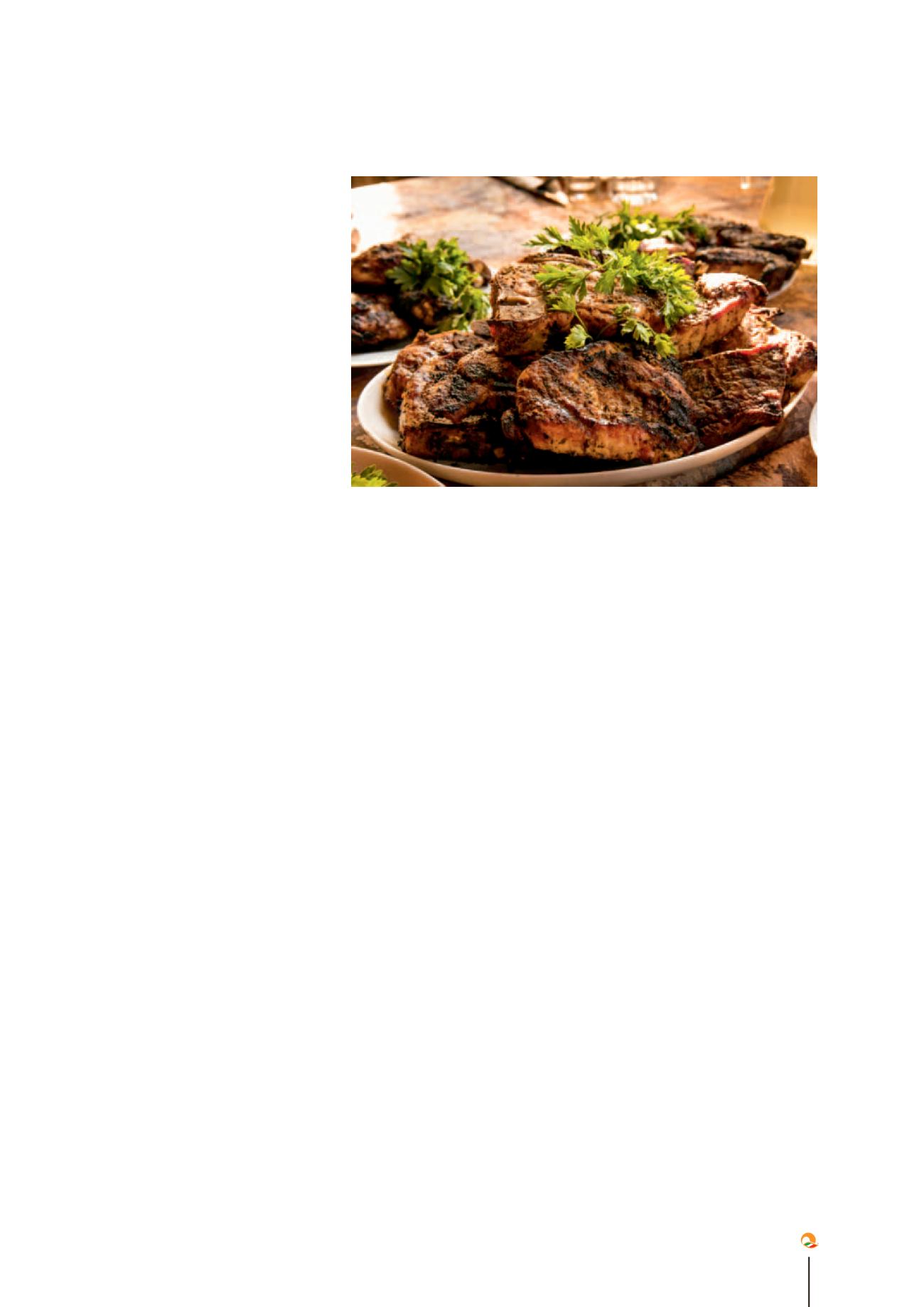
A typical open-air cooking technique
is the barbecue. “I prefer those with
olive wood or oak – he comments –
or with a good charcoal, but gas or
electric can also be effective, although
I think the result is different. The
important thing is to be careful not
to burn the meat to prevent it from
forming carcinogenic substances and,
after use, perform a very thorough
cleaning with brushes, detergent
and especially elbow grease, so as
not to leave traces of deposits». An
alternative is the grill. “There are cast
iron or chromium – he clarifies – I
prefer the first because the cooking
is more constant and uniform. The
grill is ideal for pieces of flat meat:
tagliata, entrecote, strip-loin...
because the contact with the grill
must be uniform at all points of the
product. ‘
TRADITIONAL COOKING BY
COMPARISON
There are also methods that belong to
local gastronomic traditions. «The spit
– explains Mario DeMuro – is much
used in the central southern areas for
small-sized pieces that cook in 10-15
minutes. It is a different preparation
from the Brazilian Churrasco or
from the Argentine Asado, which
include large pieces, slow cooking
and long cooking times. In Puglia
and Basilicata the butchers prepare
the meat “on the stove”, or in an oven
with embers. In Sardinia, instead,
the suckling pig is cooked whole by
irradiation with embers positioned
about 1 metre from the meat. It takes
a long time, about 7-8 hours».
POSSIBLE RISKS AND HOW TO
LIMIT THEM
In the process of cooking meat,
two families of compounds may be