


 71 / 76

APR. MAY. 2017
XI
of the restaurateur... In my opinion,
a better choice could not have been
made. They are content and this is the
best goal for a parent. I think Paola
is my heir, or the person who can
take my reins, because she puts the
same passion and the same effort that
I have done throughout these years.
What fascinates and continues to
fascinate you in this work? I think the
most fascinating thing is to see how
food is capable of cheering people
up. I think I can do this. Maybe that’s
what makes me appreciate my work
even more: seeing happy people.
______________________________
BOX
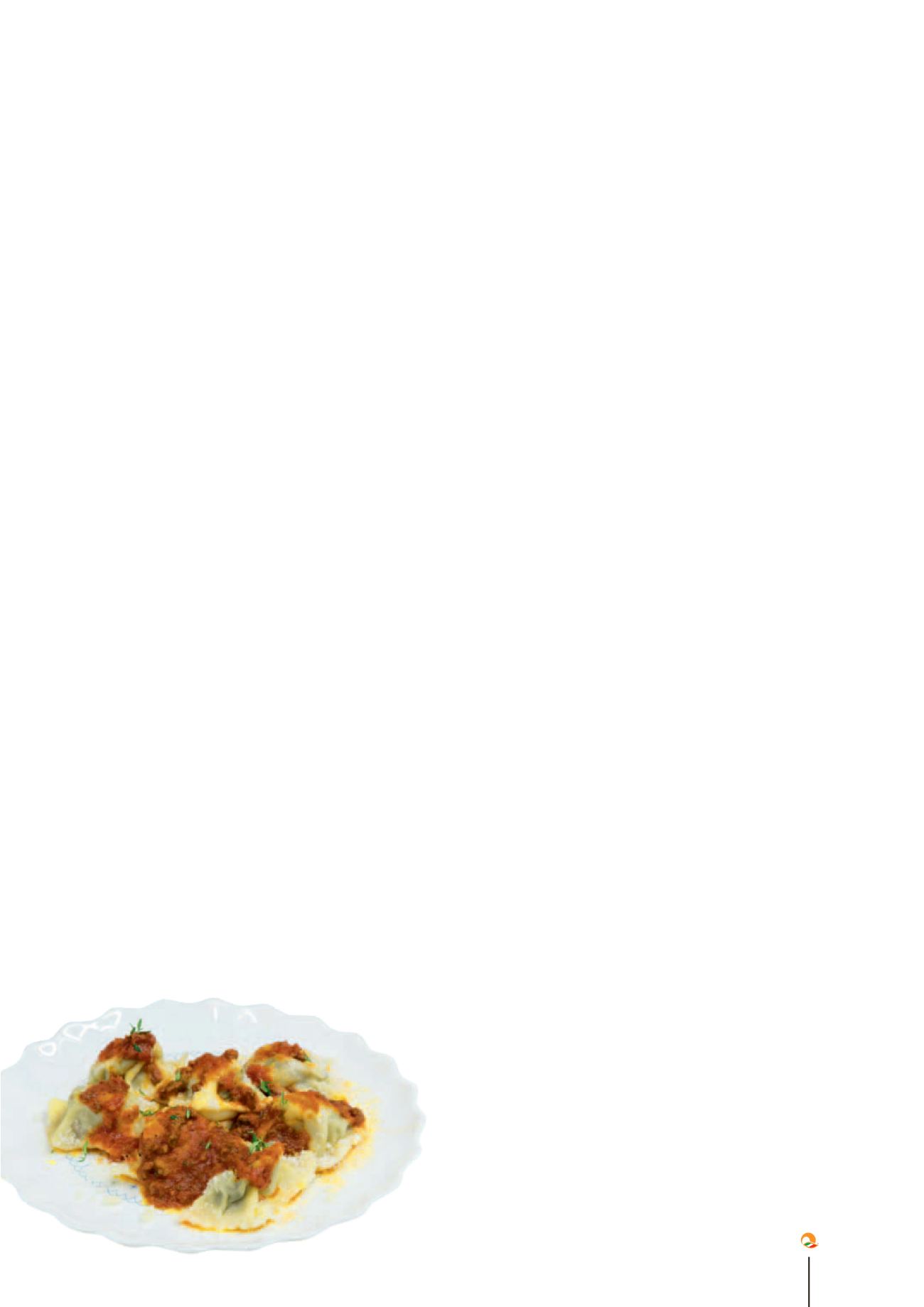
RECIPE FOR TORDELLO
MASSESE: TORDELLI OF AUNT
PIERA
We begin with the preparation
of the filling: we make a sauté of
garlic and parsley where we add the
minced meat to cook together with
the pepper, nutmeg and salt. Once
cooked, let the meat cool, where we
will add: boiled spinach, bread left
to soak in milk, parmesan, eggs and
thyme. We mix well and the filling is
ready. Then the meat sauce. We make
a sauté of onion and carrot where we
cook the minced meat. Once cooked,
add the tomato purée, salt, pepper,
nutmeg and sugar. The sauce must
cook for at least 3/4 hours. Now
we move on to the creation of the
Tordello. We make sheets of pasta
strictly by hand, laying a little bit
of filling (more or less a quantity
the size of a coffee spoon); In the
center of the sheet, from the top of
the strips we take the first and final
part and, with a decisive gesture, we
turn it downwards. We divide every
tordello, cut and put slight pressure
with the hands to give it the shape
and remove the air inside. We cook
them in boiling water, two or three
minutes, take out and season.
These are the Tordelli of Aunt Piera.
______________________________
AT PAGE 42
Stop fake Made In
Italy
A tightening on labels from April: the
compulsory identity card for milk
and cheese on sale in Italy
Tightening on food labels starts
in April. In accordance with new
national legislation, some indication
of origin will be compulsory and
necessary. In the case of milk
and dairy products the legislation
becomes particularly strict and will
make very few exceptions. The
situation was confirmed by Barbara
Klaus, lawyer of the law firm Rödl &
Partner of Milan, leading expert of
food legislation in Italy, who clarifies:
“The obligation to indicate the origin
of milk on the label of milk and
dairy products will enter into force
from April 2017. The ministerial
decree of 9th December 2016 was
published in the Official Gazette on
19th January 2017; therefore, this
Decree enters into force on 20th
April 2017. In particular, Article 2, the
indication of the “milking country”
and the country of “packaging and
processing” shall be compulsory on
the label; should the two localities
coincide, only the geographical
indication will indicate the wording:
“Origin of Milk”. However, the
obligation to indicate the country of
origin applies only to milk and dairy
products manufactured and marketed
in Italy. In fact, the ministerial decree
of 9th December 2016 expressly
stipulates that such labelling
obligations do not apply to products
lawfully manufactured or marketed in
other Member States or in third-party
countries.
In this regard, Barbara Klaus,
considers “questionable whether
the new rules are really capable of
protecting consumers and national
production.” In this regard, she
explains that: “Since there is no such
obligation in Germany and Austria,
milk and dairy products
(cheese, yogurt, etc.)
produced and marketed
in these countries
may be imported and
marketed in Italy,
without obligation
to indicate the
country of milking
and the country of
conditioning or processing. As a
result, a mozzarella produced in
Germany with German milk can be
sold in Italy even without indication
of the origin of the milk.”
X-RAY LEGISLATION
“From 13th December 2016 – recalls
Klaus – pre-packaged foods must
be compulsorily labelled with a
nutritional statement; and only
in some cases, and according to
precise guidelines established by
a memorandum from the Ministry
of Health, may exceptions to this
obligation be envisaged.”
“On the label of a pre-packaged
food product - continues Klaus - the
indications referred to in article 9 of
Regulation (EU) No. 1169/2011 must
be provided; that is, they must be
present: the denomination of the food;
the list of ingredients; any ingredient
that causes allergies or intolerances;
the quantity of certain ingredients;
the net quantity of the food; the
minimum retention period or the
expiration date; special conditions
of storage and/or conditions of use;
the name of the company and the
address of the food business operator;
the country of origin or place of
provenance; instructions for use; the
actual alcoholic strength by volume; a
nutritional statement.”
“Also – finishes the legal expert in
food legislation – the food label,
as well as providing the necessary
information about the product placed
for sale, can carry optional information
for promotional purposes (e.g.
trademarks, health claims, nutritional
claims), but these indications must
comply with the requirements for
labelling, presentation and advertising
of foodstuffs.”
______________________________
BOX
SCOPE OF THE FRENCH AND
ITALIAN LEGISLATION
The obligation to indicate the
country of origin applies only to
milk, dairy products and (France
only) to products containing meat
manufactured and marketed in Italy
and France. In fact, the respective
national laws explicitly provide that
these rules do not apply to products
lawfully manufactured or marketed
in other Member States or in third-
party countries. Since there is no
such obligation in Germany and
Austria, milk and dairy products
(cheese, yogurt, etc.) produced and