


 72 / 76

APR. MAY. 2017
XII
marketed in these countries may
be imported and marketed in Italy,
without obligation to indicate the
country of milking and the country
of conditioning or processing. It
is therefore debatable whether the
new rules are really capable of
protecting consumers and domestic
production. In fact, a mozzarella
produced in Germany with German
milk can be sold in Italy even
without indication of the origin
of the milk. The supporters of the
obligation to indicate the origin,
currently valid only in Italy, however,
intended to avoid that the so-called
“Italian sounding” products, such as
“mozzarella”, could be erroneously
considered by the consumer as
products made in Italy with Italian
ingredients. This objective is not
achieved because the dairy products
produced abroad are not subject to
the obligation to indicate the country
of origin, except for the case where
there is a similar obligation in the
country of origin (which in most
cases does not apply).
______________________________
AT PAGE 44
Italian meat,
instructions for use
Features and resources identifying
two of the most prized national
breeds and some suggestions on
how to use every cut and ensure
certainty
BY Elena Consonni
Meat is particularly fashionable
among restaurateurs: chains are
growing, hamburger bar, steak
house... to a more or less high level.
Fine meats are shown on menus and
the cuts and their characteristics
are explained. Among Italian meats,
one of the most popular is the
Piemontese, for which last March was
approved the denomination Vitelloni
Piemontesi della Coscia Igp, not yet
in operation.
“By 2018 - explains Giuseppe
Franco, deputy director of Coalvi,
Consorzio di Tutela della Razza
Piemontese - there should be the
first IGP leaders. Today, the cuts of
Piemontese meat with the Coalvi
brand sold in butchers, in addition
to the obligatory information by
law (country of birth, breeding,
slaughter), show the breed, date of
birth and slaughter of the animal,
the name of the breeder and the
municipality of breeding. The
traceability is complete and puts
a face to the name of the breeder.
The cutting plants that
adhere to our consortium
may indicate Piemontese
Race on the label». This
race is distinguished by
the reduced fat content
(2%) with a prevalence
of polyunsaturated
fatty acids (60%)
compared to
saturated.
«Our meat – he
emphasizes – is
suitable for raw
preparation (knife
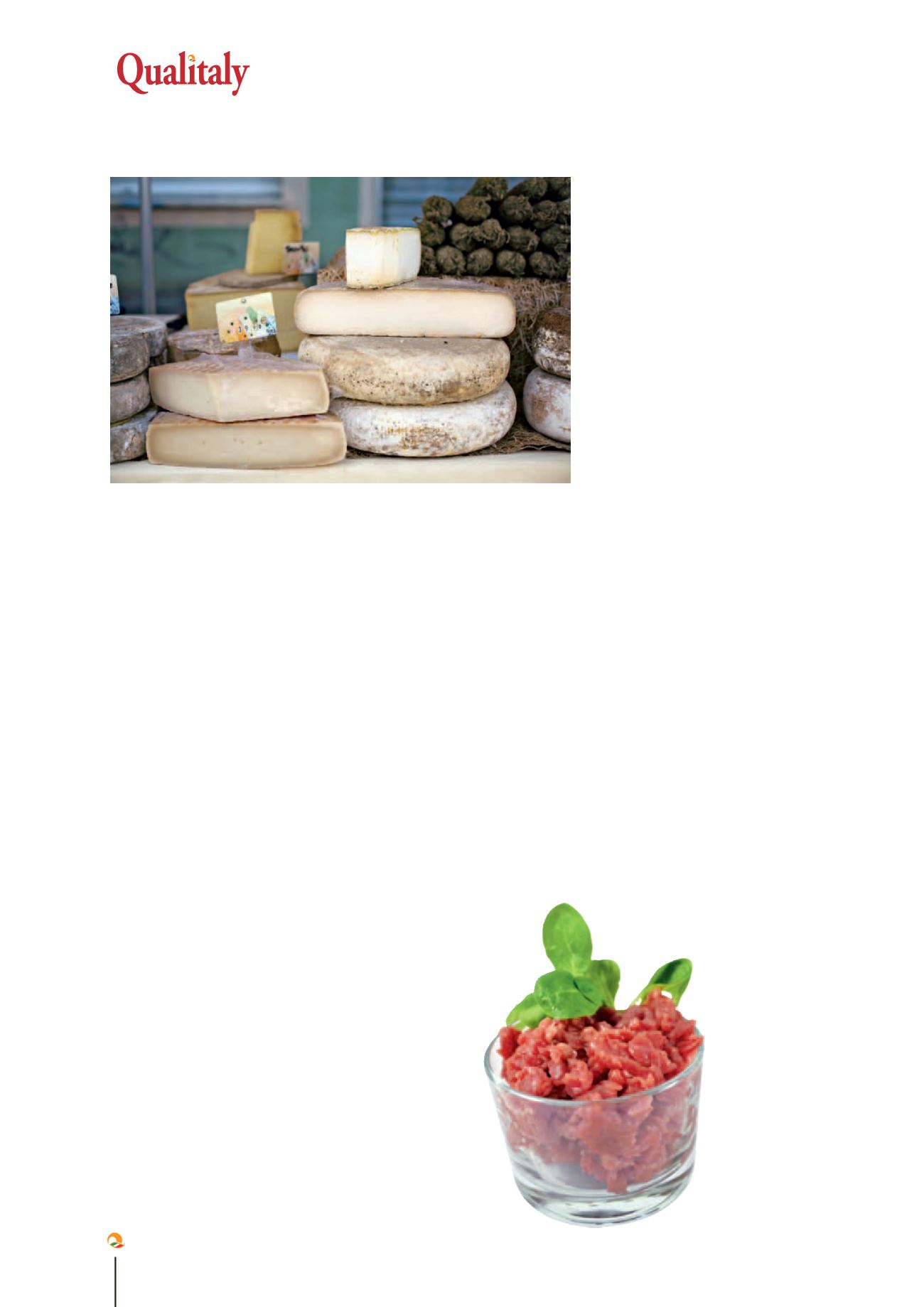
cut steak tartare,
carpaccio...) or
tagliata. Then there
are the boiled meats,
where the Piemontese ox, being
castrated, is highly considered,
as the variation of the hormones
influences the fat content, good for
this preparation».
From Piedmont to central Italy, to
learn more about another very lean
breed, the Chianina. «Fat Content
– explains Gaia Martuscelli, head
of the technical Department of
the CCBI (Consorzio Produttori
Carne Bovina Pregiata delle Razze
Italiane) - is around 2%, the colour
of the fat tends to be white because
unsaturated fatty acids are higher
than saturated and there are no
fat infiltrations in the muscle. The
colour is bright red, with a tendency
towards dark because the Chianina
is slaughtered between 21 and 23
months of age.”
The Chianina is also recognized for
its size. “The breed - he underlines -
is characterized by somatic gigantism:
it is the tallest and longest. The
most classic and well-known cut is
the Fiorentina. The real Chianina
is certified, and must be indicated
Chianina on the label, which it
obtains only if the whole chain is
certified and controlled by the CCBI».
NOT JUST FILLET!
The challenge is to enhance all
the cuts. “It is necessary - explains
Maurizio Arosio, president of
Federcarni - to support a breeding of
proximity that offers guarantees of
quality, environmental sustainability
and health. It pays to know the
product better and use, in an
economical approach, as many cuts
as possible. The national production
does not have the opportunity to
satisfy the demand of a few fine cuts
without contacting the foreign market.
However, Italian cuisine is able to
satisfy this requirement: our chefs are
the creators of spectacular dishes. To
them is given the
task of inventing
a new way to use
more possible
parts of the beef.”
Butchers are
available to
assist. “We
cooperate with
the Istituto Carlo
Porta of Milan
- tells Giorgio
Pellegrini,
President of
Macellai di Milano
and its province
MAGAZINE