



 52 / 68

DIC.GEN 2015
II
the simple reason that many of our
competitors have found themselves in
trouble, they have reduced activity or
closed. Saying that with a metaphor:
the cake was not enlarged. What really
decreased are the diners. In some ways
it could be good news: strengthen the
healthy part of the market is just fine.
But there is the other side of the coin,
and it is called Article 62. More than a
year after its introduction has proved
unsuitable for a mechanism to regulate
an industry that late payments made too
often leverage and commercial. That
is to say that we distributors we are
forced by law to comply with the terms
of payment to suppliers, the same can
not be said for some of our customers,
either by the fall in consumption, either
for convenience, either for the financial
weakness of their businesses. The result
is a sector constantly under voltage from
the financial point of view. And before
you acquire a new customer you go with
feet of lead. This is not good for the
business system, already in trouble for
the crisis. And then the legislature will
have to meddle in Article 62 and review
it for the better.
These are the question marks that hang
over this end of the year and the next.
We hope that 2015 is another year of
transition. And we’ll finally see a goal.
AT PAGE 6
2I[W
-REYKYVEXMSR
SJ XLI RI[ 'MG
LIEHUYEVXIV
The traditional sales meeting in
November was the occasion to present
to the members of the Cooperative
Italian catering new operating offices.
The sales meeting presented the
purchasing strategy of the four major
areas of activity of the central products
at positive temperature, those negative
temperature, food dried flesh and the
world. It was also an opportunity to
explain to shareholders the sales trend
for the first nine months, which ended
with an increase of 5%. That is also a
figure that is expected to continue in the
last quarter, decisive for the outcome of
the year-end.
But everyone’s attention was focused
on the new office, which is located
inside Linate Airport Business Park,
near the BreBeMi. The new offices,
rational spaces, are equipped with a
large room for meetings and meetings
with shareholders completely wired,
the restaurant with professional kitchen
to test products and two rooms for
business meetings with suppliers and
components commissions purchases.
“The move to the new headquarters -
said Mauro Guernieri, general manager
- is a strategic and operational which
allowed us to aggregate the commercial
area on the one hand and on the other
the administrative area to facilitate
the exchange of information and the
‘interaction between different people,
improving the overall efficiency and
effectiveness of our business to the
shareholders.”
AT PAGE 7
2I[W
)\GMWI HYXMIW XLI
IRIQ] MW RS[ EX XLI
KEXIW
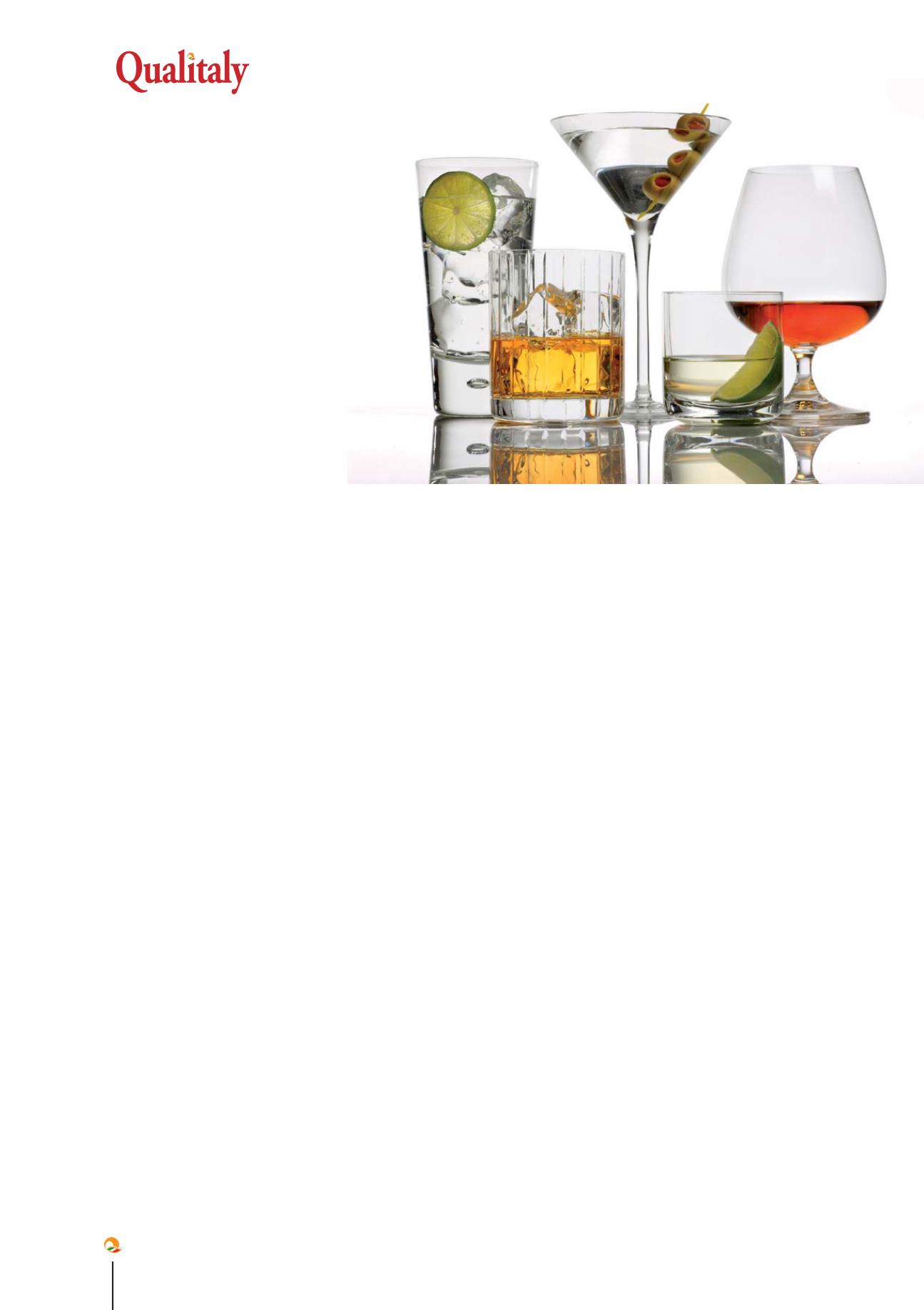
The world of spirits is in fibrillation
and deeply concerned about the fate
of the consumption of beer and spirits.
The enemy to fight has only one name:
Accise (excise duties). After the heavy
tax increases in October 2013 and
January 2014, 2015 brings with it a
further increase.
For some time Assobirra warned of
rallying workers and consumers with
the campaign Salvalatuabirra, already
signed by 100 thousand Italians. The
association estimated that the IRS would
take a sip every two of the blonde and
points out that in 11 years the excise tax
on beer in Italy has doubled.
For Assodistil the alarm is not far
behind. The fund, already suffering for
the consumer crisis, now sees in danger
even its productions of excellence,
such as Grappa, the Amari, Limoncello,
aperitifs and other products symbol
of Made in Italy. “According to data
from the cyclical Format - says Antonio
Emaldi, president of AssoDistil - for the
third quarter of the year, companies
attribute the decline in sales, 80% of
cases, the increase in excise duties.
The climate of mistrust is widespread,
also because the increase will be
downloaded especially on prices,
investment and opportunity.”
“With the increase of excise duties on
spirits that share will reach 30% in
January 2015 - observes in turn Sandro
Boscaini, president of Federvini - the
impact of this maneuver in employment
would result in the loss of over 6,700
jobs, severely weakening an industry
that expresses some regional excellence
very famous in the world: the Grappa
Limoncello, by Amari at Sambuca, from
Nocino of Modena to Mirto di Sardegna
‘. The scenery, designed by a search for
Trade Lab on behalf of the Federation,
stresses the negative impact that the
series of increases in excise produced
on suitable areas for the traditional
spirits and liqueurs. “True districts
Quality - precise Boscaini - Think of the
Piedmont, Lombardy, the Veneto and
Friuli Venezia Giulia.”
4(.(A05,