


 75 / 76

OCT. NOV. 2017
XV
canteen proposes an orzotto or a spelt
soup. I think one of the tasks of us chefs
is to keep up-to-date and always offer
something different to our customers.
It is clear that then you have to lend
yourself to the customers’ tastes, but
now these dishes are appreciated more
or less by all. “
INTERVIEW
My favourites? Buckwheat, rice and
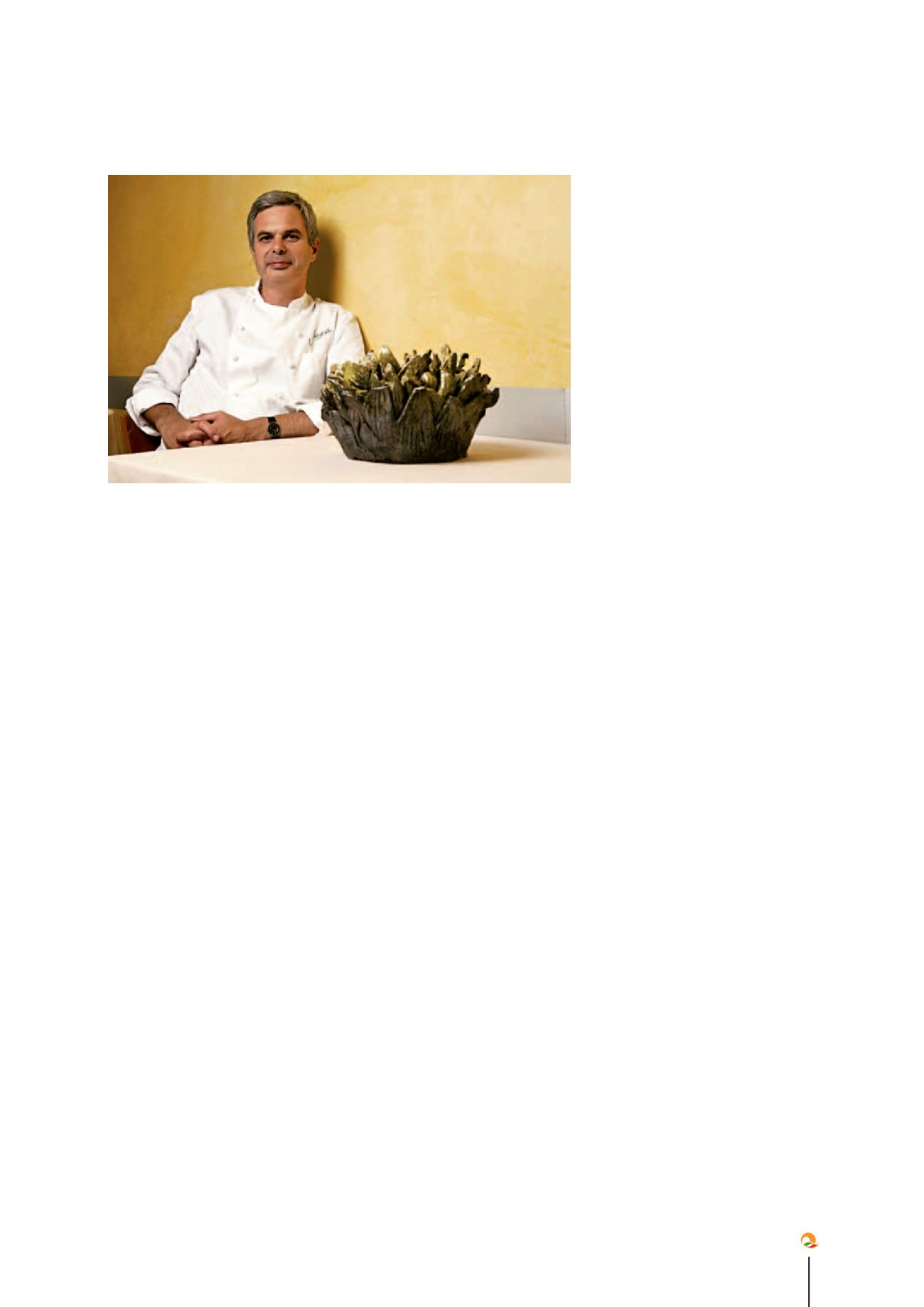
quinoa for years Chef Pietro Leeman
practices
vegetarian cuisine and in his restaurant
Joia, in Milan, lesser cereals and
pseudocereals occupy a prominent role.
That’s what he told us.
What importance do traditional
cereals and pseudo cereals have in
your kitchen? Which do you use more
and for which dishes?
In my kitchen they both matter. With
regard to wheat, I always try to use the
one of Italian origin that has traditional
characteristics, but I also use spelt and
spelt pasta. In general, however, I prefer
cereals and pseudo cereals that do not
contain gluten. At Joia we make bread
and we have on the menu a plate that
contains wheat, but most of our dishes
are gluten free. This is because I believe
that our diet should be lightened, the
wheat, in fact, contains a lot and we
must learn to use less. For me the
king of pseudo gluten-free cereal is
buckwheat, although I really like the
whole rice and the dark quinoa. Now
in the menu at the restaurant Joia we
have “Interior Landscape”, a plate of
buckwheat noodles served in broth with
different contrasts inside. At the Bistrot
del Joia, instead, the menu changes
every day and you can always find
different cereals and pseudo cereals.
Finally, I would like to point out that we
use only organic products at both the
Joia restaurant and the Bistrot .
The vegetarian cuisine implies in those
who have chosen a reflection that also
involves physical well-being. Once you
remove some foods, those who choose
to be vegetarian must add cereals in
their diet, and it is important to vary.
This happens less, however, in someone
who is omnivorous.
In your opinion, what trends can be
linked to the discovery or rediscovery
of these ingredients?
For a few decades now we have been
spectators of an expansion of the
food culture. People are increasingly
open to new products and all over the
world now exchange happens quickly,
amaranth and quinoa are an example,
they haven’t been on the market for a
long time but now you can find them
even at the supermarket without any
hassle. These products are required
and “follow trends” because people are
curious, they want to experience new
foods and ingredients, other than those
that they eat every day. Not forgetting
that quinoa is really good.
The other phenomenon that concerns
me personally is an approach to the
vegetarian kitchen where you make
extensive use of cereals and pseudo
cereals. We are, in fact, faced with an
exponential growth in the number of
people who choose not to eat meat.
Can these ingredients also be used in
pastries?
In confectionery, the most difficult
aspects to deal with cereals and pseudo-
gluten-free cereals are those linked
to leavening, to the bond between
ingredients and to the brittleness. For
example if you try to make a biscuit
with only buckwheat it is likely to
break, if, instead, you add water to
make it more compact it will become
difficult to chew.
It is difficult to make gluten-free
pastries, at the restaurant Joia we
develop - to some recipes like the Linzer
cake without gluten or the biscuits
that we insert in sweets but it is more
complex because there is a more subtle
balance. The flour binds the ingredients
and if you add a raising agent properly,
while if you use it with buckwheat will
not work because you do not feed the
bacteria properly.
What are your absolute favourites,
both as a chef and as a customer?
As I mentioned in the first response, I
really like buckwheat. Valtellina is in
my blood and therefore is part of my
culture and my memory.
It may seem trivial but another cereal I
love is rice. From my point of view, in
fact, it bridges the culture of the Orient
and our own. It is found everywhere,
from Japan to China, from Persia to
Turkey. Rice is everywhere and I really
like this cultural aspect.
Finally, I really like quinoa because I
find it has while chewing an interesting
texture compared to others. It is a
“third” texture and therefore lends itself
to original and stimulating creations for
the palate.
______________________________
AT PAGE 54
There’s more to flour
than just white
Famous in the kitchen but not
everyone really knows it in
nutritional terms.
By Barbara Panterna *
Flour, in general, is a product that is
obtained from the grinding of cereals.
We commonly use this term to indicate
white flour, from soft wheat, which
is used mainly for the production of
bread and pasta.
On the market, however, there are
many flours derived from cereals such
as maize, rice, barley and spelt, but
also from other more unusual foods
such as chestnuts, tubers, nuts and
legumes. We start with white flour, the
most known to the public, and take a
look at the nutritional characteristics.
Obtained from the grinding of soft
© PANAROTTO