


 74 / 76

OCT. NOV. 2017
XIV
AT PAGE 50
Diversely cereal
From barley to oats, from
buckwheat to quinoa, an army of
minor cereals and pseudocereals
made their appearance on menus.
What are they, how are they used,
how much do they cost?
By Elena Consonni
A pasta dish or a classic risotto is no
longer enough. Now the clientele,
especially - but not only - vegetarian
and vegan, look for something more.
Then there are celiacs and those
intolerant to gluten, who need, even in
the restaurant, to find viable alternatives
to wheat. Thus the menu is enriched
with new ingredients that have been
fished out between traditional cereals
neglected for years and among the
pseudo-cereals imported from ethnic
cuisines. “The panorama of these”
ALTERNATIVE CEREALS” - explains
Giorgio Perin,
captain of the APCI national team chef,
professional association of Italian cooks
-”is very wide, ranging from oats to
barley, from millet to spelt, then to the
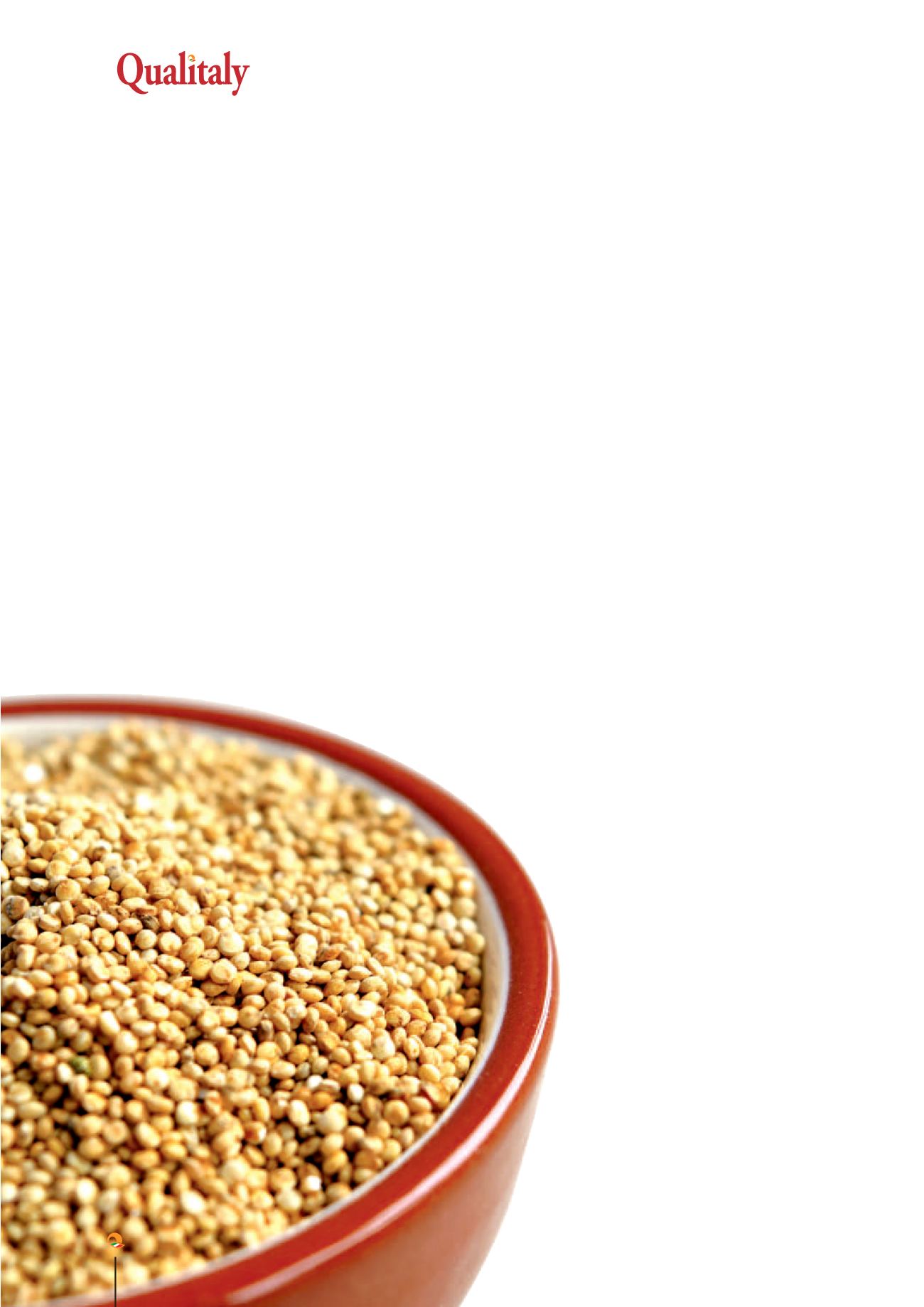
pseudocereals, like quinoa, amaranth
and our buckwheat. Surely these plants
are highly sought after by vegetarian or
vegan because they allow integration
into their diet, but also those who
are not vegetarian, just think of the
traditional pizzoccheri or the soups of
barley, spelt and rice. Thinking about
the products borrowed from foreign
kitchens, quinoa is very digestible and
is rich in calcium and lysine; Amaranth
is very protein and contains calcium
and magnesium as well as to be cooked
directly, these products are also suitable
as ingredients for industrial foods, such
as the cakes of corn and quinoa, the
paste of amaranth».
TRADITIONAL AND ETHNIC
Together with Giorgio Perin, who
knows these ingredients well because
he likes to put vegetarian dishes on
his menus, we try to know them better
and to understand how they can be
used in the kitchen. “We start from
oats - explains the chef - which is
widely used in soups with vegetables,
for example leek or pumpkin. But it
has a problem: it is thermolabile. Even
relatively low temperatures cancel its
benefits. For this the one who chooses
it for the nutritional properties makes
it germinate». In addition, whole or
ground oat flakes are an excellent
ingredient for the preparation of
vegetable croquettes and burgers.
Barley is a cereal of Italian tradition. It is
very versatile, it can be used in place of
rice in preparations like orzotto or in
soups, but it also has more exotic uses.
“Together with fermented soy beans” –
explains Perin – “it allows to obtaining
of misu, a Japanese condiment that
tastes similar to that of stock. Bulgur,
a food derived from the whole wheat
sprouted, steamed, dried and then
fragmented, is typical of Middle Eastern
cuisine and is used in salads or stuffing.
Millet is perfect for making meatballs,
cupcakes. After boiling it can be added
to vegetables. It must fully absorb the
cooking water: the right proportion is
two parts of water for one of millet».
There are then the pseudocereals, first
quinoa. “It is very versatile” – continues
Giorgio Perin – “and can be used as
an ingredient for soups, or in salads,
after boiling. Quinoa exists in both the
refined and the whole version. I prefer
the latter, for its greater nutritional
richness. The “problem” of this
pseudocereal (belonging to the family
of spinach) is that in cooking tends to
become a bit gelatinous, but just drain
it and dilute it with a drizzle of oil to
give it the right consistency. To cook
the pasta based on amaranth, instead,
requires some attention: cooking is fast,
not more than a couple of minutes, and
it overcooks very quickly. You have to
check the timing carefully»
But how much do they cost?
Placing these ingredients in your menus
can cost more than traditional dishes.
“It is not so much about the purchase
of the raw material-emphasizes Giorgio
Perin - apart from the quinoa, which
is quite expensive, the other products
do not cost much. It is not possible to
choose ingredients of low cost: those
who choose these special dishes expect
quality. Then it should be taken into
account the greater impact in terms of
time: these ingredients require more
processing. I know that because I have
the habit of putting vegetarian dishes
on my menus, whose preparation is not
fast. It is therefore hard to put them into
a complex service. They are elaborate
dishes, but they give great satisfaction.
“ All this does not take away that some
of these ingredients can also enter the
kitchens of medium level, in fast food or
collective.
“There are pre-seasoned and frozen
semi-finished products - explains Perin
- but in my opinion if you want to give
a high quality product and that gives
value to your restaurants range you have
to cook with fantasy. But I do not see
any particular contraindications that a
MAGAZINE