


 73 / 76

FEB. MAR. 2017
XIII
In reality I’m neither an artist nor a
magician or an illusionist. I am just a
person who loves being in love with
what I’m doing, a great enthusiast
who acts and cooks very often guided
by instinct.
You said that, with your staff, you
do yoga and laze for a quarter of
an hour a day “because creativity
comes from idleness”...
In my opinion it is important to carve
out some space to cultivate one’s own
creativity. It is fundamental to have
moments where you stay away from
the kitchen to see also the rest of the
world. If you close yourself within
this small protected space you can’t
have a comparison and you risk it
becoming your prison. I love staying
outdoors, staying in contact with
nature, but in certain cases my escape
can also just be mental. Because life
is a mental situation.
What is the biggest obstacle when
you open a restaurant?
For me it was the fear of cooking.
The kitchen is a part of me, through
which I offer myself to people. Thus
opening my restaurant was a huge
challenge for me, strongly doubting
myself. It may seem paradoxical, but
it is when you have fear that you are
able to push to the maximum.
You are a part of the school that
believes it is essential to make
mistakes in order to understand
the true direction. What do you
feel to say about this to those who
approach this profession today?
Yes, for me mistakes are important,
but I also know that nowadays it is
not allowed to lose too much time. To
have clear objectives is crucial. When
you are very young you can also
afford to wander without purpose,
but at a certain point you need to
find the right direction. Mistakes will
come anyway, but at least you have a
path to follow.
How do you see yourself in a few
years?
Always better I hope; I’ve just started!
You were also a judge in a talent
programme. Apart from the
controversy linked to excessive
exposure in TV of some chefs today,
can an experience of this kind really
be useful?
Personally, the experience has been
helpful. I think that you grow with
comparison and I received so much
from the encounter with the other
judges, with the competitors and with
the entire production.
Would you give us one of your
recipes?
With pleasure. Considering that we
talked about mistake, I will give you a
recipe born by mistake from trying to
make a porcini mushrooms yoghurt.
In fact, the mushrooms curdled the
milk, producing a lovely acid cheese.
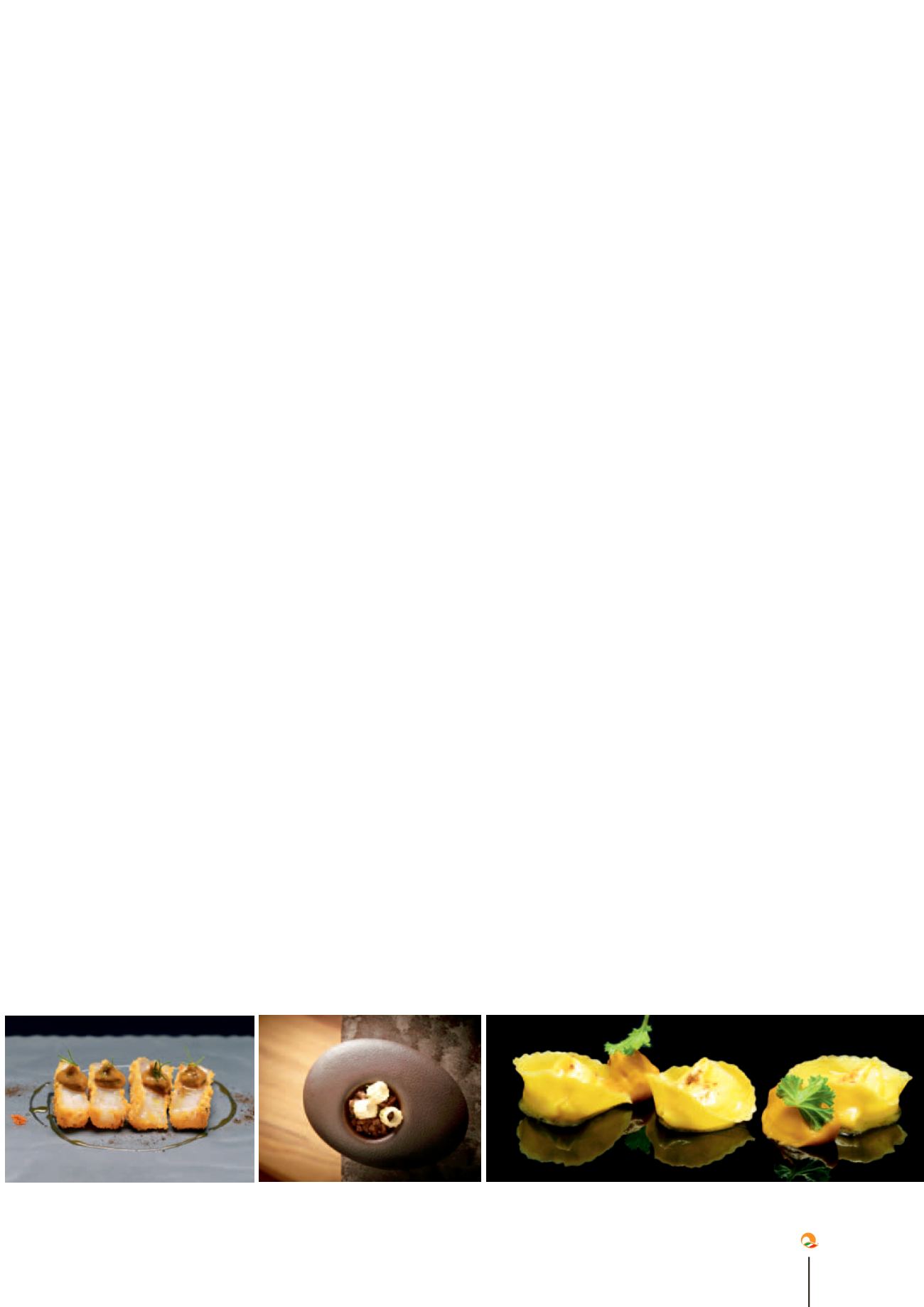
Since that day I use it to make ravioli
which I serve with a pumpkin cream
and lemon geranium.
______________________________
RECIPE
Ravioli cheese with pumpkin and
lemon geranium
For the pasta
90 g semolina 10 g of flour 50 g egg
yolk 10 g egg white Form a dough.
Roll out the pastry thinly and form
disks with a weight of approximately
3 g
For the filling
1 l milk
1 sachet of yeast
20 g dried porcini
Bring the milk to a boil in a
saucepan, take it to 41° immerging it
in a container with ice and water, add
the yeast and porcini mushrooms and
transfer it to a glass jar. Put it in the
Roner at 41° immersed in water for
six hours. Once coagulated filter it to
keep the fat. For each raviolo 13 g of
yoghurt is required.
For the pumpkin
Bake in the oven at 160° for an hour
and a half wrapped in aluminium foil,
peel it and mash it with a fork, then
form a fricassee. For each raviolo 4 g
of pumpkin is necessary.
Close the ravioli immediately with the
cheese filling, cook in salted water
and drain. Rehydrate them in a pan
with raw milk butter and a sprinkling
of cassia. Serve in a terrine decorating
with pumpkin and sprayed butter.
Serve with a sprinkle of cassia and
pieces of lemon geranium.
______________________________
AT PAGE 34
Fresh at -18°C
Quality frozen products in the
catering industry: a possibility for
the sector that is overcoming the
latest mistrust
By Maria Elena Dipace
For some time we’ve been speaking
of a growing demand on the part
of the consumer of “quality at the
right price”. This can be seen in the
shopping every day: the average
Italian, especially in this moment of
economic crisis has found himself
forced to make drastic cuts to daily
expenses.
What they did not want to give up
were the typical flavours of the
Mediterranean cuisine, i.e. all those
authentic foods that have made our
cuisine famous at international level.
However, it is not always possible to
find fresh ingredients. The enormous
interest received by the entry of
frozen foods not only in Italian
homes, but also in the kitchens of the
restaurants, justifies this.
FUNCTIONALITY
AND TRACEABILITY
Frozen food solves different problems:
first of all, it allows the possibility to
always have stocks in the refrigerator,
and moreover, are already ready for
use, there is no waste and there is a
guaranteed consistency of quality.
However, there are still a few
restaurateurs who have put frozen
food between the basic ingredients of
their cuisine; often the chefs consider
them B Series products or maybe not
suitable for the catering industry. It is