


 69 / 76

FEB. MAR. 2017
IX
on social media in ten points*
1. Carefully select the target
2. Engage the community
3. Attend to the contents (cover
picture, profile picture, app)
4. Monitor fluxes with your online
presence
5. Develop a content strategy full
of authentic and interesting tips
6. Share the contributions
of community, create special content,
created ad-hoc
7. Focus on the image, the visual
8. Diversify and rationalise the
contents
9. Emphasise your strong points
______________________________
AT PAGE 22
Bye bye to cash
registers
The implementation of new
technology such as Apps and tablet
has revolutionised many routines
and operational practices by making
the ‘old’ back office and front office
systems obsolete.
By Maria Elena Dipace
In the last twenty years, technology
has revolutionised the way we live.
Historic changes whose effects
are seen not only in the home, but
also and above all the workplace,
simplifying and improving the
operation in many sectors.
Even public establishments
have benefited from this great
transformation, especially in the
catering sector.
In the early nineties the first
handhelds to collect orders were
launched on the market; it was
an easy to use multi-function,
characterised by a long battery
life and along-distance infra-red
communication system, replaced
at the end of the 1990s by a radio
communication system. Handhelds
become a very useful new
instrument for the table
waiter, because
it allowed him to directly transmit the
customer’s choice simultaneously to
the kitchen, dining area and the till.
With the advent of the new century
firstly the arrival of touch screen
system and then Wi-Fi – the biggest
revolution of this century, perhaps
– radically changed the lives of all
with an important simplification also
in the establishment’s back and front
office systems.
THE ADVENT OF THE TABLET
In 2007, the first iPhone was
launched and in 2010 the first
tablet. Today we can say without
doubt that the advent of the
smartphone and tablet has brought
a great new revolution in the public
establishment sector with changes to
many operational habits and many
new simplifications. Simplifications
that have become even more evident
with the use of the App for the work
purposes.
Today Apps have “threatened” the
older systems in use, especially
handhelds for taking orders. Until
just a few years ago, in fact, these
held the domain unchallenged.
Then, with the wide availability of
tablet, (iPad, specifically) things
changed and traditional management
was faced with a decidedly fiercer
opponent, because of its handiness
and ease of use. This is why so many
companies have gradually started
to develop ad-hoc applications for
these new resources. Today it is much
easier to download an app onto your
tablet which performs the functions
of a handheld, but which is also
more advanced because it is endowed
with an appealing and very often
customisable graphic interface and
allows to all intents and purposes full
management.
“The world of management is
migrating from a computer-
based technology platform to that
developed for tablet and therefore
from complex software in Windows
to more streamlined and easy to use
applications – explains Domenico
Palmisani, creator of the App iPratico
– tablets have made obsolete not
only traditional handhelds,
but also cash registers
and computers at
the till. There are
many advantages,
from economic (tablets
although qualitatively
superior cost significantly
less) to speed and
ease of use. Furthermore, they allow
managers of catering activities to
break free from the constraints
and costs of technical assistance
necessary for computer-based
systems. With the tablet they no
longer depend on the intervention
of a technician but can solve
simply, quickly and economically
by themselves any inconvenience,
exactly as they would with their
smartphone. It is well-known that
the success of the smartphone is
due to the extreme simplicity of
the interfaces with which the user
interacts with the applications. In
the same way an application that
manages the restaurant activities
allows the carrying out of all the
till activities, from the issuing of
receipts to invoices paid in cash,
credit cards or meal vouchers,
delayed billing, easier and faster
stock control; even the work of the
waiters is greatly accelerated and
simplified, all to the advantage of
the service to the customer and
for order rotation which leads to
considerable advantages in terms of
productivity and therefore takings.
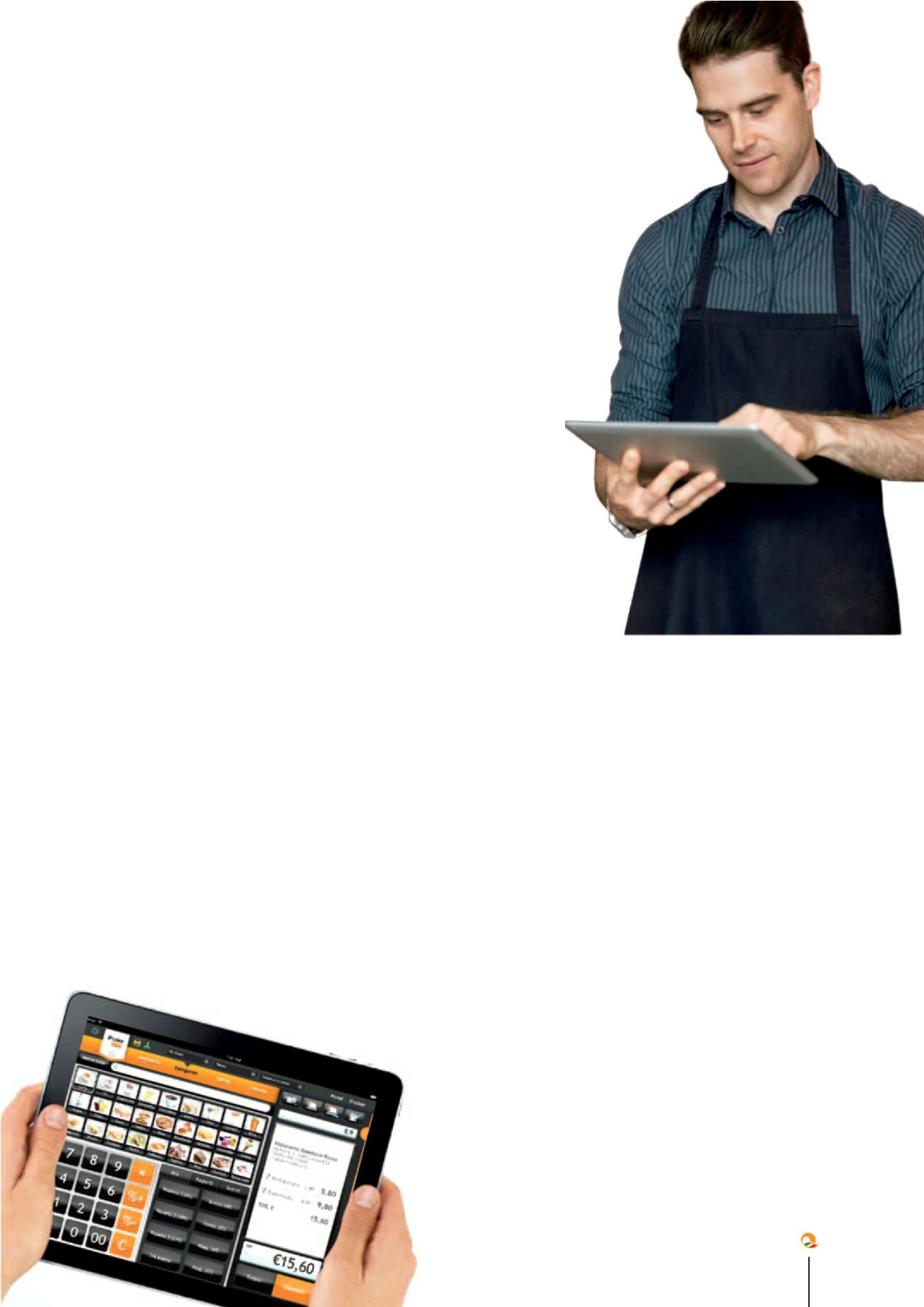
Today the waiter with an iPad Mini
in hand has at his disposal the most
technologically advanced instrument
with which to carry out his work at a