



 58 / 70

JUN. JUL. 2016
VI
MAGAZINE
World Health Organization, the
health damage caused by red and
processed meats, IRI has detected a
decrease of 16 million euro in sales
in the large-scale distribution in just
one week. And in 2015 household
purchases fell by 9% for fresh pork,
6% for the beef and 1% for chicken
and meats, recording one of the
historic lows since the beginning of
the century, according to Coldiretti.
Yet, in this desert of numbers there
is a happy island, and is called
hamburgers. Which now we can
be divided into two categories,
the fast food, in the hands of large
American chains (see box), and
the so-called “gourmet.” It is more
interesting, because it provides the
higher margins and is particularly
appreciated by the modernist no
customer, increasingly attentive to
the quality and origin of food.
“I do not like the
gourmet
definition,
we say that we started early, in
2011, to propose a good burger -
explains Clelia Martino, Development
Manager Sebeto Group, owner of the
trademarks Rossopomodoro, Anema
& Cozze, Rossosapore and Ham Holy
Burger and last arrived dedicated
to chicken, chicken Coq Nice. What
is the recipe for success Holy (now
with eight rooms in Italy and one
in London)? “First of all about the
meat, we were the first to use a Slow
Food Presidium, the meat Fassona
Piedmont La Granda Sergio Capaldo.
It means that we know about that
meat around the breeding location
and animal nutrition. A quality we
insure to the customer. And the word
of mouth of those who have tasted
it is proof of our message. It’s a way,
in short, to identify the product and
provide its quality assurance. Then
there are the fresh not frozen potatoes,
selected in Abruzzo, and 50 types
of beer”. But also the link with local
products, another large diktat of
these years, works: “In every city we
propose a hamburger with a typical
ingredient of the place and a local
craft beer”. We never miss the gluten-
free products: for intolerance, celiac
disease, those who follow fashion.
And the vegetarian, because in a
group of friends going out to dinner,
increasingly there are those who do
not eat meat, and, although in the
minority, influences the choice of the
room. It is a chameleon-like product in
short this burger, perfectly in line with
the new consumption and lifestyles.
THE POWER OF BRAND.
Under
Canadian company Technomic
research, the burgers are eaten at
the restaurant more by men than
by women (48% versus 35%), and
the characteristics considered most
important are the quality and taste of
the meat, followed by the value for
money, the quality of the filling and
finally the bread.
The quality is transmitted in
different ways, “it is important to the
certification and origin, the name.
There’s a whole ‘meat marketing’
that it is important to emerge from
the market, because the customer
requires the caterer continuity and
consistent quality, allowing you to
create an ongoing relationship and
him loyal. The trend today is this:
you eat less meat, but is looking for
quality products” - confirms Luca
Lunati, which a few months ago came
into the CIC as a reference buyer
for the meat industry, after a long
working experience in Marr. Then
there are other measures: from the
cutting knife, the hand-pressing, to
the world of fillings, that give value
and variety: but beware of the right
mix.
WORD TO THE SCIENCE ... AND
THE CHEF.
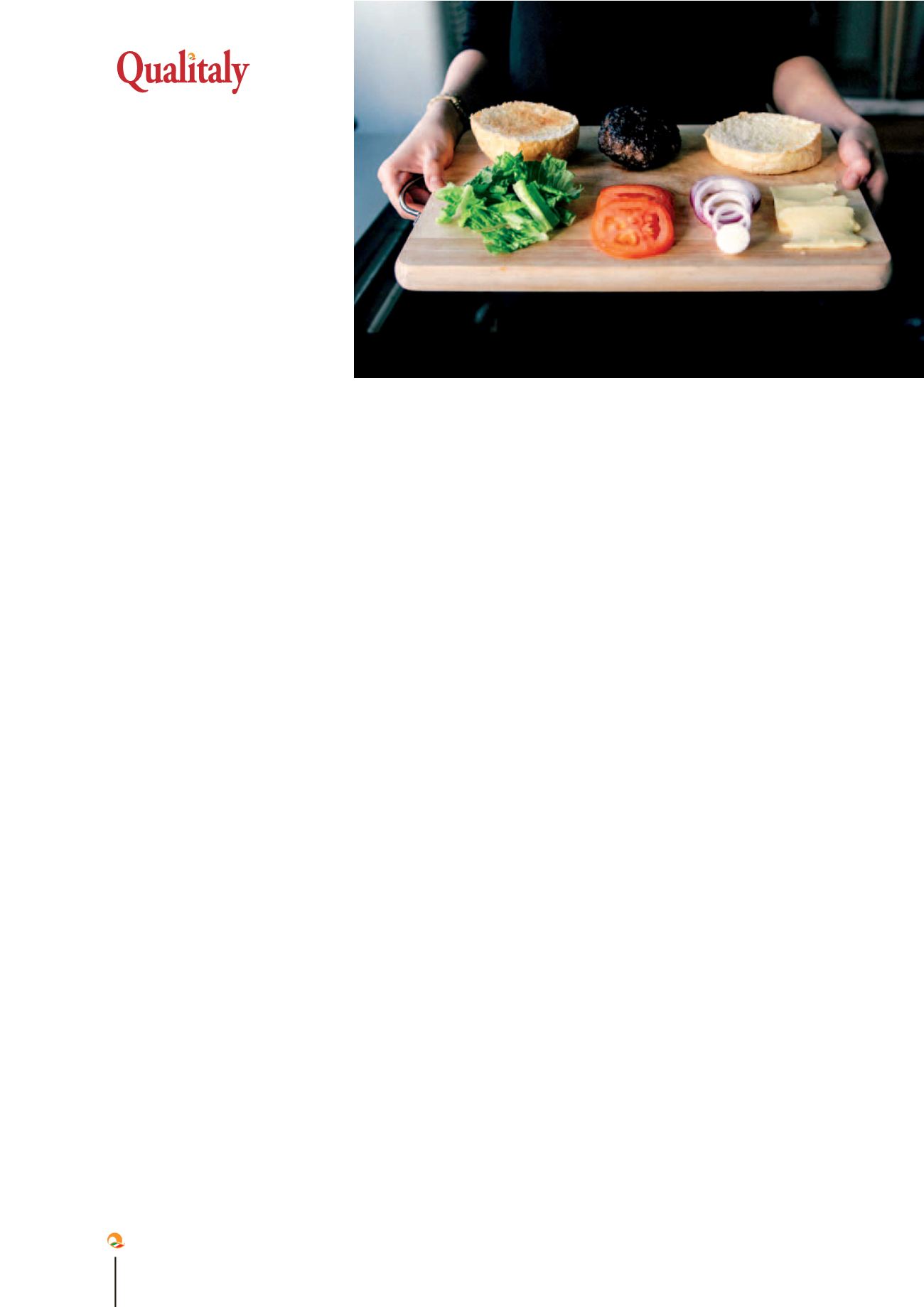
It appears that there is
“the perfect hamburger.” It codified
scientifically chef Michel Char- les
Crossmodal Research Laboratory
at the University of Oxford. It must
appeal to all five senses, the meat
must be at least 7 cm thick and
have 9 layers, with the inclusion
of ingredients “magic” such as soy
sauce, Jamon Serrano, Camembert
and Chipotle Sauce (typical smoked
spicy peppers of the row of Mexican
cuisine). It should not be eaten in the
dish but snapped, and must contain
some crunchy element (such as the
traditional fresh leaf lettuce), while
the tomato must be often 1 cm.
Science, however, clashes with the
Italian taste, which might not like
exotic ingredients such as soy sauce
and smoked chili in the sandwich.
“In fact, the perfect burger must use
a meat with the right fat percentage -
explains Lunati - giving tenderness.
A too lean meat is likely to result
dry”. According to Enzo De Angelis,
chef resections executive Ham Holy
Burger - “The perfect hamburger we
seek him day after day improving
cooking on single hamburger. We do
not have a standardized product but
a homemade ingredient worked by
artisans.
Perfection is an aspiration that we
seek individualized for each patient
with a kitchenette for the customer,
making attention if it’s sunny or
rainy, if we have a summer or
winter accompaniment. The perfect
hamburger is the sum of so much
attention. We start with an advantage
of a large raw material”.
What are in fact the reasons for
this success? “Compared to the
grid, which requires a certain
professionalism, the burger is a ‘easy
product’ to manage and to cook.
Moreover, it fits perfectly in the new
lifestyles and ways of eating: it is a
complete meal at the same time, that
satisfies, but also fast and that you
can consume anywhere” - concludes
Lunati.
BOX
THE OPINION OF THE BUYER
All Italian
CIC offers its hamburgers brand.
Features? “Exclusively Italian and a
15% fat content of meat origin at least”
- explains Lunati. Are four references:
100, 110, 150 and 180 grams.
BOX
In fast food business, foreign
chains are conquering Italy
.
Is the symbol of the fast food chains