



 64 / 70

JUN. JUL. 2016
XII
are applied grips acetyl resin; for
the latter (composed of two parts,
the blade and the handle) the most
commonly used material is stainless
steel with chrome, molybdenum and
vanadium, while the handles are
used mix of plastic materials. The
handle must not tire the hand, must
be non-slip and abrasion-resistant”.
In addition to the effectiveness
from a technical point of view the
professional knives must comply with
safety requirements for the food and
for the operators. “All the materials
used for products Victorinox - precise
Künzi - are sterilizable, resistant to
corrosion and high temperatures, and
comply with current rules on food
hygiene and safety.
The use of Fibrox, makes the handle
comfortable and non-slip. Having
also the shiny blades allows locating
more easily the dirt and makes easier
to slip the blade. There must be no
other cutting parts over the blade”.
AN ART FOR CHEF.
“The way a
chef size and wield a knife clarify
if is really a good professional,
the cut is a technique that must be
learned. The relationship between
a respecting cooker and his knives
is almost maniacal. I never would
lend mines: they could be misused,
they could lose the thread...” These
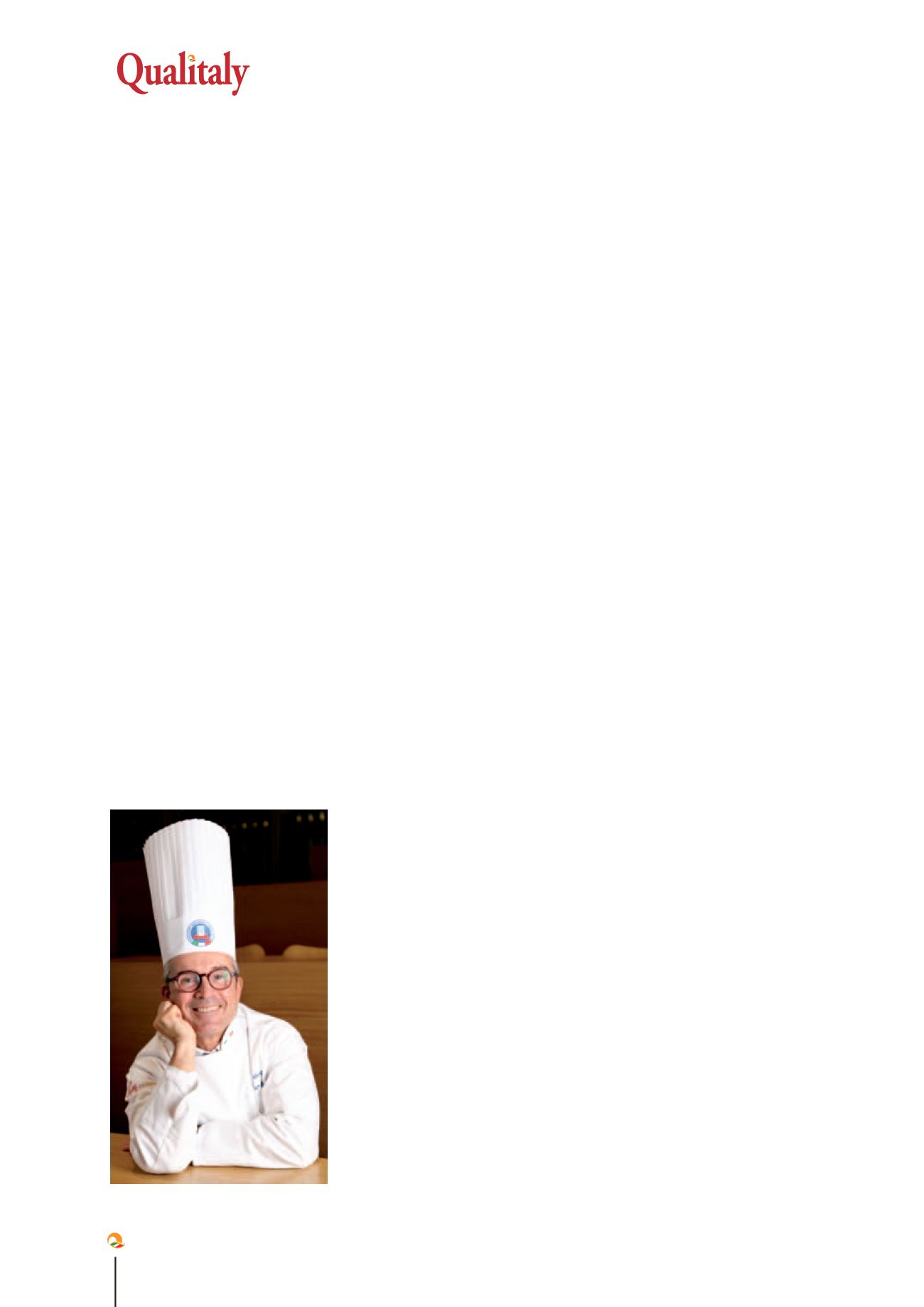
few words of Roberto Carcangiu,
President APCI (Association of
Professional Italian Chefs), makes
understand more than a thousand
explanations how much these tools
counts in the chef work and how
much attention should be dedicated
to their choice.
“The type of knife - said - should
be chosen depending on the use.
As for materials, compliance with
sanitary regulations is a prerequisite.
The blades must be in steel with
not too hard compounds, to be
filed in the kitchen. There is cut
when the knives do not cut: to
preserve the flow is also important
to do the maintenance, in particular
sharping and washing. Increasing the
temperature of the blade it involves
changing, so should be avoided
dishwasher and sharpening, whether
carried out by external, must be
made with water wheel, with the
right angle grinding”.
The neck has its importance. “Better
is not shiny or smooth: when you
work you always have wet hands or
even greasy. Grooves and serrations
to grip. The handle should be no
sharp edges and easy to handle: cut
for hours, you cannot run the risk of
blisters”. And young chefs, Carcangiu
explains not to be afraid for the price
difference. “I believe - he concludes -
on average a quality instrument costs
50-70% more poor, but its duration is
eternal, also the yield is much higher
and it takes little to recover the initial
investment. To begin with, a young
man with EUR 200-300 can create
his first set of knives decent level, I
would recommend, however, to avoid
those compounds already proposed
by the companies: better to choose
one by one the tools that he needs,
and he feels better in your hand”.
BOX
The knives forge
His name is Michael Massaro, he is
from Maniago (Pn), a town of knives.
In 2015 he decided to reopen the last
still working hammer of the country,
Antica Forgia Lenarduzzi-MASSARO,
where he works alone turning his
hobby of artisan manufacture of
knives, in a full-time job. And the
chefs are his main customers. “Out
of one hundred knives coming out
of my hands - he says - one goes to
a collector, another a passion for
cooking and the other 98 to catering
professionals.” Who better than
him can tell how is born a knife
dedicated to them? Which materials
does he choose for his knives?
The carbon steel, which is today no
longer used industrially because it
can rust, in compensation cuts better
and being soft is the easiest to be
sharpened in the kitchen. My knives
are made to be ground on the stone in
the kitchen or in molds: the blade is
particularly; if it is entrusted to those
who do not know it can be ruined.
Every stage of production is artisanal:
average realized a knife a day, to
order; in a month between 20 and 30.
What characteristics must have a
chef’s knife? It must be functional. My
knife-masters are the chefs: I compare
myself with them and create the knife
desired suitable. The blade must be
thin, sharp and rigid, for better hand
feeling and precision of the cut. Then
the weight is important: the knife by
means fail, for portion of the meat
slices has to be heavy, but a blade for
filleting or slicing must be very light.
How are the relations with the chefs
“vips”? Do they seem of being a bit
‘naughty?
Among my clients there are several
starry and the relations with them
are good, with some even friendship.
I think I begin to recognize my
professionalism, as I recognize them.
The chef is very sensitive to the
quality and to the artesian.
BOX
Not only blades
In a kitchen that gained respect can
not miss the many other tools, in
technical jargon are defined parts:
potato peeler, corer parisienne,
line lemons, zest pull, caliper-style
surgeon, thermometer probe and
then ladles, spoons and forks. “Even
in this case - explains Carcangiu - the
steel is the best material, siliconised
if using non-stick cookware. These
tools are often not personal, but the
house. Who, like me, is old school,
however, can not give up on his
staffing, even these tools”.
For those who deal with pastry,
finally, cannot miss the spatulas. “To
assess the quality - explains Künzi -
you must try to bend them. Those of
Victorinox bend in the middle and
not the one near the handle, always
returning to its original shape. Other
important tools are those for the
decorum and good knives for slicing
bread”.
AT PAGE 32
In pantry
GARBO:
THE PASSION FOR GOOD FOOD
Active for over twenty years,
MAGAZINE