



 64 / 72

april- may 2015
X
At page 28
Baccalà and
stockfish, “children”
of the same fish
We would like to clarify the
differences and characteristics of two
specialties that are actually the result
of two processes of preservation of
the same fish, which today enjoy
great credit in catering
By Mariella BONI
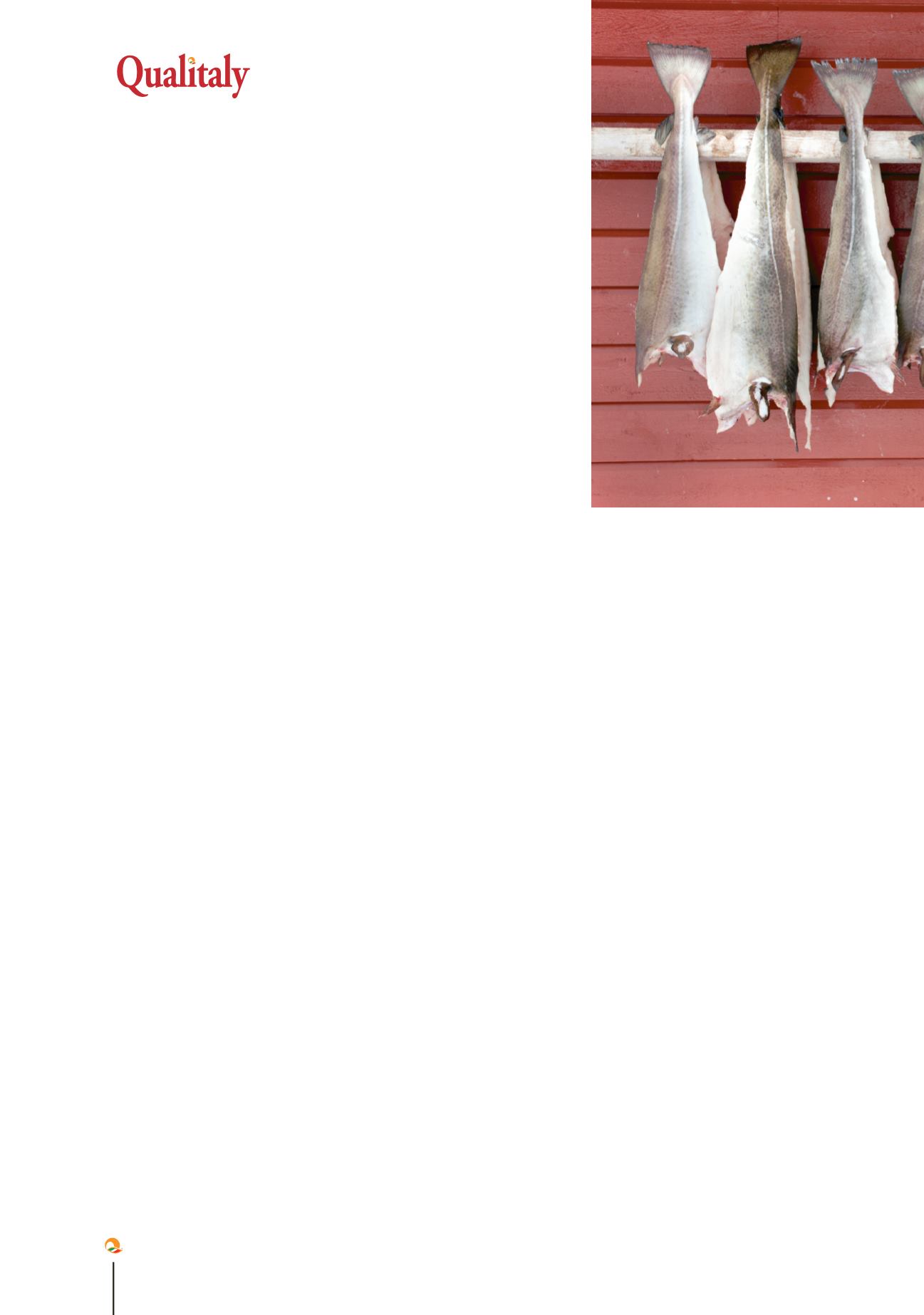
Stockfish and Baccalà: salted the first,
the second dried, are two methods to
conserve cod from the ancient tradition.
These products have in fact centuries,
when there were no other methods
of conservation of fisheries. Suffice it
to say that the arrival of the Stockfish
in Italy is attributed to the Venetian
navigator Pietro Querini who in 1431
landed in the archipelago of Lofoten
Islands, off the coast of Norway, where
he discovered the fish-stick dried in
the wind of the northern seas, easily
transportable, who brought with him
to return to the Serenissima. Baccalà
is dried to perfection generally from
mid-June and the right degree of drying
is based on an evaluation by expert
graders (the vraker), involved in the
classification based on the length, the
size, weight and other characteristics
quality that only long practice allows to
know in depth.
Coming to the present day it is worth to
make a clarification. We talk properly
with cod and cod Stockfish when
based on the type or Pacific cod Gadus
morhua, although I’m not certain the
only variety of cod that swim in the
seas.
Each region prefers one or the other,
using them in many recipes. Famous
example is the recipe for cod Vicenza,
which despite its name is prepared with
Stockfish beaten, soaked and cooked at
length without ever being reshuffled,
as it wants the recipe coded by the
“Brotherhood of the Codfish”.
READY TO COOK. If once the cook had
to face the long wash or soak for several
days to use cod and cod, now on all
companies offering products ready for
use, saving time and effort to the chef.
We spoke with Alfrediano Dovesi from
Ghezzi Alimentari (Fi), which points out:
“The restaurateur requires us cod or
Stockfish already desalted or rehydrated,
and because they do not have the time,
and because these operations require
environments equipped, which now
deal almost always companies like
ours. It desalination rehydrates the cod
or Stockfish, which can then be sold
frozen in slices, in the hearts of fillets or
whole piece. I would like to emphasize,
however, that the market is also very
northern cod that is injected with a light
brine (approximately 2%) and frozen;
under the law is called “northern cod
lightly salted”, commonly called “light
salted”. Beyond the considerable price
difference (the northern cod is much
less expensive than the cod, almost
half), this product has a texture and
a minor cut very different from the
true cod. It is important to know this
difference and suggest that you read the
labels to make informed choices. That
said, on the processing of cod desalting
is the stress that we carried out at
temperatures between 0 and 2 ° C:
this allows to have no yeast which can
create unpleasant odors and defects in
fish. The processing of cod instead, that
in our area do not want to beat (as for
example in the Veneto want him beaten,
and then the fibers are broken and
rehydration becomes shorter, about 3
days), it takes about 14 days, thanks to a
soaking in the water in the tank static.”
“Practically all the Stockfish - says
Veronica Quadrio from Unifrigo Gadus,
company that from mid ‘800 matter cod
and cod, with manufacturing facilities
in Genoa and Naples - is now Gadus
morhua, produced only in the area
of Norway. Of course there are many
other types of dried cod, but can not
be defined Stockfish. Equally specific
is the preparation of the cod, which
requires a precise salting procedure
that differs from the “light salted”, a cod
fillet (of a different variety than the G.
and G. morhua macrocephalus) lightly
salted and frozen for infiltration. Our
company deals with do the soaking
Stockfish: soaked Genovese, in Baffa;
Venetian beaten and soaked; soaked
and cut in pieces, as they ask in
Lombardy and Piedmont). The cod is
instead desalted and stored in modified
atmosphere (while I Stockfish is kept
under vacuum). It is therefore cuts
ready for cooking, with a time-delimited
conservation.”
BEWARE OF DIFFERENCES. Dino Verso
from Verso Brokers underlines: “We are
intermediaries between producers of
northern Europe and the distribution
then we import such as Norway, Iceland
etc. But cod and cod are essentially
raw materials, which generally are not
placed on the market as such, but are
processed, so that the cook should not
waste his time in these long, delicate
operations. It should be noted that
there are many qualities: cod (of the
two varieties already mentioned, ed) is
fished from mid-January until Easter,
then put to dry in the air until June and
then selected according to the quality
and sizes; from late July onwards begins
to be distributed. It is a valuable product
but sells for “patchy”: for example like
in Messina, sells well in Calabria, Naples
and Salerno, as is required in Liguria
and Veneto. Much more widespread
consumption of salted cod, of which the
most valuable variety is what you get
from fresh cod (but there is also that of
cod from frozen cod). Of course all this
is meticulously indicated on the label.”
In turn Roberto Zanobi of Formasal,
associated company Cic, explains: “In
business we have always provided the
cod dry Gaspé (cod lightly salted and
dried, a process typical of Canada,
nrd), the loins of salt cod in Norwegian
and a typology oil pan ready in 2 kg.
As for the stockfish is an article in
our country has fallen into disuse,
although sometimes it is required
to order over the Christmas period.
These are products, which do not
carry out-processing: is the refreshing
(except for the type in oil) which must
provide for the desalination and then
use in its basic recipe. In addition to
these references, we have the fresh cod
from portion and the various types of
frozen cod (fillets, steaks and battered).
magazine