



 63 / 72

april- may 2015
IX
That’s hard work, which completely
changes when he joined the company in
‘65 the first machine shelling. In the ‘70s
opened the first factory in Santa Maria
in Fabriago (Ra); 80s opens the factory
in Occhiobello (Ro) and during the 90s
to Mordano (Bo).
The Eurovo Group, is a leader in Italy
and Europe, has seen the company go
into the second generation of the family
with their children and grandchildren
Siro Ireno and Silvia, director of
services, and Federico, VP Sales &
Marketing Group (pictured).
Eggs, chicken, and not only
Hen
They have a standard weight of around
60 g, but can go up to 80, depending
on the categories of membership (S,
M, L, XL). It is suitable for any use of
the kitchen. Those nuts white, in Italy
less widely abroad are used almost
exclusively in the manufacture of the
morning (boiled, scrambled, fried)
because they recognize more easily the
freshness: if they are old form grayish
spots.
Quail
Tiny and covered with brownish stains,
the quail egg is generally serves a fried,
boiled or poached, to enhance its small
size. Perfect for appetizers and tapas.
Partridge
The gray shell with dimples can
recognize it too modest in size. Refined
product and high gastronomy, it takes a
few per serving. Usually prepare boiled
or poached.
Guinea fowl
It’s an egg a little larger than that of the
partridge and similar in size to that of
the bantam hens, but with smaller yolk
and shell very resistant. Well poached
or fried, is not however suitable for
preparing pasta.
Goose
It’s larger than that of chicken, goose
eggs (and the duck) are particularly
rich in lecithin. A feature that, when
used to prepare fresh pasta, improves
the structure. Perfect for preparing
mayonnaise.
Ostrich
The biggest ever, weighing
approximately 1500 g of which 200 of
the shell. May suffice for 8/10 people;
typically is used to prepare omelets,
omelets and scrambled eggs.
The identity card of the egg
To guarantee food security since
2004 eggs produced in Europe must
bear on the shell code traceability,
which provides important information
concerning the method of production
and origin. A sort of “identity card”
that allows you to identify the type of
farming (1 for biological, 2 if outdoors,
whether on the ground 3, 4 if in a cage),
the nation’s production, the numeric
code which corresponds to the common
livestock, followed by the initials of the
province of belonging and the numerical
code assigned from local health
authority in each breeding.
At page 27
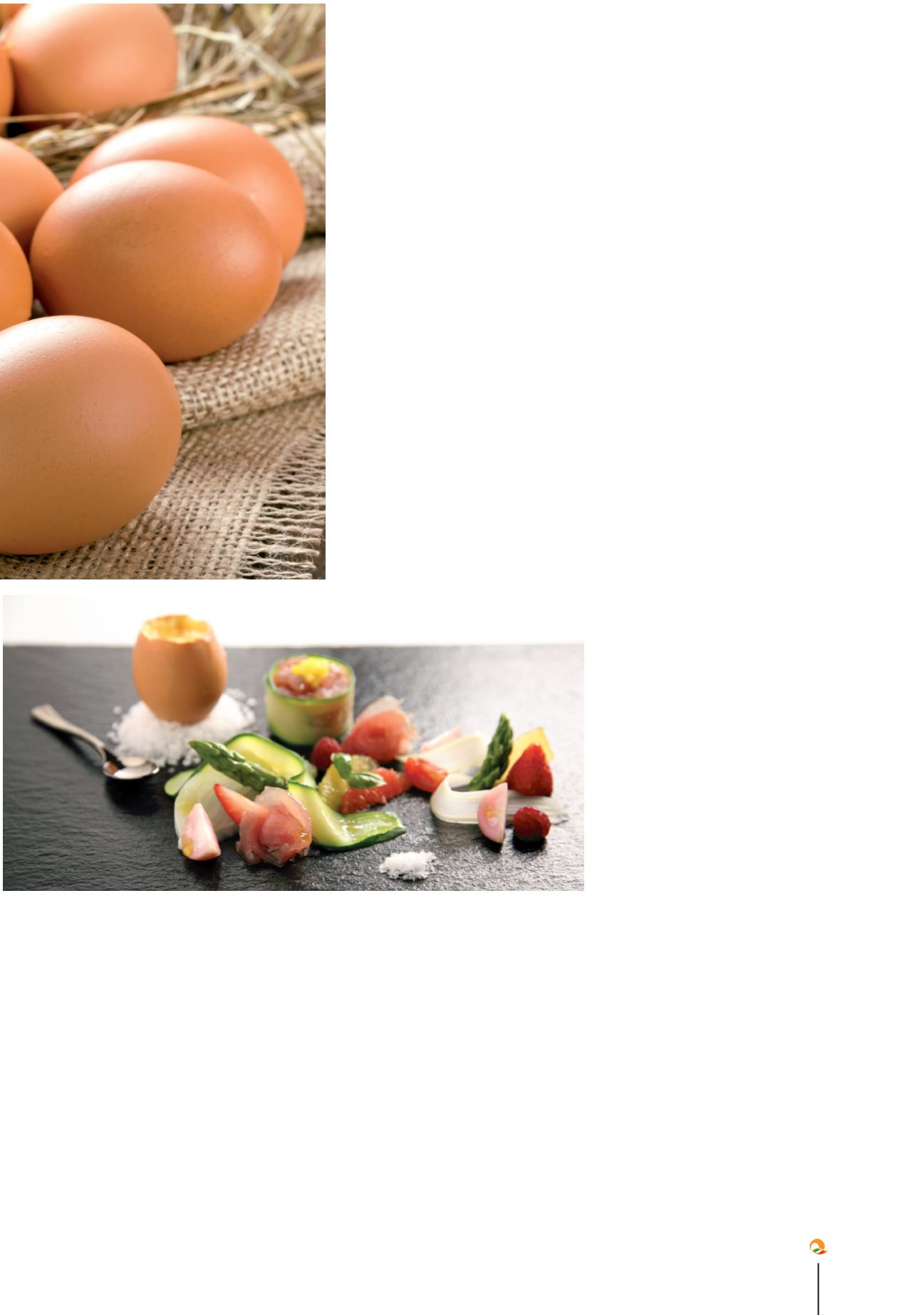
Cooked egg
cream with salad
with fruits and
vegetables, raw
tuna
Cook Author: Danilo Angè - Milan
Ingredients for 4 people:
No eggs. 4; Dl milk. 1; Parmesan g. 30;
G pine nuts. 50; Nutmeg; Mango g. 200;
Strawberries g. 100;
No grapefruit. 1; G green asparagus.
200; G zucchini. 200; Radishes g. 100;
G celery. 100; White wine vinegar dl. 2;
Bay leaves n. 2; Peppercorns; Tuna fillet
g. 400; Extra virgin olive oil; Salt and
pepper; Salt crystals.
Proceedings
With the special tool to cut the top cap
of the eggs, the shells and wash with
warm water and vinegar, let it dry.
Beat the eggs with nutmeg, milk, salt,
pepper and parmesan cheese.
Fill the shells with the mixture, toasted
pine nuts and cook in the oven for 4
minutes, let cool, sprinkle with sugar
and then brown in grill.
Cut the vegetables into slices and cook
in the oven for about three minutes with
vinegar and bay leaf, cool them and
season with salt, pepper, olive oil and
grapefruit juice.
Place the egg on a serving dish, place
the cut fruit, vegetables, tuna sliced
and seasoned with pepper, oil and salt
crystals.