GIU.LUG 2014
VII
dente”. Merit of particular grains such
as wheat Cronos that we use, excellent
quality and gives a nice straw color to
the dough. “But aside from the classics,
which formats are most appreciated by
customers? “For example, the traditional
Garganelli, format typical of Emilia, a
pasta and grain Cronos also suitable
for double firing, which we produce
in small, medium, or in a” straw and
hay “. We have studied a particular
processing method, which allows the
perfect closing and overlap the edges
of the Garganello, allowing you to cook
on duty also the central point. That’s
a format that also really likes the U.S.,
Canada and England. Just as the weeds
are special or Torchietti, very suitable
because they do a lot of volume in the
pot and keep the sauce, or the striped
butterfly, which, thanks to the stripes
become more tenacious in cooking and
collects fine sauces. Very interesting
finally queens, noodles jagged sides
for which we have studied a particular
system of shearing that causes these
teeth remain intact during firing.”
Giuseppe Congia - sales manager
of Cellino Pasta, Pasta Di Sardegna
with the brand which, while selling
all over the world has the bulk of its
professional customers in the island - is
unanimous: the cooking resistance first.
“On this aspect we are able to provide
excellent performance from the dough
to the caterer, thanks to the selection
of the best grains. Our experts evaluate
the color of the grain that needs to
be light yellow, indicating the wealth
of gluten proteins, the consistency of
the ear, the caliber of the grains, their
surface, the absence of stains or dirt.
All elements that allow us to produce
a paste with a high content glutamic,
which along with other items such as
care in the drying process, resulting in
a tight fit in cooking. The restaurant
appreciates above all, from our Classics
line, formats that have always been the
most loved: spaghetti, penne drawn
to the bronze fusilli. Usually packages
are focused on not too large: from
half a pound to 2 pounds and that
means, no later than otherwise are
less manageable. Consumption? As far
as we are concerned are absolutely
constant.”Pasta, therefore, continues to
be a food solution to high popularity.
The reason for the bronze dies
It’s a theme that has been always
debated, the difference between the
dough for bronze dies and the Teflon.
The first is rougher, the second is
smoother.
“In general - says Fernando D’Aviero of
Pasta Rummo - we can say that pasta
extruded through bronze has a higher
roughness than the other and then binds
better to the toppings. On the other
hand, there are some types of pasta that
is almost impossible to drawing bronze,
although in about 80% of our production
formats are produced with this system.”
The smoother surface of the pasta
extruded Teflon makes it suitable sauces
with less structured.
“In any case, the quality of our pasta
– D’Aviero resumes - is guaranteed by
Slow Processing Method ®: A unique
method born of the wisdom of six
generations of pasta and based on the
awareness that in order to produce
a high-quality pasta is necessary to
respect the rhythms of nature: the long
lead times of dough are in fact needed
to work the finest durum wheat, the
only ones capable of ensuring the right
protein to the pasta and give it kept
firing.”
Tasting technique
How to recognize quality pasta? Here
are some simple actions to a technical
tasting dish loved by most Italians.
t $PPL QBTUB BDDPSEJOH DPPLJOH UJNFT
t %SBJO BOE QPVS JOUP B EJTI XJUIPVU
dressing
t 0CTFSWF UIF DPMPS XIJDI JO UIF DBTF
of durum wheat pasta should be a pale
yellow
t 5BTUF BOE DIFDL UIF DPPLJOH
resistance, roughness, stickiness, taste,
yield
t $PNQBSF UIJT TZTUFN XJUI EJGGFSFOU
brands of the same type of pasta
Pasta Museum
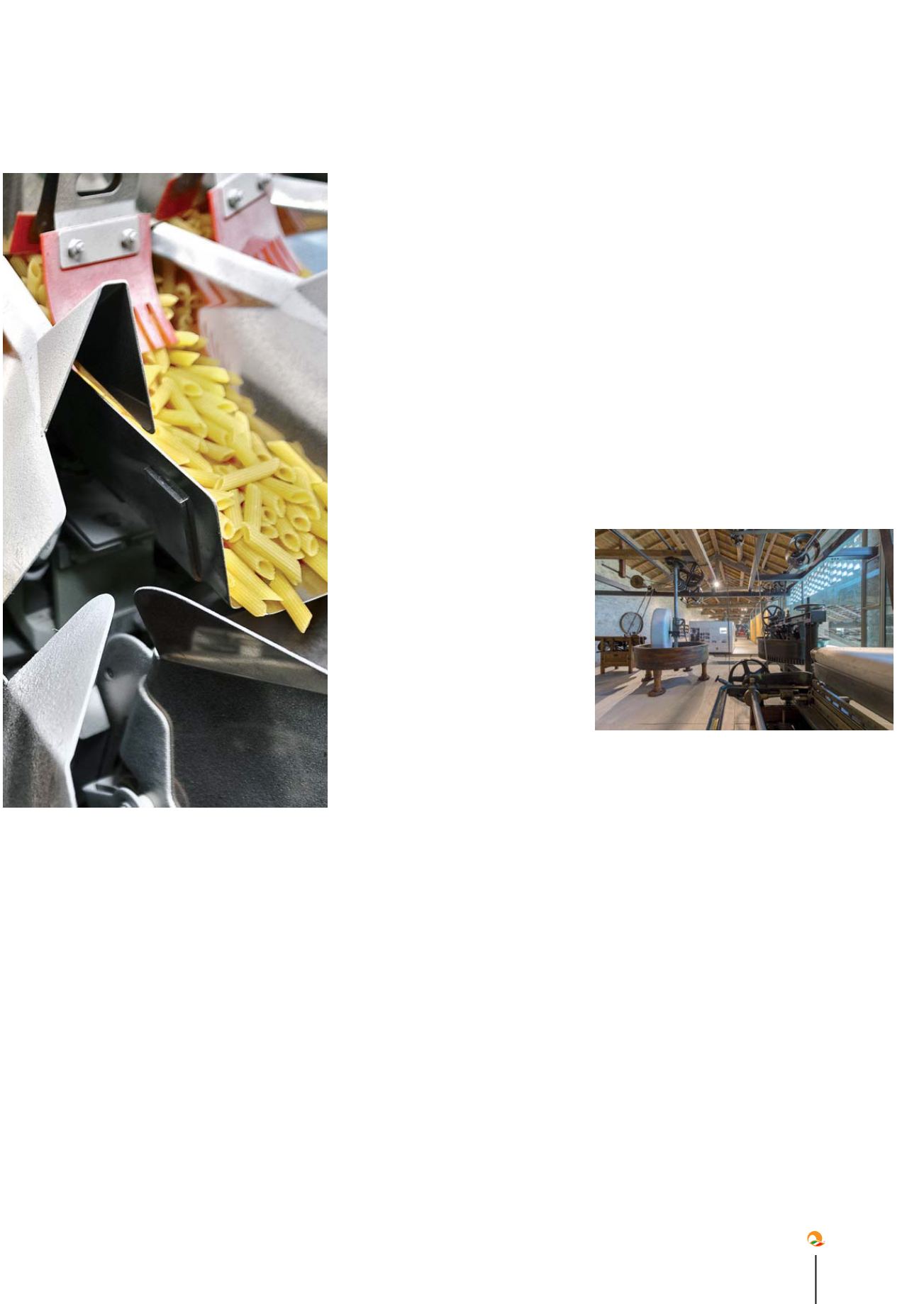
In Emilia Romagna, the circuit of the
Museum of Food grows with a major
new exhibition dedicated to the food
symbol of Italian: in May was born
Pasta Museum, inside the magnificent
medieval court agricultural Giarola
(Collecchio, Pr), alongside the existing
Tomato Museum.
Inside the museum, as well as the
history of the product throughout
its supply chain space are unique
items, such as the oldest dated 1837
sample of industrial pasta or a pasta
factory original and full of mid-800
fully restored thanks to the voluntary
contribution Associazione delle
Medaglie d’Oro Barilla (Association of
Gold Medals Barilla), relocated here.
Add to this curious collection of objects
related to the pasta as delphiniums
for the processing of artisanal or the
more common pasta colander, to the
collection of 100 of the most significant
formats with their dies.
Tel 333.2362839 - Fax +39.0521.821139
- E-mail: prenotazioni.pasta@
museidelcibo.it


