DEC.JAN 2014
XII
on how we treat it, first of all to reach
the ideal temperature.
Never turn on the gas quickly, to avoid
an unexpected thermal shock. First you
have to heat the fat so sweet then the
temperature is raised. When we realize
that the oil is smoking as soon as it
reaches the temperature, you normally
wonder why. Still, you answer, we’ve
changed recently, we have fried a few
times, ... and so ‘on. You have instead
to ask yourself how many times it has
been filtered.
The particles of flour, meat protein
and fish, bread crumb and so on. In
fact, if they are in a previous oil for
frying, they begin to blacken already
at about 75 °, losing the property fast
. Increasing the temperature they
become dark, they send acrid and
unpleasant tastes. So to recover, the oil
must be filtered well and it is a good
rule to decant and filter the good work
after each frying fat.
BUTTer? as Long as iT geTs
cLariFied
We hear more and more often clarified
butter, so that it can be found in ready
packs, although many people do not
really know what it is. The butter
is composed of parts of water, fat,
and protein (casein). Clarify means
eliminating as much as possible the
protein and water in order to make
it as pure as possible so resistant to
high temperatures (the smoke point
of the butter is normally between 120
and 160 ° C, while that of the clarified
butter is around 250 ° C). To clarify
the butter, it should be melted in a
double boiler or very gentle heat it at
a constant temperature of about 65 °
C. After about 30-40 minutes the water
evaporates and you notice that the
casein settles to the bottom: the above
surfaced is the clarified butter. At this
point must be filled into a glass jar
with a lot of care and should be left to
solidify in the refrigerator.
WhaT is The ideaL
TemperaTUre For Frying?
The smoke point of the oil is at 190 ° C,
except the lard that is resistant to much
higher temperatures. There are then
other fats, such as cocoa butter, which
has the smoke point at 230 ° C, the
extra virgin olive oil at 210 ° C and the
clarified butter, as already said, to 225
° C. The ideal temperature for frying is
therefore lower than the smoke point, in
varying degrees depending on the food
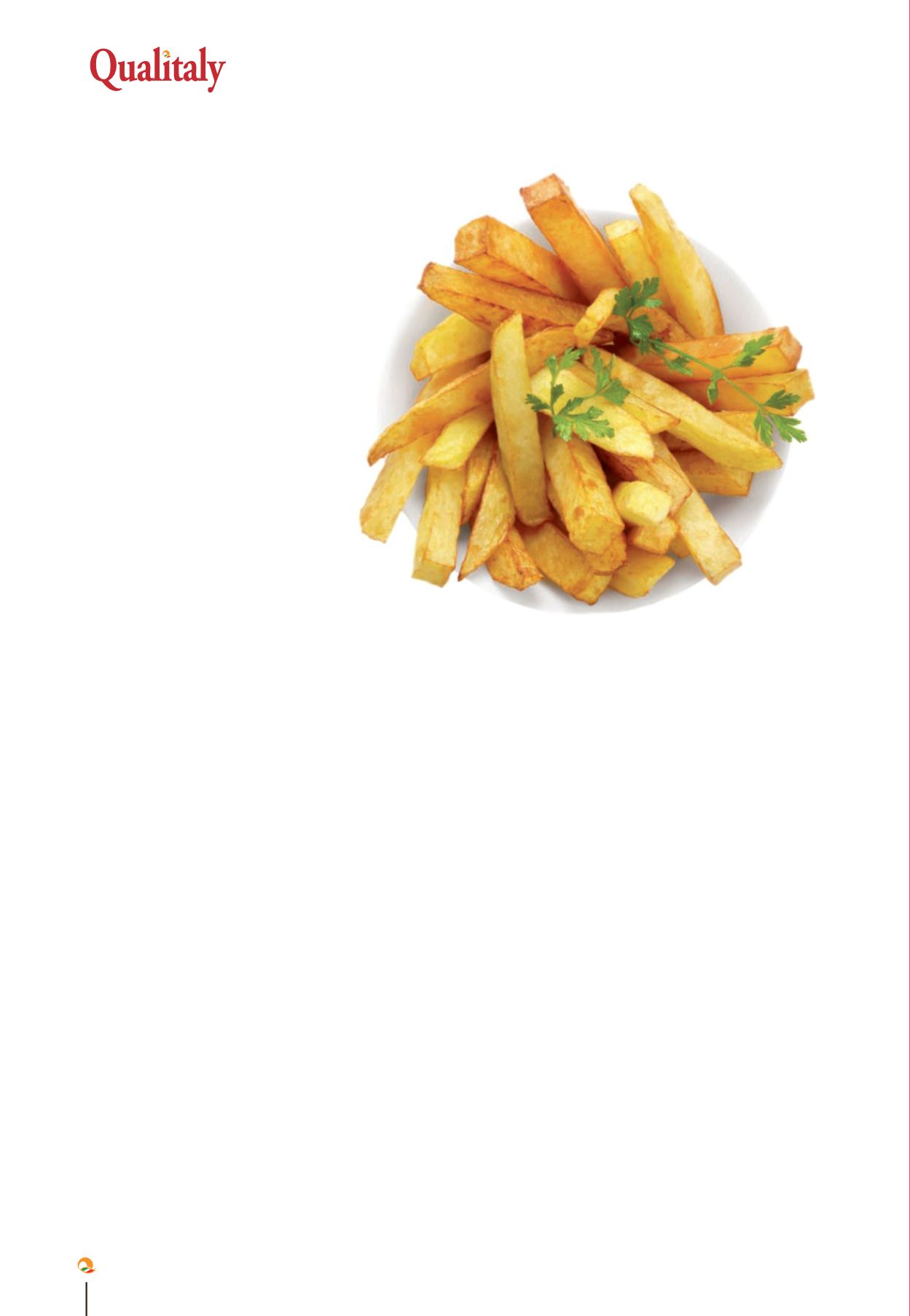
to be fried. Potatoes, for example, must
be immersed at 130-140 ° until cooked.
After a cooling phase must be brought
to higher temperature for a few minutes.
hoW mUch oiL is needed For
Frying?
It is “the” question with regard to
frying. You never know if it takes so
little oil or, if it must be very hot or
hot and for what uses. Let’s do a bit of
clarity. First, the oil must be abundant
as the grain size is large fry, the more
the oil must be plentiful and hot.
Yes, you read right: most pieces are
large; the more the oil must be warm.
I explain why. If you dip a piece into
the hot oil but not too big, it happens
that the outer crust is not formed
quickly, creating a layer “barrier”
to the oil. Conversely, lowering the
temperature, the piece of food is
soaked in oil. If the oil is very hot
you form a crispy crust outside of the
product, which lowers the temperature
of the oil cooler allowing proper
cooking.
Box
recommendaTions For The Use
oF oiLs and FaTs For Frying
1) Use only for frying oils or fats
suitable for such treatment because
they are more resistant to heat.
2) Maintaining an adequate preparation
of the food to be fried, avoiding as
much as possible the presence of
water and adding salt and spices that
accelerate the deterioration of oils
and fats. The salt and spices should
be added to the food, preferably after
frying.
3) Avoid absolutely the oil temperature
exceeds 180 ° C. Temperatures
above 180 ° C in fact accelerate the
deterioration of oils and fats. It should
then fit the fryer with a thermostat.
4) After frying is good to facilitate the
elimination by draining the excess oil
absorbed by the food.
5) Provide for frequent replacement of
oils and fats. Monitoring the quality
of the oil during frying, keeping in
mind that a lot of oil used can already
recognize, viscosity and tendency to
produce smoke during frying.
6) Filter the oil used to fry if you still
act, on suitable systems and / or inert
substances (filter aids), thoroughly
clean the filter and the oil pan. The
charred crust, the viscous oily residue
or remains of old oil accelerate the
deterioration of the oil.
7) Avoid strictly the practice of
“topping up” (adding fresh oil, used
oil). The fresh oil is altered much more
quickly in contact with used oil.
MAGAZINE


