JUN. JUL. 2013
III
of negotiations, fallen is one of the
non-tariff barriers that prevent the
full development of Italian exports of
meats in the world.
From May 28 last year, in fact, salami,
bacon cups and other meats at early
age can be exported to the U.S.,
following the decision by which the
U.S. authorities of APHIS (Animal and
Plant Health Inspection Service) have
officially recognized the benefits of
Lombardy, Emilia-Romagna, Veneto,
Piemonte and the autonomous
provinces of Trento and Bolzano from
swine vesicular disease.
“It is a first important result of
the path taken by Assica (the
Association which brings together
the manufacturers and processors of
meat sausages) to start exporting to
the United States of important Italian
delicatessen products such as salami,
bacon, cup or the culatelloı”, said
the President of the association, Lisa
Ferrarini. “In the U.S. the knowledge
of Italian is widespread (and our
products are also much imitated):
Italian food products are particularly
popular as evidenced by the purchase
of cured hams, cooked hams and
mortadella, since different years, can
be exported.”
More secure the new
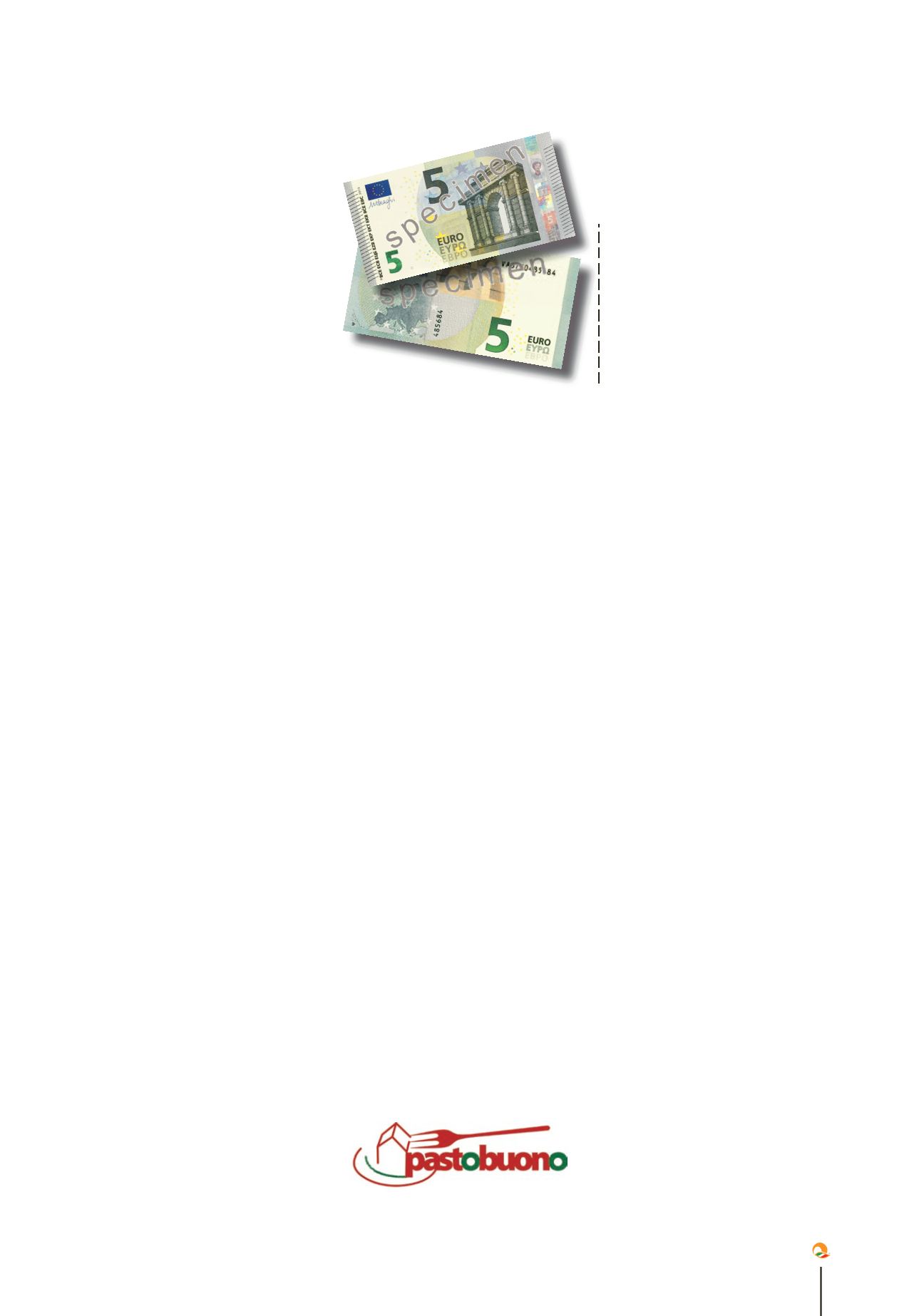
5-euro bill
With the introduction, on May
2nd, from 5-euro banknote series
of the new Europe is playing the
replacement phase of the first series
of the European currency. The new
banknote € 5 - said in a statement the
European Central Bank - is the result
of technological progress in this area
since the introduction of the first
series, over ten years ago. In the bill
have been incorporated some new
security features and advanced.
The watermark and the hologram
picture the portrait of Europe, a figure
of Greek mythology from which the
series take its name. The “number
emerald green,” the most obvious, it
changes color from emerald green to
dark blue and has the effect of a light
that moves vertically. On the left and
right margins are perceptible dashes
out that facilitate the recognition of
the business, especially for people
with visual impairments. Those safety
features, located on the front of the
new bill, can be verified easily by
applying the “feel-look-tilt” and they
are expected to be integrated into all
the tickets of the series “Europe”
When communicating to the
professional categories that handle
daily banknotes, the Eurosystem
(formed by the ECB and the national
central banks) recalled that the
first task of those who receive and
handle bills is to make sure of their
authenticity.
In the first half of 2012 a total of
251,000 counterfeit euro banknotes
were withdrawn from circulation.
Compared to the number of genuine
banknotes in circulation (on average
14.6 billion during the first half of
2012), the proportion of counterfeits
remains very low.
Bills from € 5 of the first series will
continue to circulate along with the
new notes, but they will be gradually
withdrawn from circulation. The date
on which they won’t be legal anymore
will be announced well in advance.
Even after that date they will hold
their value indefinitely and they can
be changed at any time from the
national central banks of the euro
area.
Pasto Buono against
hunger and food waste
According to research at Politecnico
of Milano, in Italy there are 6 million
tonnes, with a value of 12.3 billion
euros, food surpluses generated more
than 55% from the food chain and
the remaining part of the domestic
consumption. Of these, almost 50% is
recoverable for human consumption
with relative ease, indicating
approximately 3.2 million tonnes per
annum those defined as “medium
and high functionality”, quickly and
perfectly recoverable for human
consumption. Although, only the 6%
of surplus are recovered to be donated
and distributed to the needy.
When the surplus still good is not
recovered, it becomes waste.
The figures relate more difficult
to process the waste of small food
businesses (bars, small eateries, etc..),
Which still stood on a yearly average
of 100 kg for each individual asset.
Pasto Buono (good meal), the project
developed by Qui Foundation (the
Foundation of Qui Group) and active
in Rome, Genoa and Florence, is to
avoid waste and transform them into
resources to support needy people
and families in need, providing them
with all or part of the requirements
daily food needed to ensure a healthy
and balanced diet. Good meal plans to
give a positive contribution to a more
efficient management of surplus and
more responsible towards society and
the environment.
Pasto Buono has four objectives,
which correspond to each of the
areas of intervention and specific
actions distinct: the best use of
the food resources and eliminate
waste, supporting people in need,
protect and defend the dignity of
the family intimacy, and promote
culture of solidarity, responsibility
and collaboration at all levels of civil
society.
Operationally, Pasto Buono, which in
2012 has distributed 50,000 meals to
needy families, creates a network of
operators who daily put aside in favor
of beneficiaries of the surplus food, of
course, in perfect condition, instead
of deleting them with your household
waste.
It also organizes the logistics for the
distribution of surplus, informs and
gives a cultural and practical support
to families and operators to improve
their eating habits and significantly
reduce waste and the production
of waste and finally aggregates and
awareness around the project all
subjects and operators, public and
private, who for various reasons are
called into question and may or may
wish to participate in the project.
Mineral water at the
restaurant, a glass bottle
is better
The analysis carried out by Web-
Research.it conversations on the
web relating to the purchase and
consumption of mineral water in the
restaurant clearly see that the overall


