APR. MAG. 2013
IV
Catering and banquet
in front of the law
by Francesca Pulitanò
First of all, a clarification: talking about
catering and banqueting is not exactly
the same thing. The catering can be
technically defined as a task of serving
food and beverages (English, ‘to cater’) at
the consumer’s home.
The word, in this sense, primarily refers
to the prepared meals in canteens
in general (corporate, school, public
bodies, etc...) The word banqueting
however, more specifically alludes to
the preparation of meals aimed at the
celebration of special events (such as
weddings or exhibitions), and therefore
the term also includes all activities
structurally boundary, such as the
preparation of the tables or the buffet,
the service at the tables, the chairs
arrangement, tablecloths, cutlery and
crockery, and the final reorganization.
In both cases, the lawyer needs to
manage the problem of framing the
concrete situation in a type of contract.
Purpose can be found in two contracts
governed by the Civil Code: the first is
the service contract, art. 1655, which
states “The contract is a contract
whereby one party assumes, with the
organization and with the necessary
resources and management at its own
risk, the completion of a work or service
for a consideration in money” (in our
case , who gives the task takes the role
of the buyer, while the restaurateur the
role of the contractor). There is, however,
who sees more things in common with
another type of contract. It would be the
one of the administration that, under
Article. 1559 cc, is “a contract whereby
one party undertakes, for consideration
of a price, to execute in favor of the
other, periodic and ongoing performance
of things.” A thesis intermediate sees,
in the agreements of catering and
banqueting, mixed contracts consisting,
in fact, a combination of administration
and procurement.
Now, the importance of giving a legal
status in this type of relationship is
obvious. In the case of disputes they just
go with the most appropriate remedy.
Our code provides general guidance
in several places for the execution
of contracts. It may be recalled the
obligation of diligence in art. 1176,
which may fall within the fulfillment of
the quality requirements on products
supplied or, in the same order of ideas,
the obligation to compensate the
damage, as imposed, pursuant to art.
1218, to who does not fulfill exactly.
In fact, the principle of freedom
recognition of the contract means
that the parties may resort to specific
agreements relating to the concrete
supply: for example, you can stipulate
that the termination of the contract may
be requested by the restaurant in case
that the customer presents a number of
covered much less than those initially
agreed. For the same case, it may be a
system of retention of the deposit.
In short, the right “take a look” at
someone else’s party, is ready to
intervene to resolve the difficulties!
AT PAGE 22
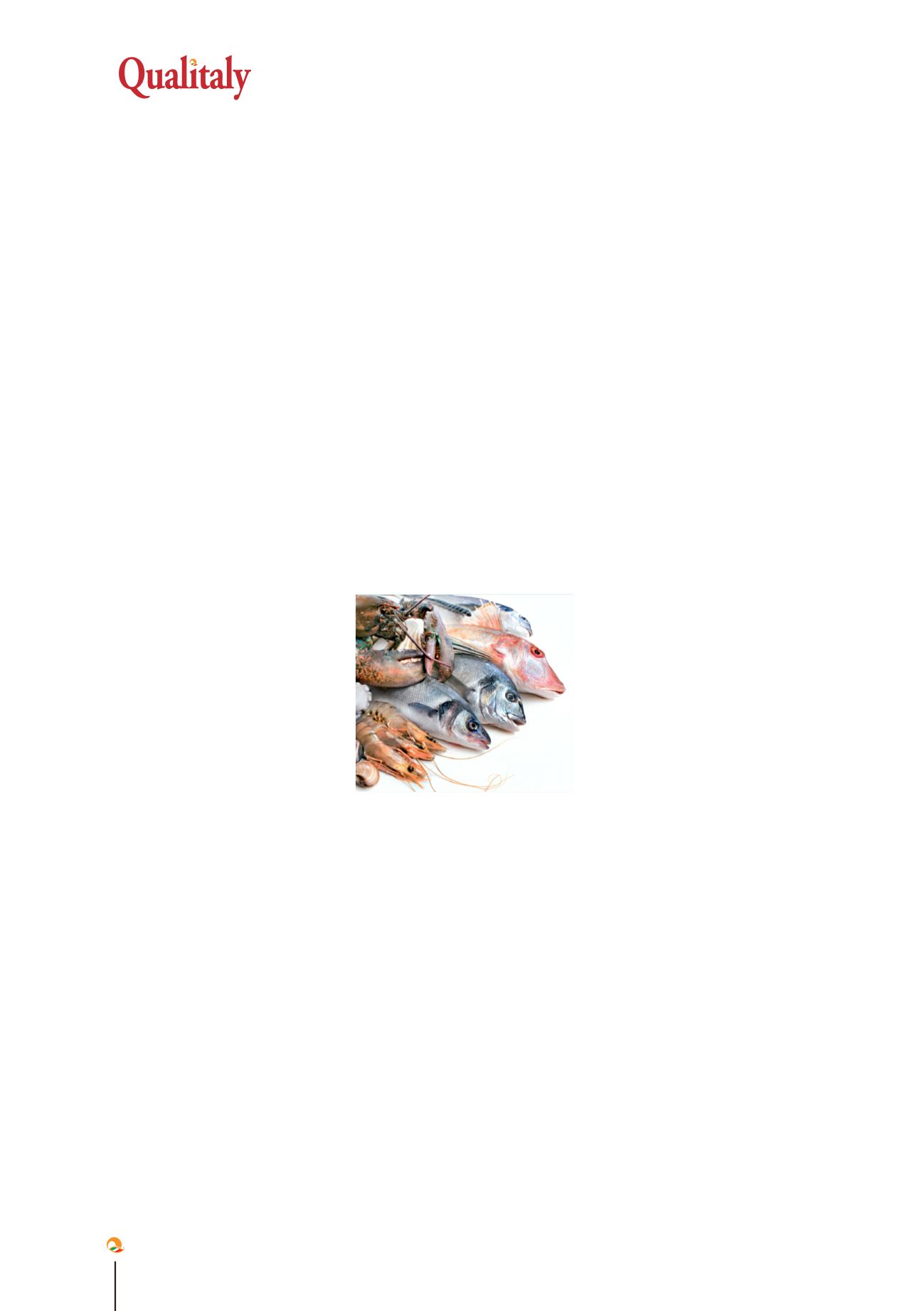
Fish, from the
frozen some quality
responses
We are talking about an evolving
market, which finds in the product
subzero an appropriate response
in terms of efficiency and service
for catering. It needs to know how
to choose, with the support of its
suppliers.
by Mariella Boni
Among the major proposals in the menu
of a restaurant, fish is definitely one of
those. It’s a valuable product for flavor,
lightness, nutritional quality, variety of
species and gastronomic versatility.
Nevertheless, the fish market is now
facing different important changes. Prices
continue to be high for consumers who
cut their food consumption, and this
in spite of some fish species that have
even seen lower figures about cards (for
example, according to ImpresaPesca
Coldiretti mussels record prices -3%,
cuttlefish -1%). In catering, the situation
is equally complex: on one hand, the
customer appreciates the fish product
and its qualities of freshness; on the
other hand he is less and less inclined to
spend to get them or he does so with a
great deal of attention to the price.
In addiction, basis for a reform are
launched by the European Parliament,
which in February approved a reform
of the Common Fisheries Policy, which
aims sustainability. The reform has a
legislation that will come into force in
2014. They put a brake on overfishing
stopping the “rejection”, which means
that they discharge into the sea
specimens that are not required by the
market, or specimens that are considered
too small. From 2015 on, States Member
won’t be allowed to establish too high
quotes. Also it won’t be allowed to
capture more than a certain number of
specimens per species, determined by
the ability of reproduction of the same
species.
The future may bring, therefore - even if
temporarily, as it is expected a recovery
of fish stocks by 2020 - at a lower
availability of fresh fish or the need to
consult a frozen product, which also
provides the consumer with excellent
quality assurance.
We spoke with Valentina Tepedino,
a veterinary, specialist on technical
consultant and lecturer for the body
of the Harbor for issues related to the
verification of labeling and identification
of species of fish products.
“From experience I believe that this
reform will affect only long-term because
in the fisheries sector it’s very difficult to
apply reforms. It is also true that it’s hard
to control all points of discharge. For
some it is a useful reform, both to protect
the environment and the consumer. The
problem is that the reality of the Italian
fishing is widespread, consisting of small
boats. The individual fishermen have a
little entrepreneurial mindset so then it’s
hard to fit that into these new rules. The
market for fish product essentially does
the wholesaler, which is what I know
how to adapt to the labeling, and then
select the product is indeed capable of
enhancing the national catch. “
Also, Paolo Cariglino, from the
eponymous company, breaks a lance
in favor of the frozen product quality.
“In our culture, you can still see the
frozen as an inferior product in a cool
place. However, this is an injury as the
cold technology is a natural ally of great
quality. Fish are comparable in quality
to the cool of the day, which is now less
and less because there are hardly any
fishermen who go and come back within
12 hours: to optimize the fishing vessels
are now out on the water 4 or 5 days if
no more. “
To have an opinion from who selects the
fish product and distributes the world of
wholesalers we asked Luciano Ciapetti,
commercial director of Gelpiave, a
company specialized in the supply and
marketing of frozen and chilled foods.
“The types of products sought by the
restaurant are made mostly of octopus,
cuttlefish and squid, although there
are many other interesting varieties.
In general however, what requires
refreshing, rather than new fish species,
is a product of high value service. In this
way, the restaurant aims to save on the
cost of labor, however, running the risk
of a standardization proposal.
I would like to underline that,
considering the poverty of our seas,
magazine


