APR. MAG. 2013
V
the frozen fish product is definitely
an important resource of high quality,
organoleptic characteristics equal to
fresh.”
Vincenzo Santapaola, New Vecagel
adds: “We are specialized both on the
fresh product and on the frozen or
thawed. I do not know if this provision
may create major problems, however
today the market is global and there
are varieties that are imported from
other countries. Today food is oriented
towards the frozen, which suffers
less fluctuations in price and it is
often more manageable, even from an
economic point of view.”
L
et’s listen to the expert GREGORI
NALON
Choosing fish without failing
There are many species of fish that
could be better used at home and
outside. In fact, the majority of fish
sold in restaurants is limited to tuna,
salmon, sea bream and sea bass. It is a
problem of consumer culture. People
may choose the bass - mostly farming -
and snub completely of all the recipes
for mackerel, caught in the open sea
instead. This doesn’t mean that people
do not like mackerel. The proof is in
the fact that the box has a thriving
market.
People should change their mentality;
they should propose alternative
species, which offer the advantage of
a good price to the restaurateur. In
this way the food cost of a fish’s plate
could lead to an acceptable sale price
in the menu for the consumer, even
during these difficult times. In this
complex market - where the prospect
is the decline of wild fish with the
result in price increases - frozen fish
represents a resource for restoration.
Only those who have the necessary
skills to treat fresh (which before to be
cooked should be cleaned, portioned,
filleted, preserved, etc.) and aimed to
a high target, can afford to continue to
buy fresh fish. In fact, the frozen offers
some advantages to the restaurateur,
beyond the price: first of all the fact
that they give less problems-side
management Haccp than fresh. Anyway
you must know how to choose wisely,
keeping an eye on some parameters.
The price, for example: if it is too low
it generally identifies a product of
lower level. Then there’s the size: a
fillet of fish of good size is better than
small ones, even if this is not enough
to determine the quality. It should be
indicated on the label then if the fish is
frozen or farmed. Finally, we have the
icing, a film of water that surrounds
the frozen product. It must specify the
percentage, of course. It’s usually better
to focus on the lowest percentage,
usually 10% is acceptable, even if the
new technologies are freezing products
icing zero.
AT PAGE 26
Fish Market,
a global situation
After the Boston international fair,
some reflections on the dynamics
and international flows supplying.
by Fabrizio Gomarasca
The International Boston Seafoods
Show is one of the main international
events for the fish market. Over 19,000
buyers and suppliers in the three-day
event (March 10 to 12 last year) have
visited the 107 exhibitors coming from
64 countries.
“Even if the show is oriented to the
U.S. market - says Mauro Guernieri,
general manager of Cooperative Italian
Catering, who visited the fair with
a group of associates and managers
of the cooperative - is an important
opportunity to strengthen ties with
our international suppliers and verify
interesting products to offer to our
members.” Mostly, it was confirmed
how much they’re changing the
dynamics of fish in the international
market, a market, says Guernieri, “that
is highly speculative, in the sense
that it is particularly sensitive to the
fluctuations in demand, driving the
presence or absence on the market of
certain species of fish at reasonable
prices. In fact, at this moment it is
difficult to understand the trends of the
market.” An example is the tuna. As
soon as they realize a decrease in the
amount of fish available on the market,
it is automatically diverted to Japan,
where the tuna can not be missing
at any cost. The same applies to the
octopus, which in the United States is
not appreciated at all.
At the same time, however, there are
high volumes of cephalopods and squid
in the first place that, for example in
Italy, are some of the most popular
products. “The reason is that the
species at the top of the food chain
are decreasing - explained Guernieri
– mostly sharks, which are the first of
the squid predators. So we have a high
volume of these cephalopods. And in
this case we get to the selection phase
of supply .
What are the prospects of a market that
is this global? “I think the criticality
of supply could come from the fact
that two large countries, such as
China and India begin to increase the
demand for fish. Today this is not the
case, but in the future it could cause
actual movements of supply at the
international level.
AT PAGE 28
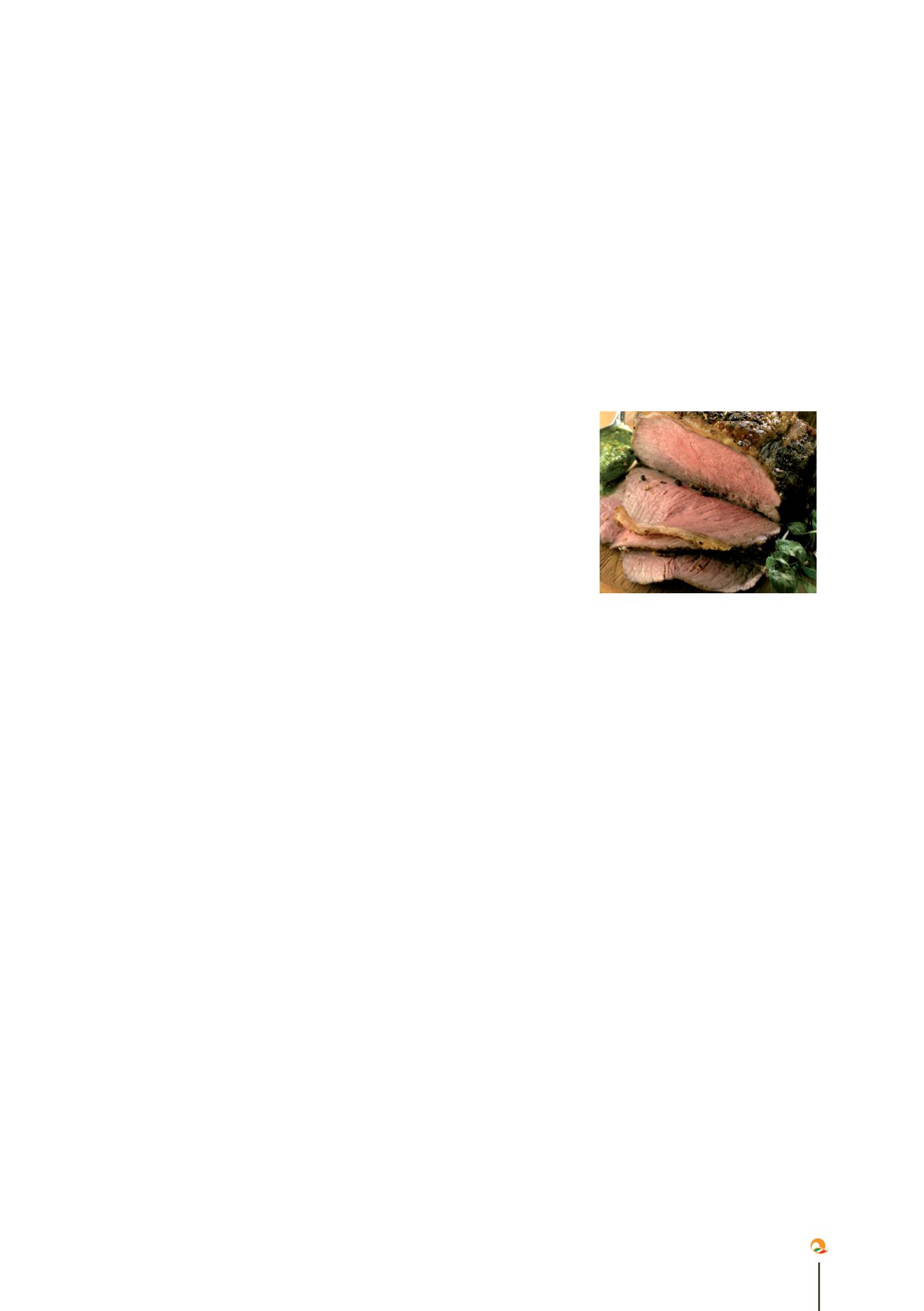
Irish meat, the reason
for a choice.
It’s product availability,
organoleptic characteristics,
livestock grazing and strict controls.
The meat sector in Ireland is getting
more and more appreciated by the
most renowned chefs.
by Fabrizio Gomarasca
Italy imports about 500.000 tones of
meat each year. Of these, approximately
10% (50 thousand tons) come from
Ireland. It’s a country of 4 million
people, which produces as much meat
as the Italian imports are. Also it has
made agriculture the first sector of
the country’s economy. Cooperative
Italian Catering chose Irish beef for its
customers and restaurateurs. Of course
it was not a reckless choice, but the
result of a careful selection that twice
got a group of members to visit the
farms, the units of slaughtering and the
processing. They had the opportunity
to see the current standards and strict
process controls that govern the Irish
meat industry. “There are four reasons
that we can identify as Irish beef plus”
explains the director of Bord Bia in Italy
John Keane (Bord Bia, for those who
do not know, is the organization for the
promotion of agro-Irish abroad, which in
2012 exceeded 9 billion euro of exports).
“In the first place there is availability.
The agricultural vocation of Ireland is
to produce meat. In a global market
where there is a structural shortage of
meat, Ireland ensures a high production
constant. It follows that for our agro-
export system is a necessity. The Irish
meat is then universally considered
high quality. We produce cattle that are
slaughtered at 20-24 months and give
a tender meat with a high fat adequate
to make it tasty. That’s also because the
livestock is bred for almost the whole
year grazing: the grass that animals eat
gives a darker color to the meat, but also
it gives a special savory taste. It makes it
less fat and low in calories, more rich in


