


 62 / 76

FEB. MAR. 2017
II
to the research firm Jfc, which for
this subject interviewed 60 owners
and analysed the budgets of 50 of the
334 Italian starred restaurants for the
2016 edition, obtaining recognition
transforms the life of a restaurant,
determining in the first “starred”
year an increase in turnover of
53.2%. “When you get the first star,
the second and the third star, your
working life profoundly changes”
– said Michael Ellis, international
director of Michelin guides, to
Vanity Fair in 2015. And to change
the ‘working life’ of the restaurants
social network also know about it.
Precisely in this way: the infinite
ocean of information available on
social networks has become the
new PR of our millennium and can
make the difference for a restaurant.
Today, nobody can ignore this
communication channel. Woe is not
to employ Social Media Manager (p.
18)! Another problem for the manager
that has to already stretch in search
of table and kitchen staff especially
due to labour costs that in Italy
becomes increasingly prohibitive.
How to exit from the impasse? In the
article on p. 26 we try to give some
practical advice. And then there are
those who have already made it even
without our advice. Indeed, there
was much to say – and much was
said to us – in an open interview in
which he explained to us how success
came starting from a little personal
dream … He is Giuliano Baldessari
(p. 30), and is the owner and chef
of “Aqua Crua” (a Michelin star) in
Barbarano Vicentino, in the Berici
Hills. Alongside him we hope that
also this edition of Qualitaly can be
the inspiration for your work!
Enjoy your read
By Lorenzo Morelli
AT PAGE 6
QI News
Coldiretti:
21% of food waste
originates from food
& beverage
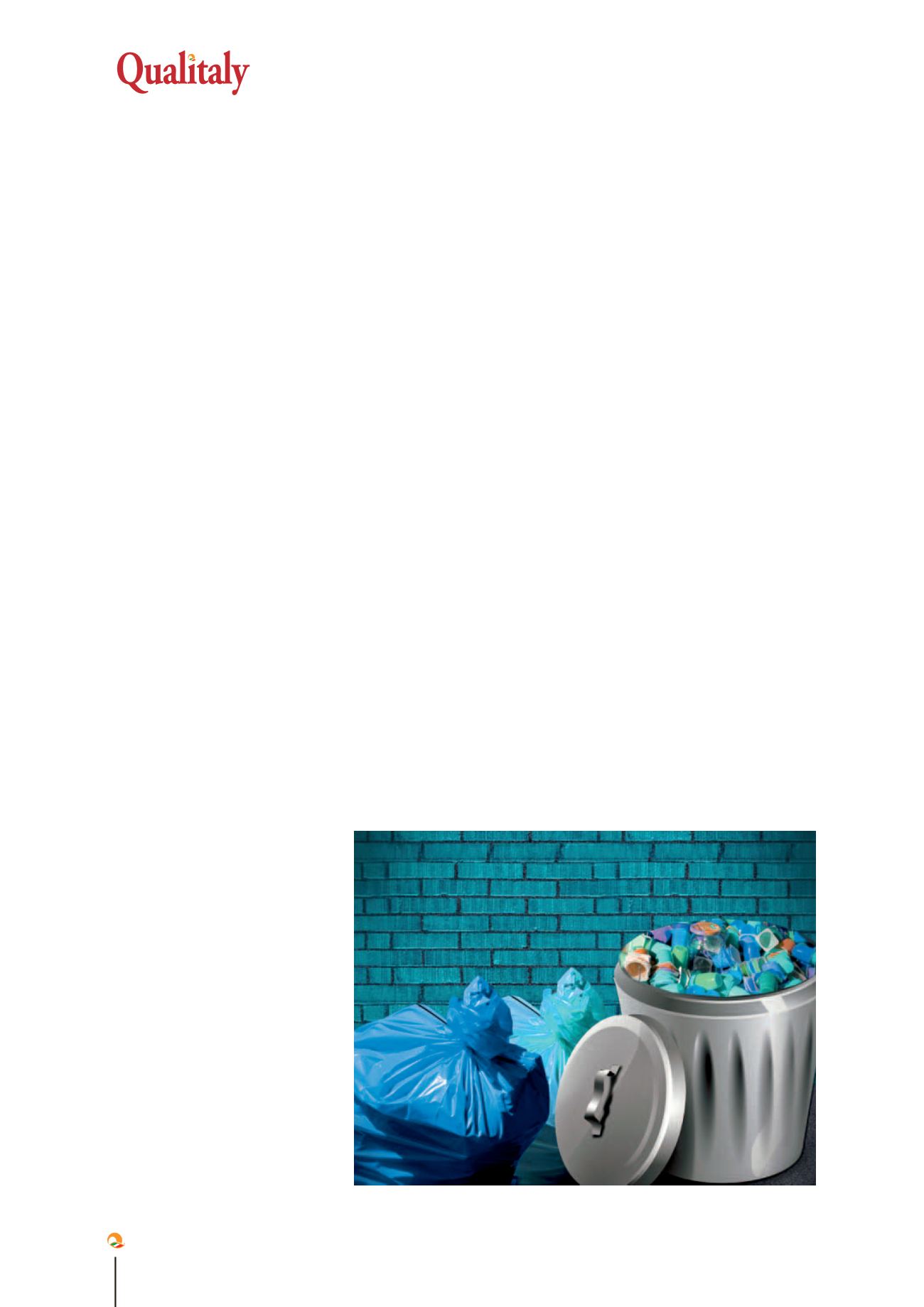
According to one survey Coldiretti/
Ixè, if the domestic wastes represent
in value as much as 54% of the
total, those in the food & beverage
constitute 21% of the phenomenon.
A value still very significant that
the new law 166/16 on food waste
has tried to curb by promoting “the
use by operators in the field of
catering, reusable containers suitable
to allow customers to take away
the leftovers”, the so-called family
bag. A commitment that has yet
to be strengthened in Italy where,
according to the survey Coldiretti/Ixè,
against a 36% of Italians who leads
to the house at least the scrap with
the so-called “family bag”, the 22%
still believe that request it from both
rude, poor fellows and the vernacular.
Complete the picture 18% of Italians
that says not to leave any surplus
when going out to eat. In the face of
this new requirement – says Coldiretti
– the food & beverage readies
itself and in a growing number of
exercises, to avoid embarrassment,
asks riservatamente the customer if
they want to bring home the food or
bottles of wine not finished, and are
put at the disposal containers or trays
ad hoc often made with recyclable
material and with pleasant design.
Ask to bring home the advanced food
when you go out to eat behavior is
very widespread in other countries
from the United States where – Refers
Coldiretti – The cartoccio scrap is an
established practice for the same Vip.
Food & Trends: from Asia comes
the mini food
New trends they make their way
through the fact of food. To detect
it is the site republic. It explains
how from Asia you are appreciating
the fashion of the “mini food”
(also called “Tiny Food”). “guilty”
diffusion, social media as Instagram,
Pinterest, Facebook and Youtube
where there are a lot of channels
– including Mimine Mini, Pocket
Resort and thumbnails Space – that
have video with the creation of
small delicacies and get a number
of views inexplicably high. Movies
that – and this is the beautiful – they
are not only virtuosisms to watch
with a bit of fun and scepticism, but
delicacies edible absolutely declined
in all possible variants of a complete
menu: from starter to a dish of pasta,
meat, fish, sushi and even cakes and
pastries. In Italy At the moment –
observes
republic.it– nobody seems
to have still competed with the Mini
Food, but the trend that leads to
miniaturize the food is not entirely
new and refers to the more known
finger food, which at least in size
recalls the asian trend, but with the
appropriate differences: “In both
cases” explains the chef Gianluca
Tomasi, director of the University
of Italian cuisine of the Italian
Federation of Chefs and author,
together to the chef Marco Valletta,
the book ‘Chef in the tip of your
fingers’ “this is preparations that can
enjoy preferably in a single mouthful.
The Finger Food however is built
with a precise rationale: foods can be
approached by analogy or contrast
(sweet/sweeter; Salty/more salty;
soft/crunchy; sweet/salty; etc.), but it
must be easy to carry out and does
not require completion times too
long, as happens instead for the Mini
Asian Food”
Packaging: oil and wine require
MAGAZINE