


 68 / 68
OCT. NOV. 2016
XVI
production a few years ago.
What procedures need to
be implemented in order to
make vegan wine, apart from
eliminating everything of animal
origin?
“You need to certified by a third
party inspection body like CCPB,
whose duty is to check that all
production stages follow that right
protocols, to exclude contamination”,
says wine expert Daniele Ferrante.
“Furthermore, producers need to
declare that all machinery and
technical aids have not used at any
point products of animal origin and
that no animals have been involved
along the production stages”.
What makes a “good vegan wine”
in terms of colour, smell and taste?
The are no differences between a
traditional wine and a vegan wine,
or at least there shouldn’t be. In
both cases, the qualities of the
grapes must be expressed at their
best to offer a wide tasting range. If
we think of processing aids, there
are alternatives to the traditional
animal-based ones. They are only
a lot more expensive, but offer the
same quality. We have done a lot
of research because we wanted
to preserve the uniqueness of our
wines, a symbol or our region.
What is the position of vegan wine
in the food service sector and
more generally in the market?
The consumption of vegan wine is
still a niche in the market, even if
last year we scored a 30% growth.
The trend to diversify in the food
service sector has certainly found a
strong support in this category and
it has found a fine balance alongside
traditional wines.
AT PAGE 48
Cocktail by Gianfranco Di Niso
Text by Davide Manzoni
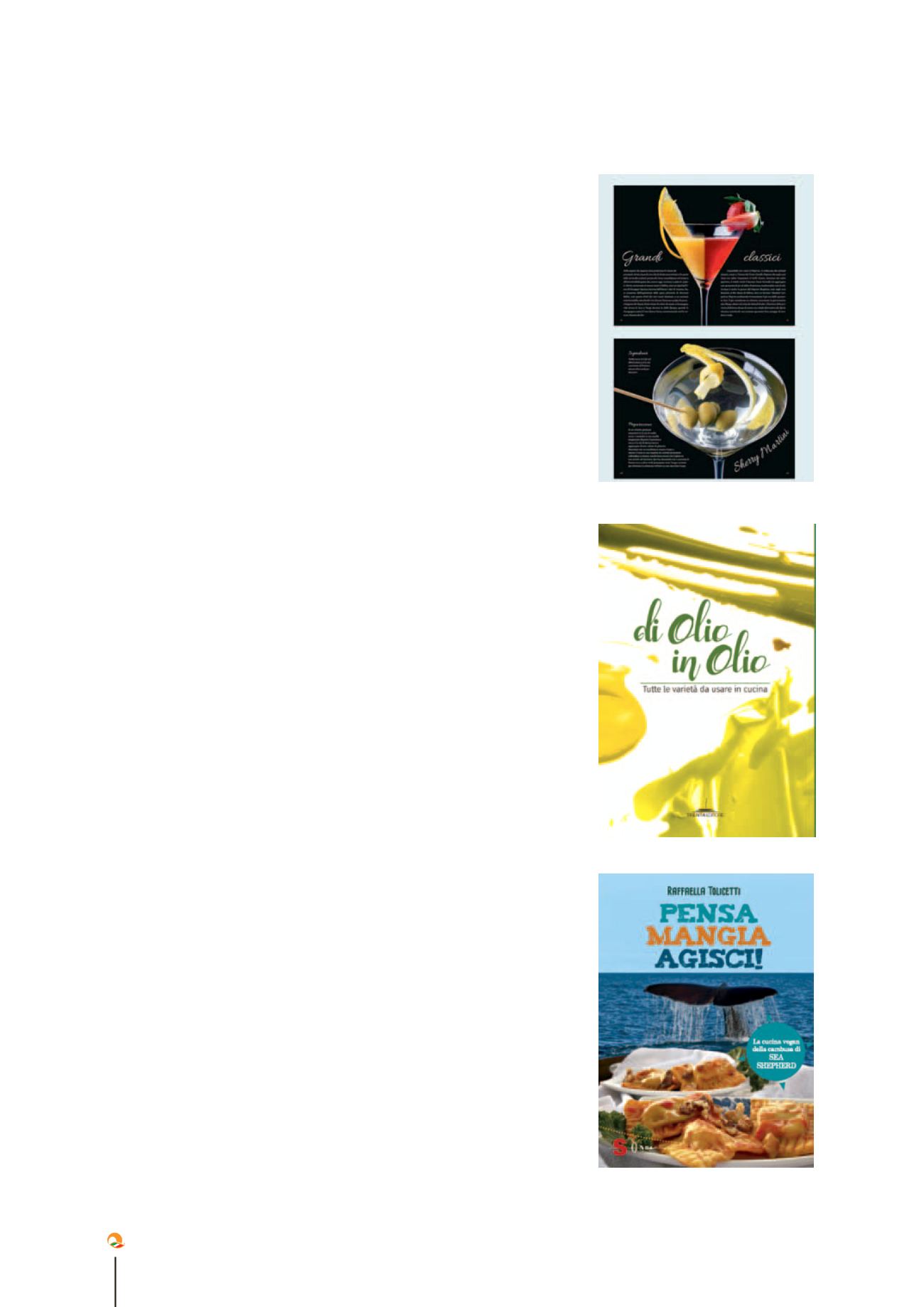
WINE COCKTAIL
www.whitestar.it€12,90
A book to... drink in one sip! With
the beautiful still life photographs
by expert Fabio Pedroni, this book
has a selection of 90 cocktails -
most of them new - made with wine.
From the big classics, like Negroni,
to a reinterpretation of traditional
drinks made with spumante wine,
from the Spritz to the less known
cocktails made with Madeira or
Sherry liqueurs. All recipes, by the
internationally acclaimed barman
Gianfranco Di Niso, are easy to
follow and very detailed, in order
to lead the reader into the world of
cocktail making step-by-step.
By Mariaelena Goroni
DI OLIO IN OLIO
www.trentaeditore.it€19,00
It is always nice to spend time in
the kitchen trying out new recipes.
Why not start from oil then? Olive
oil is tasty and good, but there are
many varieties of vegetable seeds
oils for the cook, some of them very
little known. What flavour will a
salad have if dressed with hempseed
oil? How about meatballs prepared
with soybean oil? Or desserts with
hazelnut or walnut oil? “Di olio in
olio”, from oil to oil. The book will
satisfy all curiosities and is divided
into two main sections. The first
section is about olive oil, seed oils
and flavoured oils and it has a
chapter about seasoning oils and
cooking oils. The second section
has a selection of recipes grouped
according to the various oils used,
like olive oil, linseed oil, pumpkin
oil, hempseed oil, hazelnut and
walnut oil, avocado oil, corn oil and
grapeseed oil. There also tips for
deep frying at home!
By Raffaella Tolicetti
PENSA, MANGIA, AGISCI
www.sonda.it€11,90
Being the chief cook on board of
The Sam Simon, of the Sea Shepherd
fleet, i.e. how to join vegan cuisine
and active campaigning. This is a
recipe book and a guide to get to
know an organization that protects
marine wildlife all over the world.
Raffaella Tolicetti tells the reader
how she does her share to save
the Planet by cooking well and
avoiding food waste, even in the
middle of a storm or while tackling
the Japanese fleet. More than 50
recipes, all 100% vegetable-based
for people who want to cook and
eat consciously, thinking about
the environment and combining
taste with active participation. This
is an international overview of
environmental activism in its most
extreme forms.