


 61 / 68

oct.-nov. 2015
XI
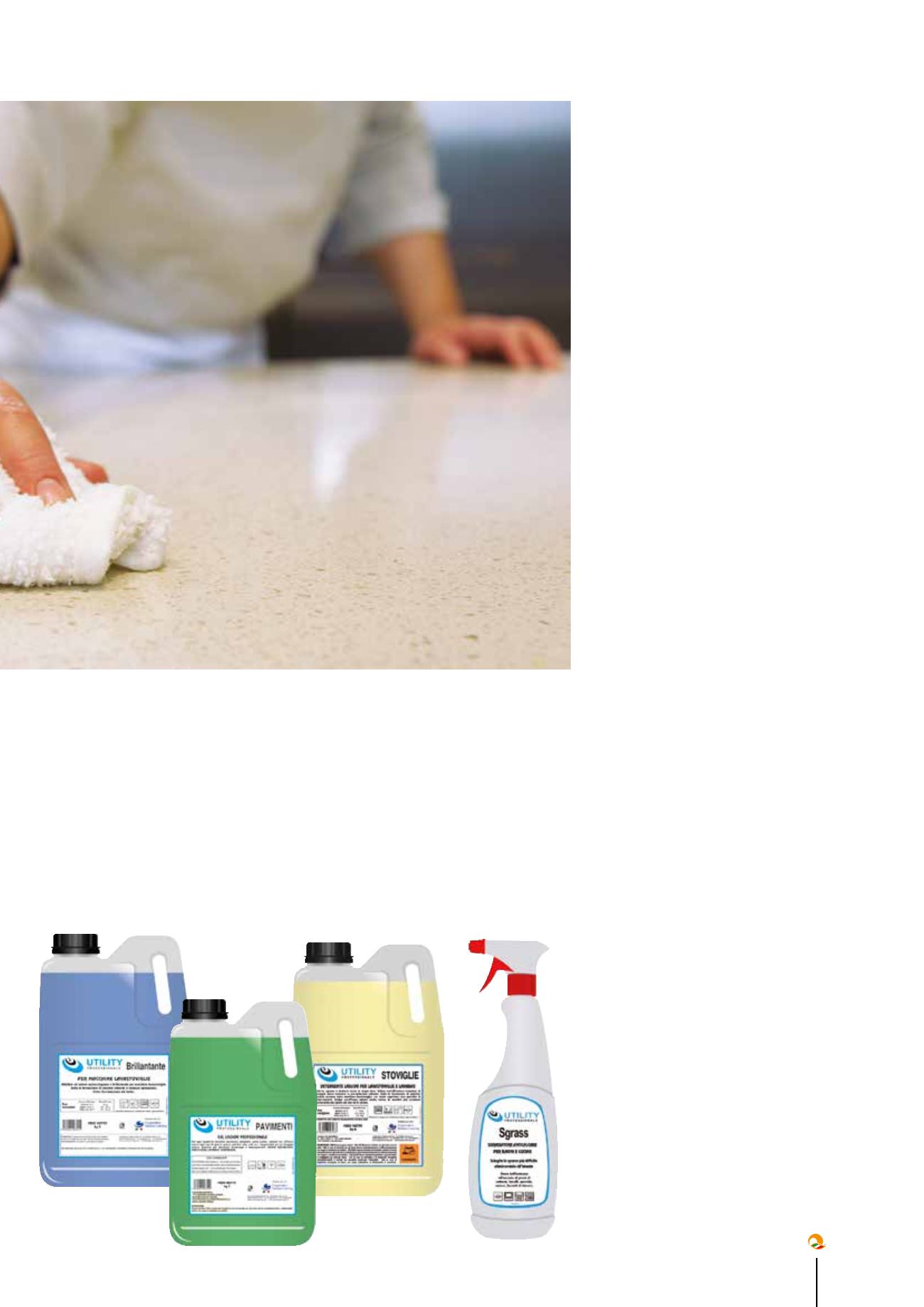
floors, coverings, restaurateurs prefer
the concentrates, while for other needs
(for example, the washer or degreasers),
opt for those already ready. In any case,
the product is equipped with sheets that
give precise information on how best to
use our products.”
Reading the label or the sheet is not
only important from an operational
point of view. “Based on my experience
- concludes Farina - users do not
pay particular attention to the active
substance in the product, as the
symbolism of risk. They prefer a
mild detergent solution or irritating,
look for products with less impact on
surfaces and safer for operators. The
environmental aspect, however, is
currently still quite neglected in our
country.”
How about the dishes?
If the washing is done manually, it is
necessary to sanitize or with a chemical
product (the same as used for slicing,
for example) or with a sterilizer to UV
or steam.
For the dishwasher there is a product
with disinfecting power, but is the
temperature of the rinse (typically above
80 ° C) to have curative effects against
pathogens. “An empirical method for
evaluating the temperature is sufficiently
high - stresses Katiuscia Consonni - is to
verify that the dishes come out almost
dry. If they are dripping of water, it
means that the rinsing temperature is
too low.”
At pAge 38
Cook fast or slow?
The pros and cons
We don’t need principled positions
between fast or slow cooking. It’s the
food itself that defines which one we
should use. But often it is the union
of the two techniques that gives the
best results. Especially when we talk
about meat
By Gregori Nalon -
www.gregorichef.itIn the evolution of the kitchen a
contrast between slow cooking and fast
cooking has become more and more
street, including low temperatures for
a long time and high temperatures for
fast cooking. It’s actually a misplaced
concern, because in the kitchen there
is the “single thought”, that is to say
that each food provides maximum
yields if properly cooked, cut down and
preserved.
But let’s see some examples. We
could cook a fillet of sea bass with
sweet temperature, to keep intact its
characteristics, and to date we all agree.
The same sea bass, however, cannot be
subjected to prolonged cooking because
its holdings would be “flaky”, the pulp
weakened, torn. On the contrary a piece
of meat cooking requires a very long,
proportioned to the cut (greater time
for the cuts type knuckle, shoulder,
muscles, etc.). A stew, a piece of
shoulder muscle, the cup, takes very
long cooking at low temperatures,
allowing the structure to cook, mellow,
mature, becoming soft, but also juicy
and flavorful. If instead we cook a fillet