


 60 / 68

oct.-nov. 2015
X
At pAge 34
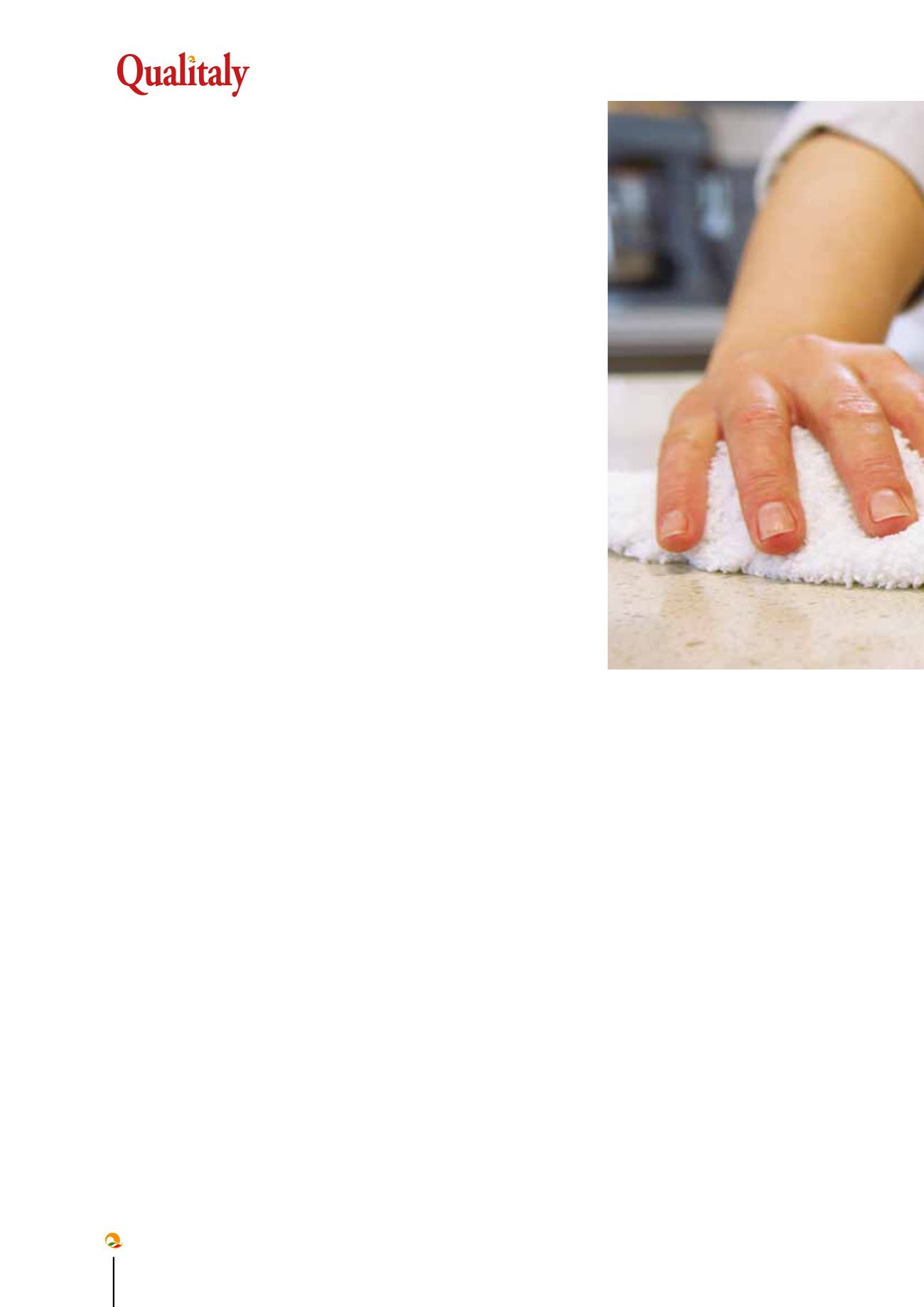
It’s time to clean
up!
Although the HACCP requires sanitize
surfaces in contact with food, many
restaurants held it badly. That’s how
it should be done
By Elena Consonni
One of the prerequisites required by
law 852 for food companies (including
public exercises) provides that all
surfaces that come in contact - directly
or indirectly - with food must be
washable, smooth, non-porous, with no
crevices holes, made non-toxic materials
and in good repair. Stainless steel is the
choice of excellence, but other materials
are also permitted, provided that if
they lose their characteristics being
maintained to restore them.
“Surfaces - says Katiuscia Consonni,
HACCP consultant for catering industry -
must be sanitized: which means not just
cleansing, it also takes the disinfection.”
The good hygiene practice sanitation
includes 5 stages: initial rinsing,
cleaning and rinsing detergent,
application of sanitizing the manner
and times, final rinse and drying
with disposable paper. “In reality
- continues - the best solution both
from a practical point of view (time
reduction) that to avoid the risk of
reversing the operating steps is to use
a unique product with function of both
detergent disinfectants. Detergency, in
fact, must always precede disinfection;
for distraction if we reverse the two
phases in contact with the disinfectant
stains loses its effectiveness in whole
or in part, making vain the procedure.
Using a single product with properties
of both detergents disinfectants (always
following the operating procedures
suggested by the manufacturer) protects
it from the possibility of error. The
HACCP plan must be indicated the
procedure followed by sanitizing any
kind of surface, so that operators,
consulting it, can know which product
to use, how and with what frequency. If
you use professional products (but not
mandatory) is well attach the data sheet.
There is a frequency of treatment that
works for all operators and all surfaces.
Approximately sanitation must be daily
for all the dishes, floors, equipment
everyday, weekly for the interior fridge,
structure and hood filters (but for a
restaurant frying much once a week
is too little), monthly or quarterly for
shelving which contains the non-food
products. The important thing is that
the frequency indicated in the plan
of self-control and established based
on the characteristics of the activity is
respected.”
BY THE THEORY SEEMS all quite
simple and logical, but the experience
of the consultant says that sanitation
is not the priority for the majority of
businesses. “It will be a case - says - but
often when I make an inspection, the
sanitizer is just finished. Despite all the
procedure it is correctly specified in the
HACCP plans for most simply remove
any grease and even if they use the right
product (and not always the case), the
procedure is not performed correctly.
The details are neglected: for example
sanitize the door of the refrigerator, but
not the seals that are difficult to clean.”
Unfortunately the same ASL seems to
be more attentive to the paperwork that
clean. “They come sanctions because
they lack documents - concluded
Katiusha Consonni - while situations
of obvious dirt are not ratified. The
fact is that the lack of documentation
is objectively demonstrable and
unannounced, and the dirt is a
subjective parameter, which should
be demonstrated with a levy, which,
however, does not see it in the
restaurant business for a long time,
by veterinary inspectors. The limit
prescribed to take a pad surface, but do
not do it directly.”
False Myths
Among the many urban legends, there
are also related to sanitation. Let’s
clarify those once and for all
VINEGAR? NO THANKS! Though it
has a slight bactericidal action, it’s not
enough to kill food pathogens.
BLEACH EVAPORATES. After a time of
opening the bottle, chlorine tends to
evaporate and then loses the curative
effects. For larger areas you can use
chlorine tablets to be diluted in water
and used at the time.
BE CAREFULL TO ALCOHOL. IT IS
TOXIC. It is valid as a disinfectant,
but it is denatured and the denaturant
is toxic, unfit for food contact. Then
alcohol it should be rinsed as any other
disinfectant. As it evaporates, however,
it is easy to forget to wash, and then you
risk a chemical contamination of food.
You could safely use alcohol food, the
cost of which, however, is too high for
use in cleaning
Which is the optimal
detergent? Effective and safe
The members of Cooperativa Italiana
Catering are offering to their customers
as the only representatives for all
purchases, not including food. As part
of the cleaning, the brand of CIC is
Utility, a range that includes 18 products
that meet every need of the restaurant
owners in the area of cleaning and
sanitation: floors, kitchen and bathroom
surfaces, dishwasher and dishwasher
(for hand washing) rinse, bleach,
descaling, hand washing soap.
“The most popular – says Ada Farina,
head of marketing for Detergenti
Bettari, a company specializing in the
production of products for professional
cleaning, CIC partners for this sector -
are Utility Pavimenti, Utility Sgrass and
Utility Stoviglie.”
The range includes both concentrated
products, to be used after appropriate
dilution, that those ready for use.
“Even if the focus is more expensive
- continues - taking into account the
dilution, using the cost is the same. For
magazine