

 70 / 76

DEC. JAN. 2018
X
new restaurant is called Aperto.
With which Italian colleague would
you like to work?
There are many Italian chefs with
whom I would like to work with but,
in particular, I would like to find
myself working alongside Gerardo
Novi! For me he is an idol, at his age
he is still doing the season in Costa
Smeralda. I would also like to work
with the team of the Association of
Basilicata Chefs, it’s a great team and
I am proud to be a member!
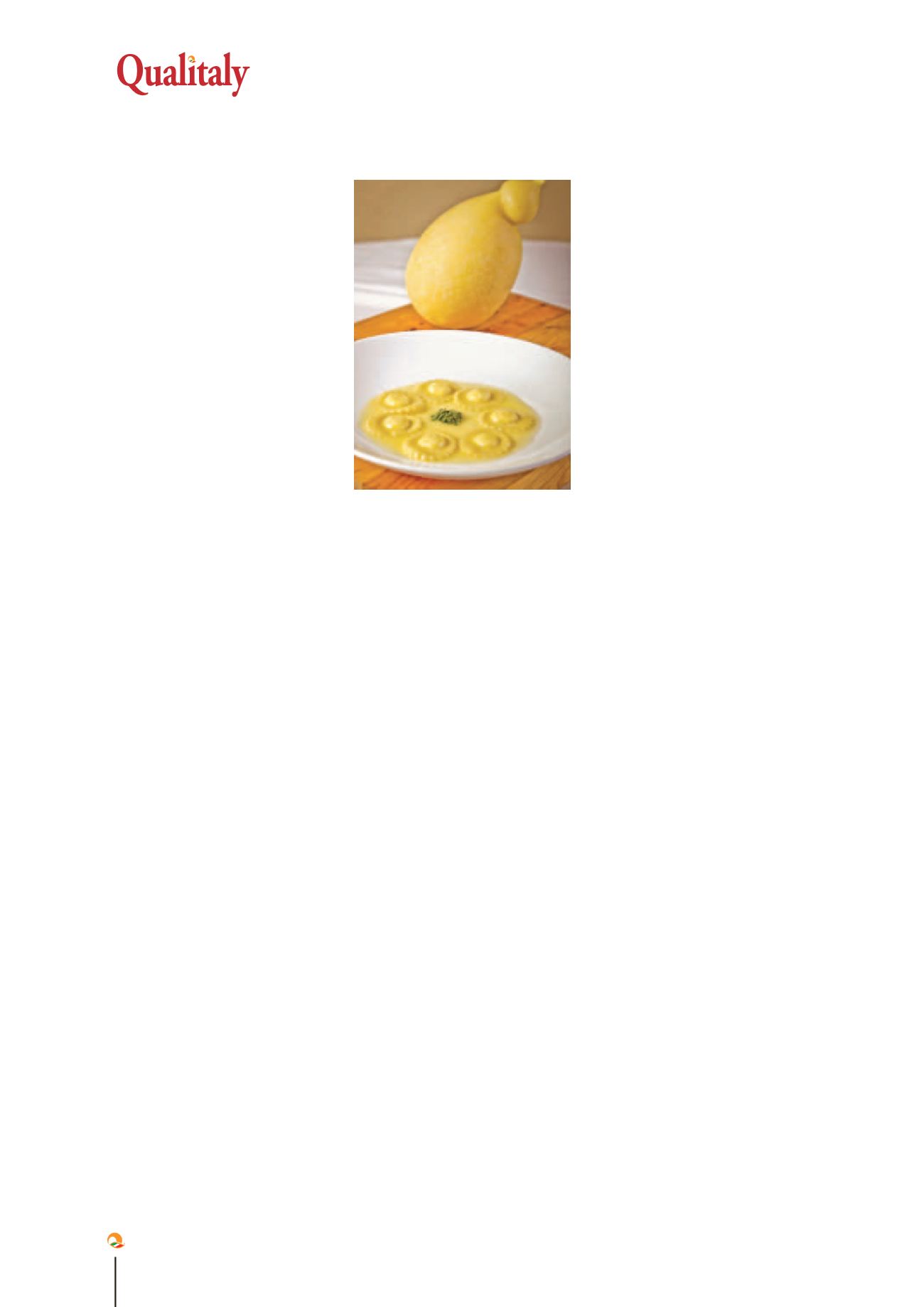
Ravioli stuffed with Caciocavallo
In my region of origin (but I think
the concept is valid for all of Italy)
there is a saying: “When a stranger
arrives around here, he cries twice!”
The first because he discovers a very
different reality, a timeless country
and, consequently, a little difficult
to live at first; the second time he
cries because, after then becoming
accustomed to the traditions and
beauties of the place, he does not
want to leave.
To complete the bounty of the
gastronomic products, Caciocavallo
is a prime example, a cheese also
shared with Puglia and Calabria.
Precisely because of its originality
and its unique taste, I decided to
serve it at my dinner, The Beauty
of Basilicata, at the James Beard
Foundation in New York.
Caciocavallo is obtained from the
milk of the Podolica cows, an almost
extinct breed which, in fact, still
lives on the Apennine mountains
of Calabria-Basilicata and in some
parts of Puglia and Molise: they are
particular cows, strong and gentle
at the same time, wild (they can
live outdoors) and friendly to man.
All features that make this cheese
an absolute delight. The name
Caciocavallo comes from the maturing
that takes place “on horseback”
suspended between two poles.
______________________________
BOX
INGREDIENTS FOR 6 PEOPLE:
For the pasta
250 g flour (plus an addition for
working)
56 g butter at room temperature
2 eggs
½ teaspoon salt
For the filling
125 g of grated seasoned Caciocavallo
80 g ricotta cheese
1 egg
For mixing
100 g of grated seasoned Caciocavallo
100 g butter
3 tablespoons of chopped fresh sage
Mix the ingredients for the dough until
it becomes elastic; work it for about 10
minutes, wrap it in cling film and let it
rest for half an hour.
Meanwhile, in a bowl, prepare the
filling by adding the Caciocavallo,
ricotta and egg and mix it all very
slowly and gently.
At this point, roll out the dough with
a rolling pin (or with the machine to
pull the crust): it must be thin. On
half put the stuffing with a spoon or
a pastry bag; close with the other half
and with the wheel cutter trim the
edges. Alternatively, you can also use
a round mould. Seal the edges well.
Boil in salt water for a few minutes
and drain al dente. In a large frying
pan, melt the butter and sage on a low
heat, finally add the Caciocavallo and
stir well. Sauté the ravioli in the pan
and serve hot.
Recommended Wines:
Dry Riesling
______________________________
AT PAGE 26
Cooking is not a game
How important is the training of
young people? Are the use and
diffusion of territorial products, the
traditions and the origins of catering
fundamental?
However, the direction taken by
the new fine cuisine is always
highlighted.
Because you can’t live with starred
chefs and TV stars alone
By Riccardo Sada
New techniques and new horizons
overlook the market, in the sector,
putting different generations in the
spotlight. The doors of the Marchitelli
Hotel Institute of Villa Santas Maria
(CH) opened for Qualitaly to see
closely the professionalism and
skill of teachers and pupils, and to
understand the paths that the new
students can undertake with modern
means.
For over 5 years, more than 750
students learn and apply theory
and practice, culture and craft
successively spread throughout the
world as a single belief. The teachers
Sergio Giulio and Franco Di Genni
are however in agreement: there is
still a lot to do.
“There are too many chefs and too
few cooks, which is why it is very
important what can be created
from an institution like that of Villa
Santa Maria. If you do not know the
history and the past - continue the
professors - you can not foresee the
future and build solid foundations.
Five centuries ago thanks to the
Neapolitan family of Caracciolo, who
based everything on game meat, a
tradition handed down for such a
long time thanks to a continuous
passage of witness; the pupils
today start from here and arrive
throughout the rest of the world. The
kitchen evolves over time, always
starting from its roots; here in the
Institute we simply give continuity
and development to this flow. We
assist culture by following the
ministerial programme. Regarding
chefs or cooks, let’s just say that
restaurants need to find willing
people. We ask the new members,
now, why has no one chosen the
hotel trade. Nouvelle cuisine has
turned everything upside down.
However, today’s foundations are a
cornerstone: they are nutrition and
experience. Trends must be taken
with the due caution: micro-climatic
cuisine, for example, is interesting
to follow and interpret. We must pay
attention to the chemistry and the
organoleptic changes of the food:
cooking is not a game “.
The word then passes to pupils Luca
da Fermo and Emilio D’Emilio, from
an open day in which hundreds of
classmates have been involved.
MAGAZINE