


 54 / 68

DIC. GEN. 2017
II
systems by giving restaurants
doggy-bags. Restaurants will have a
tax relief when paying the disposal
of solid urban waste.
So, with the new year come
new fiscal deadlines as well as
obligations regarding safety on the
workplace and food safety (page
16). There also new kitchen trends
linked to sustainability (page 20)
and new trends in the wine world,
more and more in everything
organic and vegan.
And for those who love stories
with a happy ending, we went as
far as New York to tell the story
of the forward looking chef Denis
Franceschini who, after 15 years
spent at Cipriani’s, opened his own
place ‘Bar Italia’. It has become
a real success and it has further
increased the visibility of our ‘made
in Italy’ in the world.
These are nice stories that CIC
wants to share with you, wishing
you a 2017 full of opportunities and
attention to those in need!
By Lorenzo Morelli
AT PAGE 6
QI News
Agribusiness: invoice
payment times still
too long
According to data published in the
latest Market Monitor (focused on the
food business in Italy and abroad) by
Atradius, a world leading company
specialized in trade credit insurance,
surety and collections services, after
several years of economic crisis the
performance of the Italian food sector
has improved. This thanks also to
the diminished costs of raw materials
and energy. The food business has
always had a prominent role for the
Italian economy, supported by the
international reputation of the Made in
Italy brand, employing 385,000 people
for a total business of 135 billion euro,
27% coming from exports.
In spite of this improvement, the
Italian food industry has supply
payment times that are considerably
longer than average compared to other
countries. They amount to about 90
days since the date of invoice, i.e.
three times longer than Germany (30
days), more than twice longer than
the Netherlands (40 days) and longer
by 10 days than Spain (80 days). For
the first semester of 2017, compared
to the same period last year, the levels
of insolvency are not going to get
worse. Actually, the payment times of
commercial invoices should be stable,
anyway long in spite of the measures
taken by the law.
“The Italian food industry –
commented Massimo Mancini,
country manager at Atradius Italy
– is still fragmented in several
small companies. The international
reputation of their products is very
strong, but they often have difficulties
in opening up to exports, even if
external demand is growing from
Europe, from the USA and from Asia.
It is very important to work on foreign
markets, but they must be cautious.
They have to protect their trade
exposure through credit insurance
schemes”.
AT PAGE 8
Looking ahead
More than 40 years’ experience and
a deep trust in the new generations -
the lucky mix for a successful business
By Maddalena Baldini
A firm voice, clear ideas and a nice
accent from Emilia, with full rounded
words. A great presentation for
Antonio Bocchi, head of Ristogamma,
an important food business specialised
in the
Ho.Re.Cachannel.
Can you tell us how it all began, Mr
Antonio?
It was the second half of the 1970s. A
great time for the Italian economy and
for the food industry. Together with
three other partners, we decided to go
down a different path, to have broad
business perspectives. We all had in
common the desire to do something
and we were all enthusiastic at the
idea of starting a business. We started
off in the frozen meat trade and we
called our business Bastiglia Carni,
from the town where we were based.
It was 1977 and the business was
immediately successful.
How many years later did you
decide to change the business?
About 10 years ago, we decided to
move and to enlarge the business.
From Bastiglia, near Modena, we went
to Rubiera, near Reggio Emilia. We
also changed our name in Ristogamma
because we decided to deal with
everything concerning the restoration
business. That was a very good
decision and today we can proudly
say that we have more than 3,000
products.
How is the logistics organized?
We are a solid business. Our
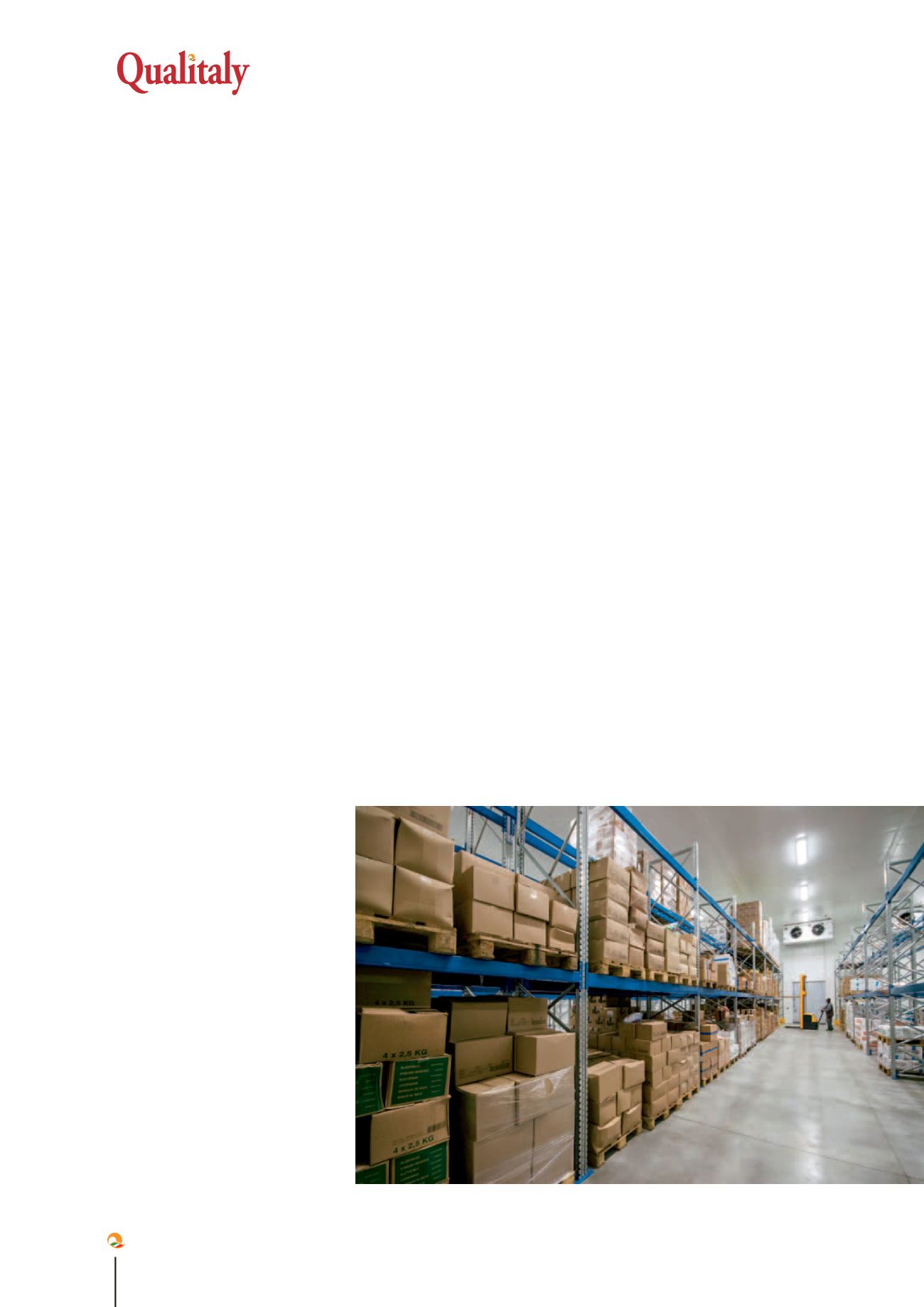
headquarters covers 3,800 sqm, with
offices and refrigeration rooms for
fresh and frozen foods (+5 °C and
-20 °C). Some time ago, we added a
further area which can hold about
500 pallets of frozen food. Deliveries
and transportation are also tightly
organized. We own lorries and vans
MAGAZINE