


 54 / 68

OCT. NOV. 2016
II
Ever faithful to its “Look Deeper”
slogan, and to celebrate the World
Food Day, SIAL also organized
the conference “Sustainable Food
and Innovation – the 21st-century
Challenge”, which allowed all the
sectors concerned to share practical
and interesting initiatives to face the
global food challenge – something
that will undoubtedly kick-start a
new era.
It is before everybody’s eyes that
we are at a crossroads. Our modern
customers will not be easily
pleased with a dish that is nice
and tasty. There must be more to
it: what counts is the ingredients
and they must be top quality, have
controlled origins and guaranteed or
sustainable food supply chains. This
is the reason why producers (also
present at SIAL) are competing to
offer raw food ingredients that meet
these criteria: gluten-free, vegan,
OGM-free and so on.
It is true this is still a niche market,
but we must know what it is about
and how to use them at their best
in the kitchen to guarantee a
comprehensive offer to customers.
A 2016 research by Coop
highlighted that fruit and vegetables
make up over a third of all foods
consumed (article page 14). This is a
trend, which cannot but engage the
food service sector.
“Is it possible for an omnivore chef
to include credible vegetarian and
vegan options in the menu in full
compliance with these customers’
needs?”. The answer is “yes” and
is given by Emanuele Di Biase,
a vegan pastry chef and teacher
coordinator at Veganok Academy
(article page 18). We have all the
tools: specific cooking methods
(look at the article on sous-vide
cooking on page 30), vegetable
granulated bouillons (page 22) and
wines produced according to vegan
requirements (page 46).
There are a lot of customers who
want to have an unforgettable
experience and indulge in a little
luxury when they go out for dinner.
For them, we have a wonderful
interview with Chef Massimo Bebber
from Trentino, who has undertaken
a one-way journey to New York
and now manages Sirio Ristorante
at the 5-star luxury Taj Hotels in
Manhattan. We have been there for
you and now we will show you.
Enjoy!
By Lorenzo Morelli
AT PAGE 6
QI News
Clean Labels,
Proteins and Health.
The main current 8
food trends
The Italian dinner table is changing
fast. Not just as a response to
passing trends, but as a result of
a different approach to nutrition,
food and diet. This is causing deep
changes in the policies of big food
companies that are investing more
money into innovation and into
customer satisfaction. What are the
current macro-trends, whose results
we will see (and taste) in the coming
months? Osservatorio Assolatte has
carried out a study on all the current
international food trends and here
are the most important eight.
#CLEAN LABELLING
Clean labels are one of the most
significant food trends of the
moment everywhere in the world.
This type of “clean” labelling is
more understandable and allows
customers to identify the most
natural and reassuring products,
going beyond the many marketing
slogans and the false food myths. All
dairy products are made from one
single ingredient (milk), therefore
they are very appropriate for “clean,
clear and understandable labelling”
that characterizs “real foods”.
#PROTEINS
Western Europe is the geographical
area where proteins are most
consumed. And where people want
to increase their consumption.
The dairy industry is the first
for importance and it is the most
dynamic with many new protein
products launched on the market,
from whey-based drinks to snacks
that contain milk proteins and to 0%
fat Greek-style yoghurt.
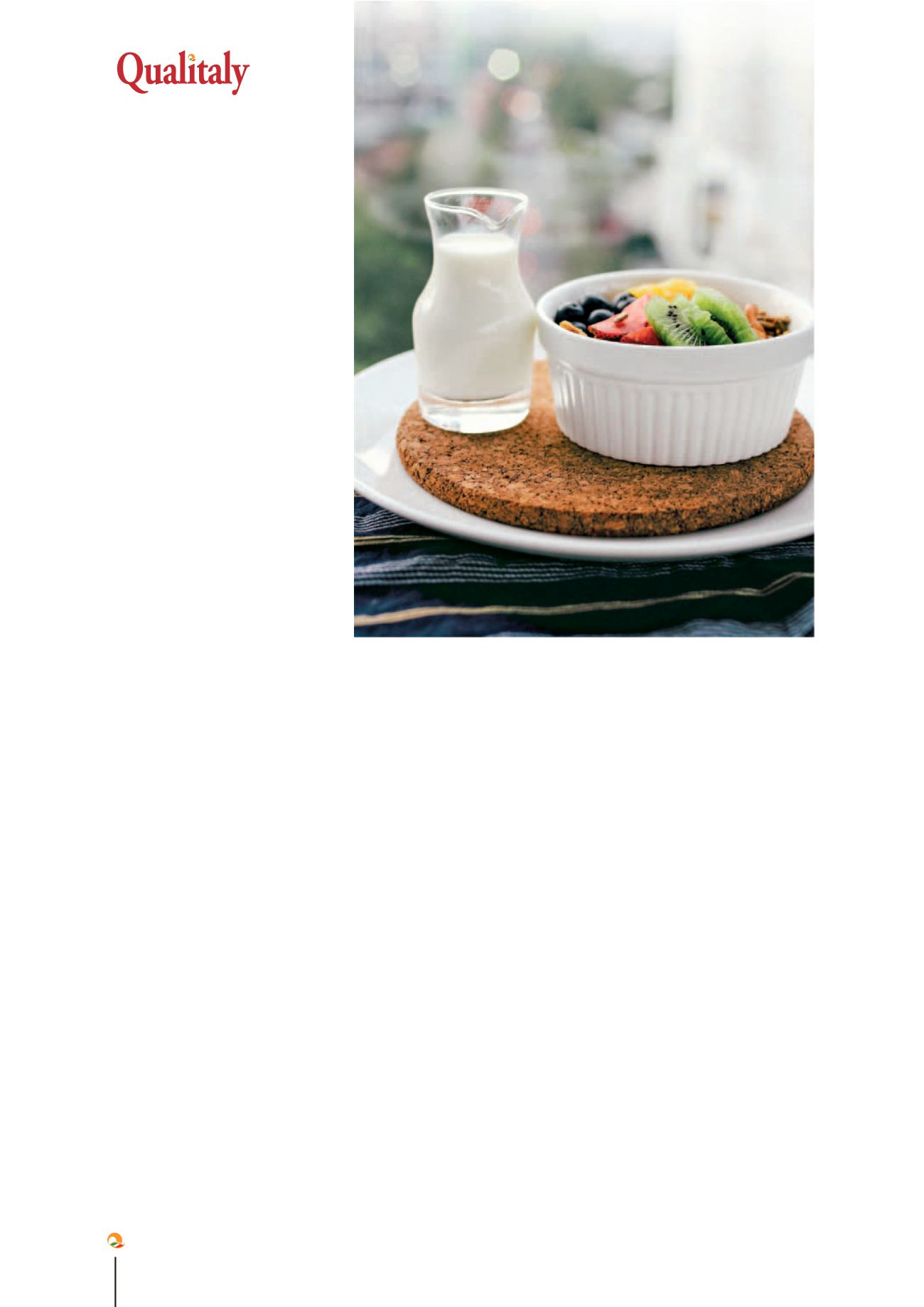
HEALTHY LIFESTYLE
Wellbeing is an oasis where people
want to find a better lifestyle, with
more energy and personal health. In
the dairy sector, this translates into
an increased offer of milk, yoghurts,
fat-free cheese (including mozzarella
cheese and Greek yoghurt), dairy
products with reduced salt (like
mozzarella cheese) or cholesterol
(like butter), but also yoghurts and
fermented milks with new benefits
MAGAZINE