


 83 / 84

APR. MAY 2018
XV
with sourdough. Two of the most
important representatives of the
sector agree and give the same view,
Simone Padoan and Renato Bosco,
respectively of the pizzeria I Tigli di
San Bonifacio (Vr) and Saporè di San
Martino Buon Albergo (Vr).
Pizza and leavened products, what
are the elements that distinguish
their success?
S.P.
Looking at one of the symbols
of Italian cuisine, I wanted to
reinterpret it in a personal way,
without neglecting the fundamentals,
here the seasonality of the
ingredients, the starting point,
namely the dough and the fact that
pizza is still one of the favourite
dishes in Italy and abroad.
R.B.
The world of yeast is
fascinating, it is a continuous study
and research, especially starting
from the ingredients that must be
used. Moreover, when it evokes
memories, perfumes and flavours,
it becomes the protagonist of the
table, without forgetting that,
above all, pizza is one of the most
widely consumed street foods, it is
a fast food that can be enjoyed by
everyone.
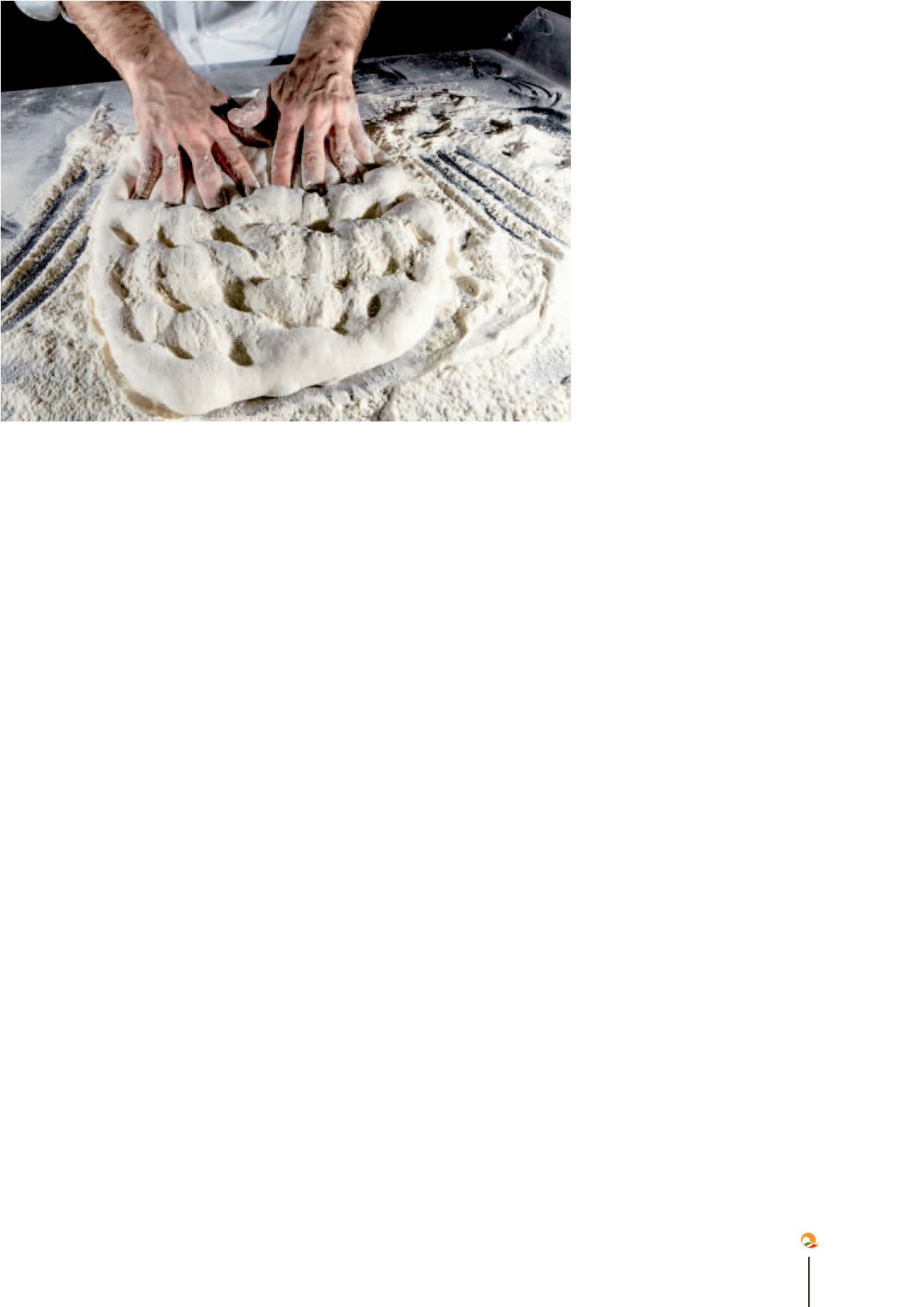
A good pizza starts with the disc
of dough and its leavening. What
are the fundamental steps?
S.P.
I apply the basic rules of bread
making: the idea of making a good
bread, the projection on the base for
pizza, from flours, to yeast to rest
times. I love sourdough and natural
stone flour, especially soft wheat and
whole wheat.
R.B.
We start from the selection of
flours, in recent years the world of
grains has evolved, proposing much
those obtained from ancient grains,
perhaps from integrated crops. The
sourdough is linked to all this, which
is fundamental for giving the product
greater flavour and a ‘longer’ life.
What are the advantages of using
sourdough?
S.P.
The spontaneous fermentation
of sourdough has a complex
and intense aromatic bouquet,
characteristics that vary also
according to the ‘hand’ of the person
who works it, becoming almost a
signature and a customisation. The
dough matures in an advanced way,
becomes easily digestible and richer
in nutritional terms.
R.B.
Bread or pizza made with
sourdough is more digestible, with a
very rich range of aromas and tastes.
It can be seen that they are kept for
longer: for example, bread made
with sourdough remains soft for a
week, a cake like panettone for up to
40 days.
What are the contraindications?
S.P.
The use of sourdough must be
gradual, as it involves longer and
more complex steps than the use of
brewer’s yeast. Incorrect use occurs
mainly when the internal acetics are
too high, transforming the product
into something that, paradoxically,
goes against the concept of the
digestibility just mentioned, often
causing a lot of thirst.
R.B.
The sourdough must be stored
under optimum conditions so that
it does not become externally
contaminated, which could alter
the characteristics of the yeast. The
consequences are that of a yeast that
is too acidic, so much so that it is
not possible to complete a dough,
making it unpleasant; attention must
also be paid to flour for refreshment
and water.
What are the times for a correct
leavening?
S.P.
There is no precise time frame
to follow. Certainly, when using
sourdough, you will have to wait
longer than when using a dough
made with brewer’s yeast; if the
latter is put in a larger quantity, it
will give a quick swelling but not
a ripening, while the sourdough
cannot be used in excess and must
be proportioned also according to
the flour used. One thing is certain,
you can’t think of making a dough
with sourdough and bake it in the
same evening.
R.B.
No fixed times exist. You have
to work thinking about what you
want to get from the dough and
project into the final result. There
are many factors that contribute to
the success of a good bread or pizza,
from flour to water. If you don’t
respect the “natural” times, you may
find yourself in front of a leavened
product with an uneven pitting, little
volume and a too pungent smell.
What are the elements to evaluate
a good pizza?
S.P.
In addition to the aromas, good
flavour and final aesthetic taste, a
pizza must be healthy, wholesome,
ethical, seasonal and able to make
the ingredients that make it up
immediately understood.
R.B.
It is always useful to make
a sensory analysis taking into
consideration the fundamentals such
as cooking, aroma, overall structure,
taste and digestibility.
What will the pizza of the future
be like?
S.P.
Pizza making is a real job!
Consequently, it requires a long-term
vision that starts with a professional
awareness and addresses the
customers, for it is they who make
the difference. I see the pizza of the
future as being linked to teamwork,
a concept of catering, product
differences, regardless of whether
it is simpler or more complex. The
pizza chef of the future will have to
be more and more trained as a cook
as well as an expert in the White Art,
with attention to nutritional aspects,
combinations and seasonality.
R.B.
We are facing a new generation
of more advanced and attentive pizza
makers, ready to turn pizza into a
real health conscious dish and able
to offer the customer a true taste
experience, that’s why there will
be no lack of curiosity, research
and studies on ingredients to select
and on the leavening procedures.
Pizza is constantly evolving; new
combinations are created to obtain
different results but always with an
eye on tradition.