


 82 / 84

APR. MAY 2018
XIV
and good taste. That’s why, Pace
comments: “I haven’t tasted Cracco’s
pizza, who is a great chef who cares
about aesthetics. Because the pizza
he has made is bad.”
Overseas eating pizza is becoming
synonymous with the Italian
restaurant. In New York, as in Los
Angeles, the number of bars and
restaurants of some of the most
famous pizza makers is increasing:
Gino Sorbillo, Gabriele Bonci. Real
local products, not Italian sounding
(see box below).
Even if, painful though to say, it
is precisely on the front of quality
agriculture that Europe, and Italy
in particular, is failing. According
to the latest report by the European
Environment Agency, pesticide use
is not decreasing. In 2015, sales
in France, Spain, Italy, Germany
and Poland accounted for 72%
of EU pesticide sales (practically
three quarters of the entire EU
consumption).
However, Made in Italy continues
to be a brand synonymous with
excellence. It is not only the Eataly
supermarket chain specialised in
Italian quality products, turnover
400 million; but also and especially
small and medium companies
that are becoming known for the
characteristics of the product, such
as Spontini (see box below).
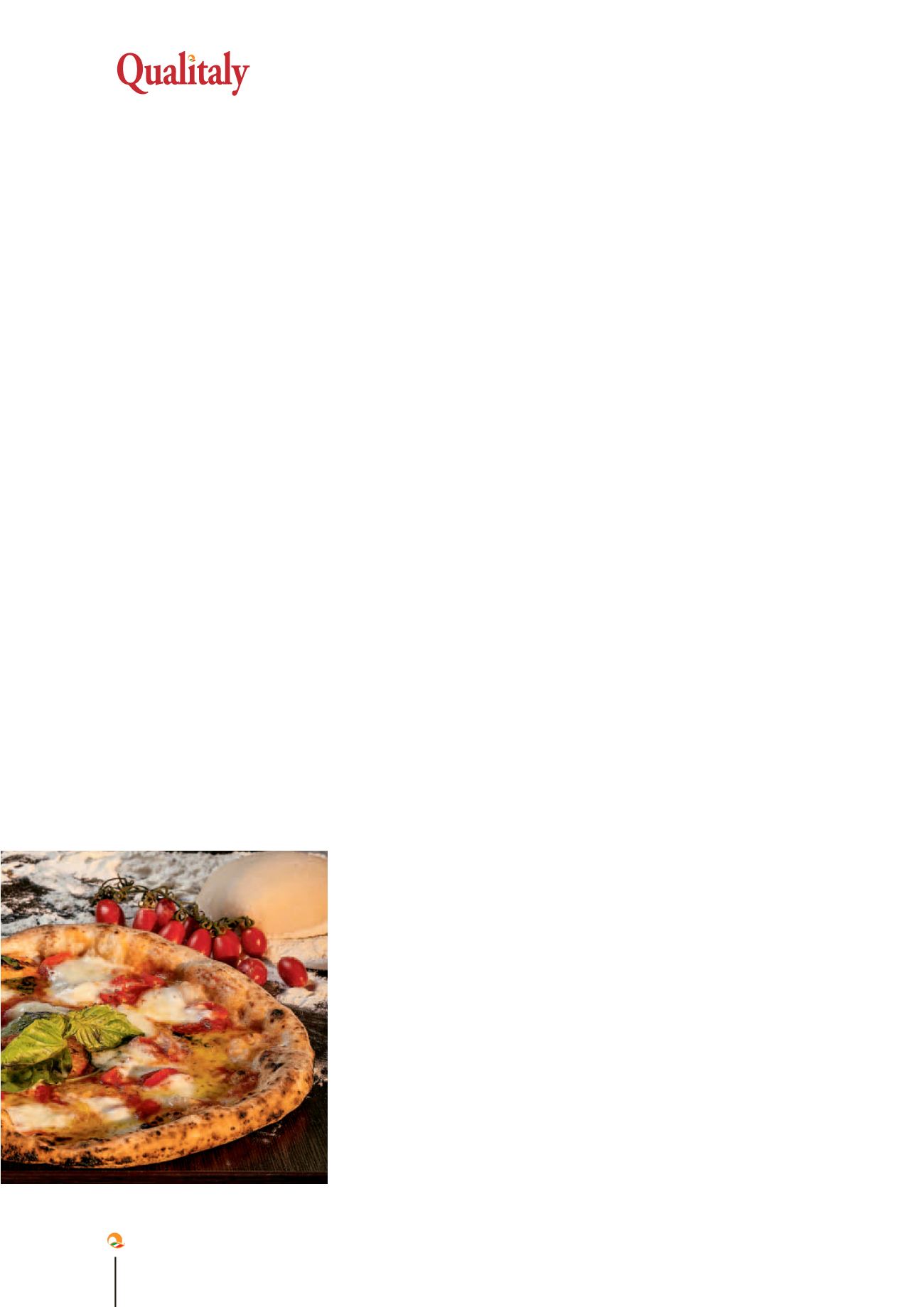
In short, whether it’s a Margherita
or a Marinara it doesn’t matter, the
essential point for pizza will be to
excel in the dough, or rather in the
disc of dough. Making pizza is art,
a craft. Our cuisine knows how to
work with tradition to the best of
its ability. The Mediterranean diet,
typical products. The ingredients,
the seasoning, will enhance the base.
Whether you honour the Vesuvius
etiquette or not, whether you are a
‘Pizzaioli’ member, certified cook or
not, to improve the numbers the goal
must always be the same: to innovate
in tradition.
We must take into account the
new features introduced following
the UNESCO recognition of the
profession of ‘Pizzaiolo napoletano’,
which is added to the other
excellences of our country: Italy
has the largest number of World
Heritage sites: 53; China is second:
52. A stimulus for everyone to make
the territory, and its products, the
protagonist of the near future.
______________________________
BOX
PIZZA VS ITALIAN SOUNDING
Parma Ham produced in China. The
parmesan cheese, the mozzarella.
We do not count the products that,
in the rest of the world, we try
to pass off as Italian: “the use of
geographical names, images and
brands that evoke Italy to promote
and market products that are not
related to our country”, we read
on the website of the General
Directorate to Fight Counterfeiting:
“A market worth 54 billion euros a
year (147 million per day).” And that
has an antidote, Made in Italy. And
the recognition of pizza by UNESCO
is also a tool to protect our most
famous dish and the economy now
linked by the phenomenon of Italian
sounding.
______________________________
BOX
THE CASE HISTORY: SPONTINI
Pizza high, streamlined, sliced. from
Milan to the world. Spontini®, Milan
sliced pizza brand, will also arrive
in the Middle East and North Africa
after the expansion agreement with
M.H. Alshaya Co. soon in Kuwait and
also in Japan.
The shop has a fortunate history: in
1953 it fed the Milanese in the post-
war economic boom. From there,
the Innocenti family, who have been
leading the company since 1977, has
managed to reach the international
market (in Italy, 21 sales outlets:
14 direct, 7 franchised, www.
pizzeriaspontini.it).
______________________________
AT PAGE 56
IN THE PANTRY
Four-handed
leavening
From the history of one of the most
beloved products to the vision of
great interpreters of the sector such
as Bosco and Padoan. Here is the
pizza, increasingly creative and with
impeccable ingredients
By Maddalena Baldini
It may sound incredible but the first
time the word “pizza” appeared on
an official document was in 997.
Yes, 3 years before the fateful year
1000. Apparently, the person who
used it was far removed from fear
of the end of the world, since he
uses it to indicate a part of a rent
instalment for a mill near Gaeta, in
Lazio. The subject in question was
the Bishop of the Lazio city and the
people to whom he refers are the
spouses Merco and Fažana, the new
tenants of a beautiful mill, who, in
accordance with the agreement, were
committed to providing at Christmas
and Easter “duodecim pizzas”, twelve
pizzas in addition to other products.
Obviously, it was a pizza very
different from the leavened and
seasoned one known all over the
world today, perhaps something very
similar to a focaccia. Pizza would
be discussed again several centuries
later, precisely in the recipe book
of the cook of Pius V, Bartolomeo
Scappi although, the pizza described
in the recipe is a sweet preparation.
Similarly, it is interesting to note
that, during his trip to Naples,
he was one of the characters in
Collodi’s works at the end of the
1800s, speaking of pizza as a disc of
leavened and abundantly seasoned
bread dough.
THE SEARCH FOR QUALITY
Moving on from pizza and extending
the concept to leavened products in
general, the transformations have
been remarkable, especially when
today, all the major experts in the
sector - pizza makers and bakers
- agree that customers, when they
sit at the table of a restaurant, do
not want only a pizza or a tasty
leavened product, but they also look
for a product made in a certain way,
with careful procedures, using flour
less and less refined, and leavened
naturally, even better if made
MAGAZINE