



 75 / 76

FEB. MAR. 2018
XV
those favoured by children who
are also the most exposed subjects,
compared to adults, based on their
body weight.”
A COMMITMENT FOR EVERYONE
Faced with this danger, and to protect
consumers as much as possible, the
European Commission is now asking
food business operators to take all
possible measures in order to reduce
the formation of acrylamide in food.
Even those working in the restaurant
industry are required to adapt, indeed,
those who operate in more complex
situations, for example in structures
under direct control and within
the framework of a trademark or
commercial license, such as part or a
franchise of a larger interconnected
company - and it may be the case
of structured restaurant chains or
canteens managed by collective
catering operators - are required to
pay even greater attention.
Obviously it is not left solely to chefs
and restaurateurs to handle this
problem: the Regulation provides
precise indications, food by food,
which operators are required to follow.
“First of all” - continues Roberta De
Noia - “we need to work on prevention,
good practice, analyse the level of
training and awareness of staff and
provide targeted involvement on the
management of these specific aspects.”
POTATOES: GUIDELINES FOR USE
As an example, here is what the
regulation demands for French fries,
a product widely present across
restaurants’ menus. Measures to
reduce the formation of acrylamide
start from storage: fresh potatoes must
be kept at a temperature above +6°
C. “Before frying” - the technologist
continues - “you have to follow one
of these instructions, which are not
applicable if you use frozen potatoes.
The first one indicated is to wash and
let the potatoes soak in cold water for
a period of time between 30 minutes
and two hours, then rinse them. The
second is the immersion of potatoes
in hot water, followed by rinsing; the
third is blanching. Following one of
these three procedures, it is possible
to fry using oils and fats which
allow quicker frying and keeping
the cooking temperature lower than
+175°C.”
Other indications? Do not cook the
potatoes too long, but only until
golden brown; turn baked products
over after 10 minutes or half of the
total cooking time; do not overfill
the fryer basket, to avoid excessive
oil absorption. It is also necessary to
skim the oil frequently to eliminate
crumbs and, in general, to observe the
cooking instructions recommended by
the manufacturer.
Operators who are involved in more
complex activities must implement
additional measures: the Regulation
provides that they ensure compliance
with the storage conditions provided
by suppliers, use calibrated fryers
(to monitor cooking times) and
that control the acrylamide content
in finished products to verify the
effectiveness of the actions taken.
______________________________
BOX
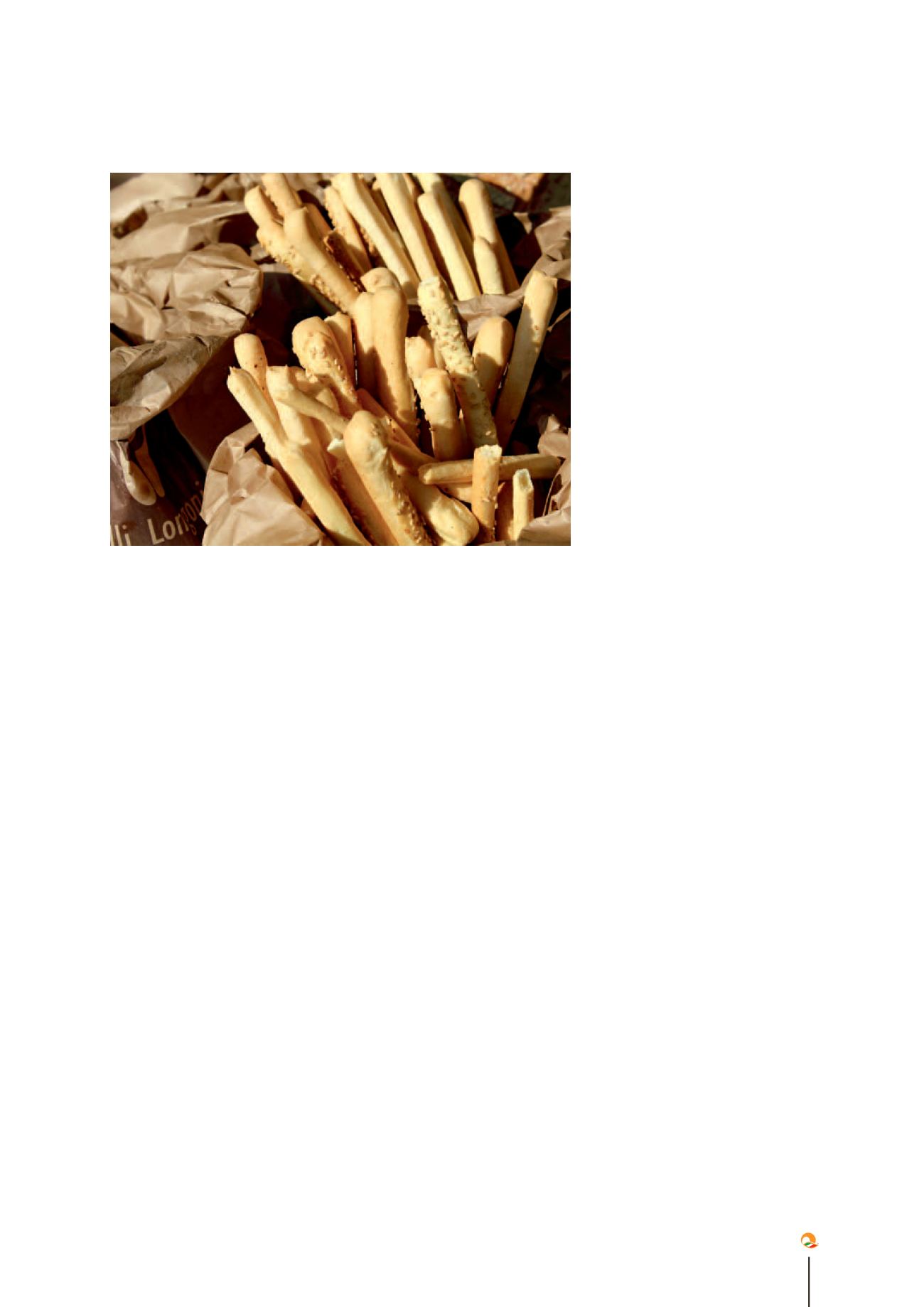
PAY ATTENTION ALSO TO BREAD
Another product that many
restaurateurs now prepare themselves,
and for which the Regulation gives
specific indications, is bread. In this
case, the law requires to extend the
yeast fermentation times as much as
possible and to contain, as much as
possible, the applied heat and cooking
times, stopping at a lighter colour.
If bread is enriched with different
ingredients, such as seeds or toasted
nuts, the toasting temperature should
not be too high.
These measures may also apply to
pizza, even if not covered by the
Regulation.
The blackened edges represent a large
source of acrylamide.
AT PAGE 46
WELLNESS AT THE TABLE
Milk and lactose-free.
Guidelines for Use
The number of consumers that, due
to problems of intolerance or simply
by choice, decide to eliminate milk
and its derivatives from their diet
is growing. What is there to know
from the nutritional aspect and
what is lactose-free?
By Barbara Panterna*
Milk has always been considered a
rewarding food, perhaps because
it takes us back to childhood and
pleasant memories. Its candid
appearance has always led us to
believe that it was harmless, so that
it could be taken in large quantities,
and that it was healthy for bones,
as our grandparents told us, but,
especially in recent years, milk has
been abandoned by many and more
and more studies affirm the opposite
of what we thought in the past,
demolishing all our beliefs and thus
creating a great deal of confusion. In
this article we will look at the pros
and cons of this opalescent substance
that both young and old like so much,
but that more and more people say
they don’t tolerate.
Chemically, milk belongs to the
colloid family. It is an emulsion
because it contains, in addition to
water, macromolecules such as fats,