



 65 / 76

FEB. MAR. 2018
V
reduction is obvious: “we throw
as little away as possible, we have
25 selected suppliers, one for each
product, we only use poor cuts like
capon offal, grains, sweetbreads, but
also weird vegetables or fish liver.”
This allows us not only to get to
know often forgotten ingredients, but
also only those strictly Italian (“I do
not use ginger”), but also to contain
prices despite the high quality of
ingredients. And in the restaurant?
“None of the guys had worked in
a restaurant before. They have an
informal and warm approach, which
compensates for some technical
errors.”
DERSETT, 4 FRIENDS AT ...
THE RESTAURANT
Among the first restaurants reported
on Trip Advisor in a difficult place
like Milan, Dersett (the number
“17” in Milan dialect) opens at the
end of September by the design
of Riccardo Danesi, just back from
France where he won the Michelin
star, and three childhood friends.
Presenting itself - also as a marketing
strategy, however successful - as a
restaurant specialising in comfort
food, it is frequented among others
by the “Well-to-do Milan in jeans”,
in relaxation mode, and has a
wide-ranging clientele, whose age
ranges from 20 to 60 years old and
with a common purpose: to spend
a nice evening. “We offer traditional
Italian dishes revisited, not abundant
portions, gourmet presentation -
summarises Danesi -. We decided to
remove the classic divisions between
appetiser, first and second course but
suggest a path of flavours, we explain
where the products come from and
how they are cooked. We use a lot
of cooking at a low temperature,
a difficult technique that can even
turn eggs into a Livornese. And that
requires a lot of work behind the
scenes, in the kitchen, to find ideal
times and temperatures.” On the
menu are modern traditional dishes
“for the classics there is already the
trattoria”, from Baccalà alla Veneta,
to pumpkin rice, spaghetti with
broccoli, forgotten recipes such as
tonno di coniglio “a dish from the
nineteenth century, from Piemonte”
and “ variations on the theme” such
as tripe salad and croquettes “that
recreate the flavours of cacio e pepe.”
And now? “Given the success, we plan
to open other premises with the same
concept”.
The past has returned, but looks to
the future.
______________________________
“You do not eat only to satisfy your
appetite but also your emotions”.
______________________________
BOX
THE ARCHITECT: “INSPIRE
YOURSELF WITHOUT COPYING”
“When we talk about opening a
traditional restaurant, I think of a
contradiction in terms: how can a
locale that you have just opened
be defined as “traditional”? says
the architect Andrea Langhi, who
specialises in the design of public
places, to whom we turned to
understand how to develop decor
and environment for this type of
proposal. “Apart from the really
traditional restaurants it would
be more appropriate to talk about
those “inspired” by tradition, instead
of creating a replica or a physical
copy, by putting together some old
tables and some stuffed chairs, one
should seize the spirit, the soul, the
authenticity.”
What does it mean in terms of design
to create a “traditional and authentic”
venue? “It means making people feel
at ease, surrounded by an atmosphere
that tells a story relying on
recollections, on collective memory,
on cultural references. Customers
must feel that they are not proposing
something artefact, but a reassuring,
intense, real experience. A little like
when remembering a journey, trying
to revive emotions and feelings. Using
materials, shapes, lights, colours
instead of words.”
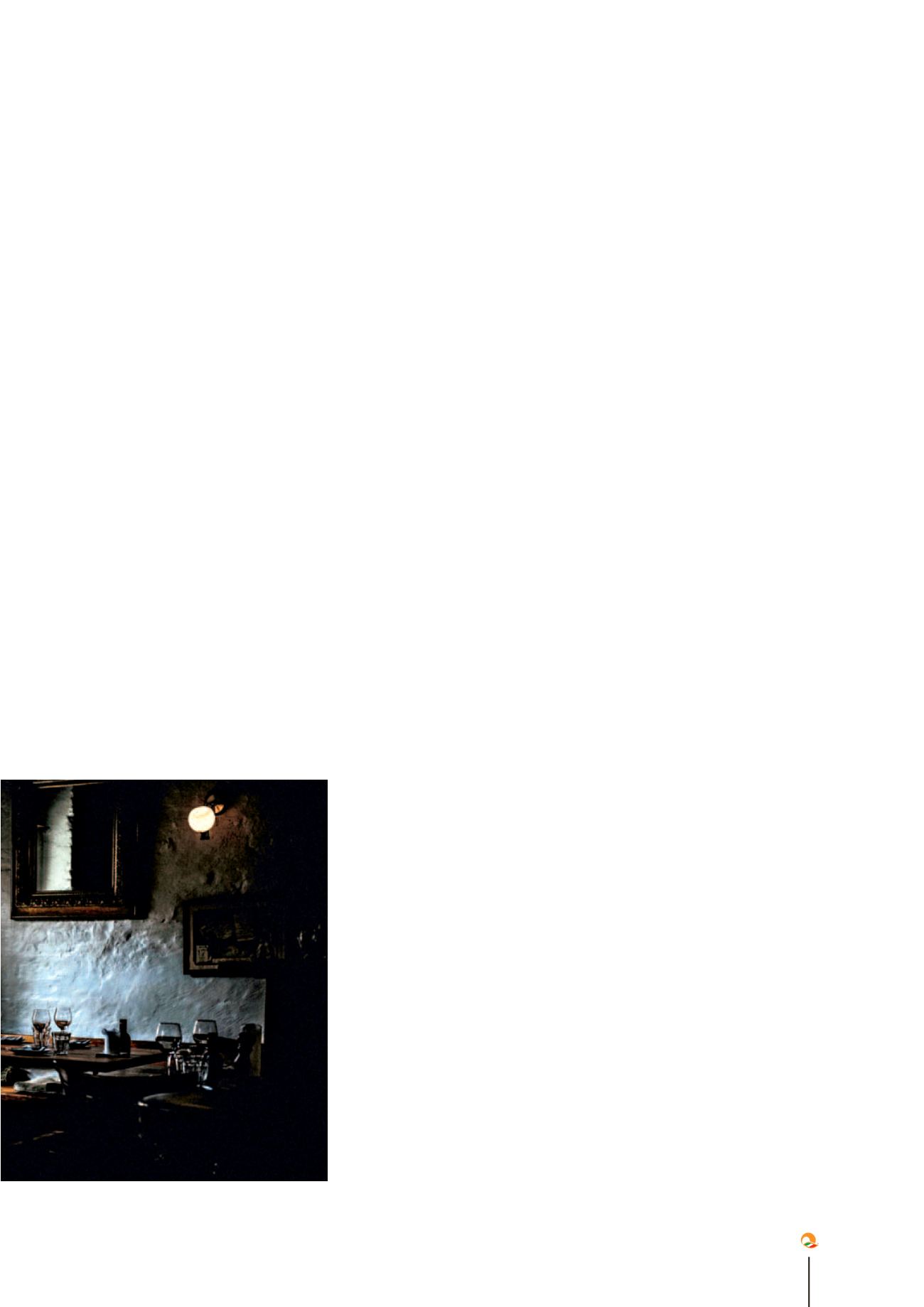
Photo Bistrososo. Formigine (Mo)
by Daniele Domenicali. Project by
Andrea Langhi Design.
______________________________
BOX
THE FOUR PILLARS OF THE “NEW
TRATTORIA”
Cuisine Strike the right balance
between tradition and creativity,
old flavours that evoke pleasant
memories and satisfy the needs of the
contemporary palate. The quality of
ingredients is essential, even if they
are “poor” cuts. Even the “shared”
dishes between diners encourage
conviviality.
Setting Avoid the fake trattoria effect:
it’s better to focus on warm colours,
woods, some pieces of modern art,
some old photos or prints on the
walls (I put those of my “Trippa”
family). Soft lights, but without
exaggeration. Avoid cramped tables,
to be comfortable it takes at least 80
centimetres per seat.
Service It must be attentive but not
intrusive. “I take two minutes to
explain the dish, then if you want
to find out more you ask or look at
the menu where the origin of the
ingredients is displayed” (Dersett).
Price Pay attention to the bill, but it
would be wrong to apply high prices
in such a locale: many customers
choose to avoid the rigidity but also
the high bill of the starred restaurant.
______________________________
AT PAGE 18
IN DEPTH
Quantity vs quality
No longer a fashion but a reality.
The All You Can Eat formula focuses
on big binges. With some business
risk, however, profits are there and
visibility is constant. A promotion
spread throughout the rest of the
world. Let’s see how it works
By Riccardo Sala
At the limit of the consumer
exasperation, on the border line of
breaking even, the All You
Can Eat formula was born in the
United States and overflowed to the
rest of the world, including Italy.