


 65 / 68

DIC. GEN. 2017
XIII
second courses and they allow to keep
the price/portion ratio under control.
But they have long preparation times.
If they are fresh, you have to take into
account the time to shell them and
also that they are not always available.
If they are dried, the problem is the
soaking time. In both cases, cooking
times can be rather long.
Canned legumes (and more generally
all canned greens) can be a viable
alternative. “These are vegetables
preserved in a light pickling liquid
(with about 1% salt) - explains
Silvia Galeazzi, marketing manager
at Conserve Italia, the supplier
for Cooperativa Italiana Catering
of Qualitaly products -, also
called preserving liquid. They are
preserved in cans thanks to the use
of heat, with a sterilizing treatment
that kills bacteria and germs that
could be present in the vegetables”.
STARTING FROM FRESH OR DRIED
PRODUCTS
Maurizio Davide, quality engineering
manager of the company, explains
the production process. “The
first thing is to prepare the raw
ingredients, that can be fresh or
dehydrated (dried). Starting from the
fresh products harvested on the field,
after reception in the plant, there
are various steps to take: cleaning,
ventilation to take off leaves and
green residues, washing using
drinking water, stoning, separation
through vibration, electronical
classification, calibration and further
electronical classification.
For dehydrated raw ingredients,
some of these operations are not
necessary because the vegetables
arrive at reception already cleaned
and calibrated, but they needs
appropriate time to rehydrate before
being processed. After ventilation, the
product is floated to the rehydration
tanks where it is kept for a few hours
before being electronically selected”.
Each raw material is identified by
a product specification which is
part of the supply contract signed
by the supplier. It describes and
quantifies the characteristics and the
main qualitative parameters that the
vegetable must have and it also defines
aspects such as OGM absence and the
remaining quantity of chemicals using
in the growing process.
Many of the raw ingredients
(sweetcorn, peas, beans, greenbeans,
cheakpeas) are provided by member
producers and grown near the
processing plants. The supply chain
is very short. For products that are
not grown in our country or that
are grown in very small quantities
(cannellini beans, Spanish white
beans, etc.) the raw products,
generally dried, are bought abroad
from specialized companies that must
comply to specific supply regulations.
Products arrive from the Americas
(Argentina, the USa, Canada, Mexico),
a few countries in Central Europe
(Poland, Hungary) and Turkey.
The real processing, which includes
canning and sterilizing, begins
with blanching, which is a thermal
treatment in hot water (80-90 C) to
extract the air from the vegetable
tissues and to help a variation of
consistency. After this, foreign
materials are disposed of and
after a manual selection, done by
experienced staff, the vegetable is
canned and topped with preserving
liquid. After cans are sealed and
coded, they are sterilized with a
thermic treatment under steam
pressure at a temperature of 121 °C
for about 20 minutes. During the
process, there are various control
checks. The finished products have a
minimum shelf life of four years.
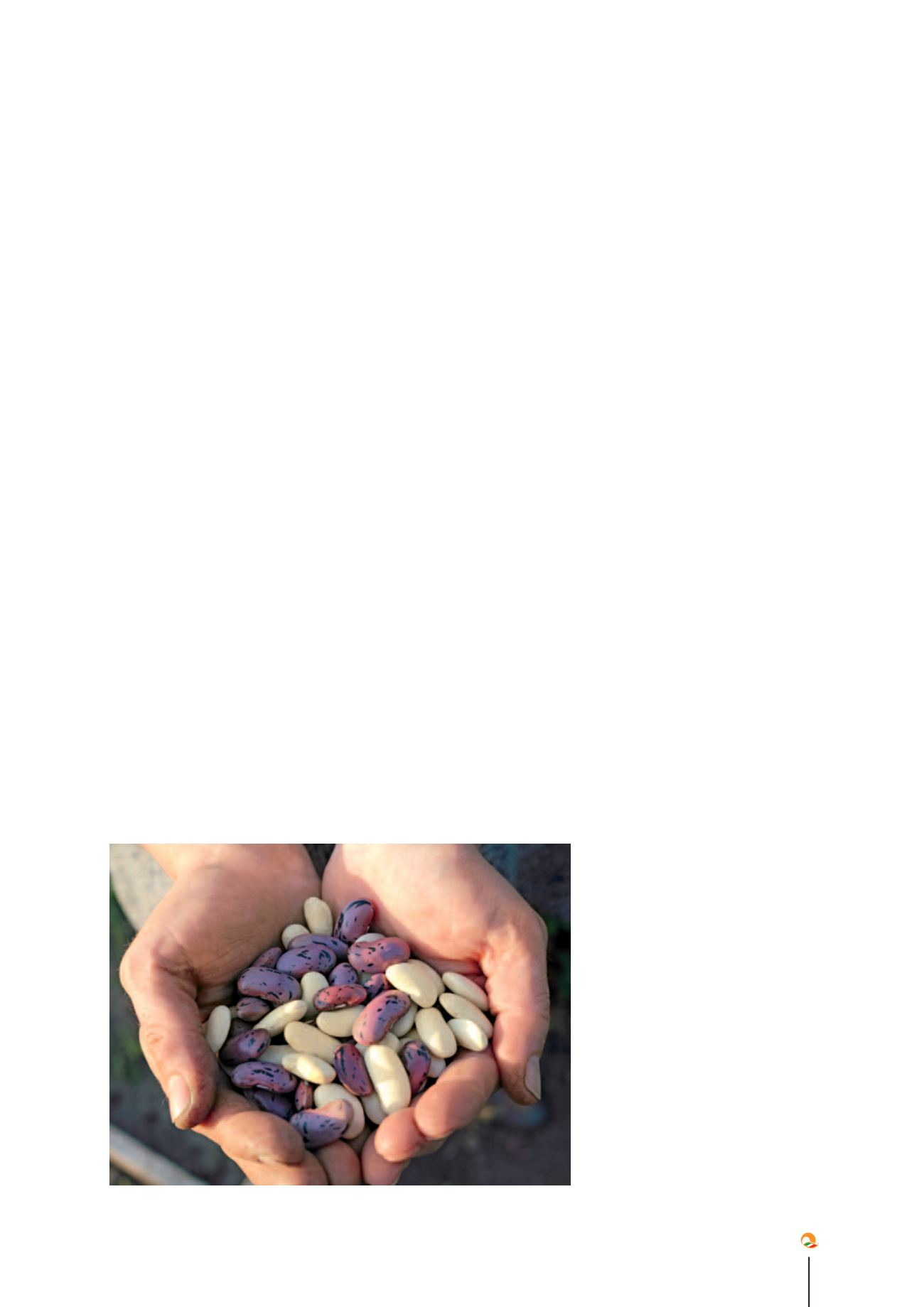
The Qualitaly range includes Borlotti
Beans, Cannellini Beans, Spanish White
Beans, Peas, Greenbeans and Sweetcorn
in 3kg jars. Giorgio Frigo at Cooperativa
Italiana Catering comments: “These are
the products that chefs use the most.
We chose Conserve Italia as our partner
because it is one of the main producers
in the sector, but also because it is a
Cooperative, just as we are”.
AT PAGE 30
IN THE CUPBOARD
Mortadella Bologna,
all the taste in one
slice
Bedeschi Salumi, a historical
‘salumificio’ in Emilia, is the
Mortadella Bologna PGI (Protcted
Geographical Indication) for the
Qualitaly label
By Elena Consonni
People who think that production
regulations are a modern invention
ignore the history of the Mortadella
Bologna. This salami originated in
the XVI century and it was given
the name Bologna by Cardinal
Farnese, who published in 1661 an
announcement where he coded the
production of the salami.
This aniticipated the modern
regulations, that limit its production
to Emilia Romagna, Piedmont,
Lombardy, Veneto, the Province of
Trento, Tuscany, Marche and Lazio.
The regulations describe the product
in detail: the ingredients that can be
used to make it, the process to make
it, the characteristics of the finished
product and its packaging.
All these characteristics belong to
the Qualitaly Mortadella Bologna
Pgi, produced by Badeschi Salumi, a
historical ‘salumificio’ founded in 1964
in Vigarano Mainarda (FE). Its original