
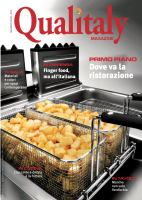



 65 / 72


June July 2015
XI
At page 34
Crème for canapés,
first and second
course
These creams are used in a wide
variety of cuisine to customize recipes
and to make sandwiches and canapé
sandwiches and canapé
Cream of green olives: green olives
(80%) reduced homogeneous paste
with the addition of other ingredients
(sunflower oil, olive oil, salt, water).
Truffle cream is a cream of mushroom
champignons cooked and added
summer black truffle, mixture of spices
and herbs, breadcrumbs.
Cream cheese: mix of four cheeses
Italian and European (Maasdammer,
Grana Padano cheese, Emmental,
Fontal), shredded, brought to the point
of function homogenized with butter.
Cream with scampi: using scampi (32%)
processed and made creamy with milk,
butter, sunflower oil, tomato,.
Creamy white truffle: sauce made with
oyster mushrooms and white truffle.
Black olive cream: cream made from
black olives (80%), water, sunflower oil,
extra virgin olive oil, salt
Cream of artichoke is a cream that has
as main ingredients artichokes (69%),
sunflower oil, olive oil, onions, and
potato starch, rice flour.
Cream asparagus: asparagus (68%),
sunflower oil, potato starch, rice flour,
sugar, salt, yeast extract, spices, acidity
regulator: citric acid (E 330).
Cream with red radicchio: radicchio 78%
min., Sunflower oil, onion, red wine,
potato starch, salt, spices, flavors, yeast
extract and acidity.
Cream of porcini mushrooms: cream
made from 70% porcini mushrooms
(Boletus edulis), sunflower oil, water,
onions, rice flour, dextrose, milk
protein, salt, spices, flavors, yeast
extract and acidity regulator
FORMAT
In glass jars of various sizes depending
on the product: 520 g green olives, 520
g cream of black olives, 500 g the truffle
cream and white truffle, 500 g and 550
g that with scampi cream cheese, 540 g
cream with artichokes, asparagus, 530
g cream of radicchio, 550 g cream of
porcini. Shelf life of 35-36 months.
At page 36
Crispy and toasting.
The fry is served
Get a good fried is the result of many
operations carried out to the fullest.
Let’s go through those together
By Elena Consonni
A nice plate of fry can be a good
business card for a restaurant; it’s served
at the time of the aperitif or dessert.
Like any preparation the final result
depends on many parameters: the oil,
the equipment and, above all, the skill
of the chef who uses them.
“In a professional kitchen - says
Giacomo Spampinato, marketing
manager Angelo Po - the time and the
result is money. For an optimal frying
and quickly, then, the chef will have to
turn to a deep fat fryer able to climb
rapidly in temperature and with a digital
display to be able to know when is
the ideal time to soak the food. If the
dive is done early, the result will be a
non-fried crispy and very greasy. If the
temperature is too high, there will be
a toasting of the surface of the food
so energetic to darken even before the
inside is cooked. Abroad, where the fry
often constitutes the main course or
in fast food restaurants, the fryer must
be equipped with timer and automatic
lifting of the baskets, as the top of the
fryer Angelo Po, for a perfect result and
standardized.”
RESTAURANTS IN TRADITIONAL
usually the fryer is positioned in the
side kitchen reserved for main dishes,
along with grills and fry tops. In
fast food instead of the deep fryer is
the queen of the kitchen, and so its
positioning is usually central to the
cooking area.
To select the optimal fryer you must
make an assessment based on the type
of food and the amount that the Group
expects to produce. “Angelo Po – he
continues - has a wide choice: for those
who want or need for cleanliness,
as for example fries mainly food in
batter, the fryer with hot keel of the
ship is definitely the best choice. The
091FR7GX model also has the function
of recirculating oil which provides
filtration and leaves the operator free
to decide whether to perform an oil