



 61 / 68

FEB-MARCH 2015
XI
clear of obstructions. The staff, for its
part, must wear appropriate footwear,
always close the doors, dry immediately
spilled liquid on the floor and avoid
rushing. Fall into the categories of
environmental risk exposure even at
high temperatures (can cause symptoms
ranging from rashes and symptoms of
fainting, to collapse and shock and heat
cramps) and excessive noise, which in
the long run causes deafness.
Another possible source of risk is the
manual handling of loads, which can
lead to musculoskeletal disorders. To
prevent them, in the kitchen, you should
exercise caution when lifting pots, pans,
baskets of dishwashers or commodities,
with assistance when the load is too
heavy.
Knives and other equipment (also
electrical) edges are another enemy
of the health of chefs and aid. With
some changes, though, the cuts can be
prevented: the knives are kept in good
condition, stored in a knife and washed
separately from other dishes. To cut,
you have to use a cutting board and
slip during cleaning or replacement of
appliances sharp blades cut resistant
gloves should be worn.
AN ENVIRONMENT THAT HOT! In
the kitchen you can avoid having to do
with fluids, products and equipment at
high temperature, but some behaviors
can help reduce the risk burns. For
example, use a tray or basket to carry
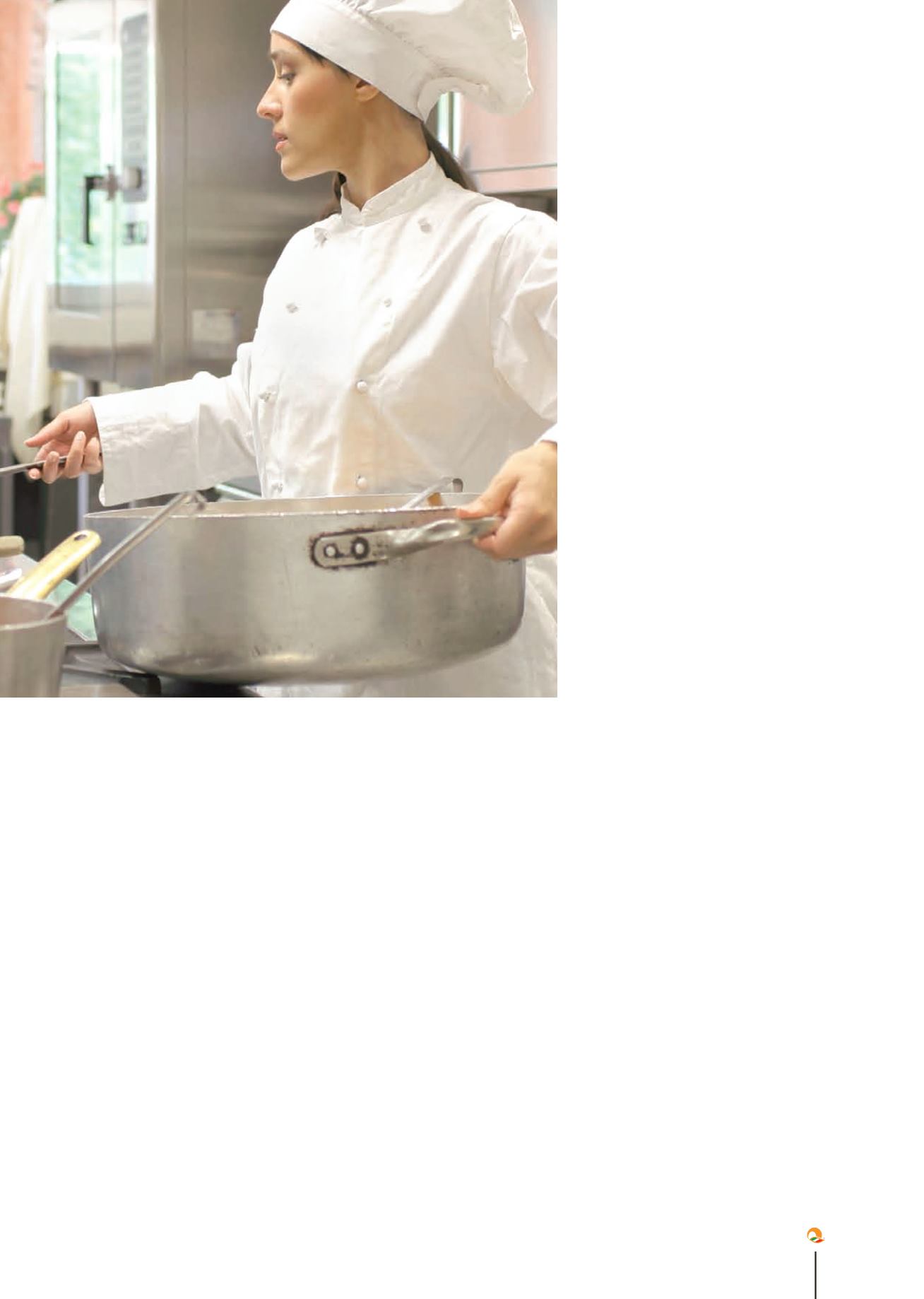
tools, hot, keep the handles of pots and
pans facing the inside of the stove and
not towards the outer edges, looking up
hot items with dry cloths, use automatic
devices to dip food in fryer and dispose
of the residual oil only after cooling.
Although the risk of fire is certainly
not negligible, in the kitchen, for the
presence of electrical equipment,
flames, and fuels such as oils and
fats. Keep clean lids, caps and filters,
ovens, cookers, fryers, fume hoods,
do not leave rags or other combustible
materials near heat sources, maintain
electrical equipment in good condition
and subject to regular checks attitudes
are useful to reduce the risk . Important
not to leave embers unattended and, at
the end of the work shift, close all the
valves of gas and check that all electrical
equipment is turned off.
Continuous training of all operators,
in particular the new arrivals and
temporary workers, helps to reduce the
level of risk for everyone.
Risks also psychological
The damage to health is not just the
physical one: the many shifts in the
evening and at night and on weekends,
along with the high stress levels that
can be achieved in the kitchens may
compromise the work-life balance
of employees. The conditions of
discomfort, in turn, contribute to
increasing the risk of accidents.
DPI chef!
Wear personal protective equipment
reduces the risks. Here is how:
Footwear: must have non-slip soles.
Sandals are preferred because a closed
shoe holds more easily any hot liquids.
A back strap prevents loosening.
Cut resistant gloves: to be used during
the cleaning of machines with blades or
sharp or intense cutting operations.
Apron-less: you wear when performing
operations with the knife toward the
trunk of the operator.
The incidences of accidents according
to the tasks
Chef
22%
Waiters
21%
Attendants
13%
Bartenders
7%
Rotisserie / pizzaioli 4%
Lesion site of injuries with
permanent consequences in the
hotels sector-risoranti
Hand
17%
Ankle
7%
Chest
8%
Arm and forearm
7%
Wrist
15%
Knee and spine
10%
source Inail
Safe appliances, according to law
The equipment used in professional
kitchens must meet specific minimum
safety requirements defined by the
European directives. Especially for
equipment used in professional kitchens
the main directives are Directive Low
Voltage, Gas and Electromagnetic
Compatibility.
Each equipment for sale must be
accompanied by a declaration of
conformity and can not circulate on
the market if it carries the CE mark.
The CE marking is the final act by
which the manufacturer declares
that the product you are entering the